The Christmas bread is leavened

The Christmas bread is leavened, of course
This is a feast of joy and warmth
The yeast will rise

We have been anticipating this
For nine months
For four Sundays
There is time to let the dough rise, let the yeast ferment, let the child form

Joy comes in the morning
As mother and child sleep

Another child rises early
Anticipating cinnamon rolls

For the Christmas bread is leavened.

May our hearts be leavened too

cinnamon-roll


Thanks be to the custodians

mopAfter we all leave the church building on Christmas Eve – after the old friends who grew up here reconnect and go over to Broadway to find a place to have a drink together; after the choir trundles back downstairs to hang up their robes and put away their candles (you will put away your candles, won’t you?) and says ‘see you in the morning’; after the pastors hang up our robes and collect the sweet little gift bags that make their way to the office; after the deacons scour the pews and find some bulletins and a glasses case and hopefully no one’s cell phone – after we all leave this building on Christmas Eve, our faithful custodian will still be there.

We will say good night to him, of course, and thank you, and see you in the morning and do you want us to stay with you till you’re done, but he will say no. No, I’m fine.
And then I imagine he will double check the other building and turn off some stray lights. He’ll make sure the Christmas tree lights are unplugged, as well as the lights on the wreath in the balcony, and that the sound system is off. He’ll make sure the candles are really, truly extinguished. He may restock the paper goods in the restrooms. He probably won’t vacuum , and that’s fine. He’ll check the building to make sure everyone has left, and he’ll turn off the final lights, and set the alarm, and make his way home an hour after all the rest of us.

I am grateful to the custodians, the ones who work at our church and all the custodians, who are the first to come and the last to go, the ones who turn the lights on and off, the ones who do the cleaning that most of us don’t want to do, the ones who fix dripping pipes and restock supplies, the ones who sweat or freeze down in the boiler room when the dang thing won’t work (again), who graciously receive all our complaints with the patience of Job.

There is something holy in that work, don’t you think? There’s something in all those tasks that seem so mundane that echoes the divine a bit. Think about it. The first to show up and the last to leave. The one who cleans up the messes. The one who hears all the complaints with an expansive heart. The one who makes sure our spaces are safe and warm and welcoming with the most pragmatic of things.

Sometimes I wonder if when Jesus comes back, he won’t seek out all the custodians and janitors and sextons first. They know. They know what it’s like to be a bit lonely in work whose scope is hard to appreciate by lay folk like you and me; they know what it’s like to clean up messes that we thoughtlessly left behind. They, like him, are the ones who are often unseen, unacknowledged, unappreciated.

At Christmas we appreciate Jesus very much. We are so glad he was born, not simply because it gives us a chance to celebrate. We appreciate Jesus because he did something he didn’t have to do: he put on the mantle of human flesh, as that saying goes; he limited the divine unlimitedness to know us and save us, however we understand those verbs. We appreciate that little Lord asleep on the hay, that infant so tender and mild, the one whom shepherds greet with anthems sweet.

We appreciate him less during other parts of the year, as the snow melts and carols are replaced by love songs or Irish jigs or “Here Comes Peter Cottontail” or whatever seasonal song needs to blast away in the elevator. We acknowledge Jesus less in July. He’s still at work, healing, cleaning up after us, receiving all the complaints. So maybe we can work on acknowledging him a bit more in July or September or Groundhog’s Day.

In the meantime, think about those janitors and custodians:  the ones at church and the school janitors, Lord love them; the folks who clean up airplanes, especially after a trans-continental flight; the ones in hospitals and nursing homes and stadiums. If you’re so moved, seek one out. Say thank you.

It’s a holy thing to do for someone who does holy work.

Mary & Me

img_9952Mary is making the rounds again this Advent, and as per usual, I’m not entirely sure what to do with her.

Is she the model of female submission?  The victim of unwanted impregnation?  Is she too young to marry and bear a child, or just the right age for her time and place?  Is she quiet and shy, head bent down, eyes gazing at the floor?

Or is she a warrior, a Rosie-the-Riveter, the woman who not only said yes but also said let’s topple the patriarchy?  Is she the one who turned surprising news into a power play?

Is she the faithful servant?  Is she a good-enough mother?

Oy, Mary.  Oy.

True confession: in the first few weeks after I gave birth, I found myself praying to Mary.  I was pretty sure that God the Father and God the Son and that merry, floating, fire-y Holy Spirit could not begin to understand hemorrhoids, c-section scars, engorged breasts, and the complete feeling of inadequacy and terror, even with all the Godhead had learned during the Incarnation.  So I sent a few up to the BVM.  Because she knew.  She had been there, and on a donkey, no less, in some small, non-private smelly place with animals, away from family, donut cushions, and Tylenol.

This week in worship our choir is presenting five songs about Mary and while I’m off the hook for a sermon, I do find myself wondering about Mary again.  The Magnificat could be posted on Pantsuit Nation and get 10,000 likes.  The role of women in Christianity could be looked at anew – are we simply to say yes to the church, yes that’s our role in the kitchen and the nursery, yes we’ll let the men do all the heavy lifting of teaching and preaching?  Or do we look to Mary and say, hey, we’re called to topple thrones and send the rich away hungry?  We’ll be in the kitchen and the pulpit, thank you very much.

Mary fades from the story as it goes on; it is Jesus’ story, after all.  Maybe the tune of the Magnificat faded too, and people forgot the melody.  Maybe we lost sight of what a revolutionary Mary was.  Maybe we need to reclaim that, for the church, for Pantsuit Nation, for our daughters, for our sons.  For our world.

“My soul magnifies the Lord, and my spirit rejoices in God my Savior,
for he has looked with favor on the lowliness of his servant.
Surely, from now on all generations will call me blessed;
for the Mighty One has done great things for me, and holy is his name.
His mercy is for those who fear him from generation to generation.
He has shown strength with his arm; he has scattered the proud in the thoughts of their hearts.
He has brought down the powerful from their thrones, and lifted up the lowly;
he has filled the hungry with good things, and sent the rich away empty.
He has helped his servant Israel, in remembrance of his mercy,
according to the promise he made to our ancestors,
to Abraham and to his descendants forever.”

May it be so.  Amen.


Bleak Midwinter

rainIt rains so much in the Pacific Northwest. Although our little family usually doesn’t put up any Christmas decorations until the first or second week in December, this year has been so rainy and so dark we decided to hang the outdoor lights on the day after Thanksgiving.

There are those years when “In the Bleak Midwinter” is my favorite Christmas carol, that or “O Come, All Ye Faithful.”  This year the bleakness wins, and it’s not just the weather.

We’ve lost some dear saints in the congregation this year. I look out in the pews on Sunday morning and I see their spouses and their children and their friends sitting there without them, and melancholy descends.  It’s their first season without this person who brought light or warmth or laughter or kindness to their life.

Then there is the bruising left over from the election season, and the uptick in hate crimes since November 8.  There’s Syria, and refugees, and poverty that never, ever abates for some people.  There is the reality of aging parents.  On some days if feels as though Yeats was terribly prescient: the centre cannot hold; mere anarchy has been loosed upon the world.  I too am slouching towards Bethlehem.

If my sweet little family’s Christmastide celebrations began on December 24 and ended on the 26th, I would be happy.  But my daughter loves Christmas.  It’s her favorite holiday, and it has nothing to do with Santa or presents.  There’s nothing she really wants for Christmas – except to be with family, which is hard with two clergy parents.

When I ask her why she loves Christmas, this is what she says.  “Everyone is so joyful, and everything is so pretty and decorated.  There are so many lights, and people sing.”

I’m not sure where she picked this up as I’m usually a bit crabby during Christmas, failing miserably at being mom, spouse, and pastor all at once.  She sees through that, or around it or beyond it.  She sees the big picture: we celebrate Light coming into the world.

So perhaps this month, as the rains pour down and it’s hard to tell if the sun has risen yet; this month, as the news tells more terrible stories, and people tell stories of grief and fear; this month, as I once more fail at being a cheerful pastor/mom:

I will look to my daughter, so happy for this season.  I will look at her with hope for the joy she will carry into this month and the years that lie ahead.  I will look to her with a gratitude that goes beyond words, gratitude for her presence and her life.  I will look to her so that she can show me the way, even through the bleak midwinter.

For a little child shall lead them.

Bare branches reaching to the sky

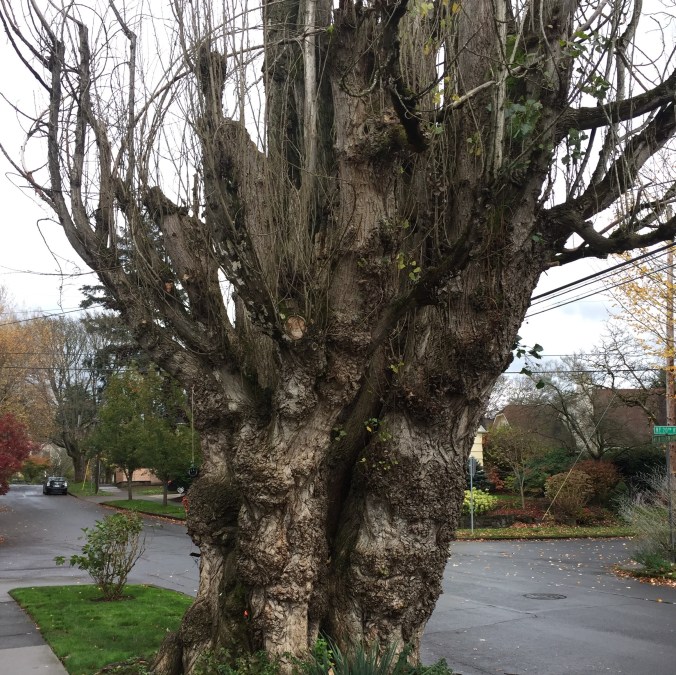
img_9842The poplar at the end of the block – thought by some to be the tallest poplar in the state – has lost its leaves.  It’s an upward reaching tree, and it looks a bit forlorn, though that could be some transference on my part.

But there is beauty in those bare branches.  You can see the architecture of the tree, of all of the trees whose leaves have flown downward for the winter.  I find that reassuring, that I can see the structure of the tree, where the nests are, what dead branches haven’t fallen yet.

There is something plaintive about it; the trees look as though they’re beseeching their sky-god for help.  It looks like beseeching and not praising, but as I said, there could be some transference going on there.

On election night, as the map of the U.S. turned more red than blue, I said one of those beseeching Hail Mary (the basketball kind, not the rosary kind) prayers.  Oh God, please, change this, I yelled in my head. As it turns out, God is not some genie in a lamp whose belly I rub and my every wish and prayer are answered.

For me, for my political and ethical sensibilities, for my understanding of the call of the gospel, this election and its aftermath has been hard and wrong.  But it has revealed the architecture of some things: my own prejudice and assumptions, as well as my faithful and ethical grounding; it has revealed branches of my fellow citizens whose worlds and attitudes are completely unknown and foreign to me.  It has revealed nests of strength, of protest and compassion, that may have been hidden, and dead branches that need to come down, like racism and misogyny and xenophobia.

So I find myself confessing a lot more, and seeking humility.  I find myself trying to be more brave and trying to reach out to those so different from me.  I find myself weeping still at times, and getting worried and angry.  I am hopeful too. One day those leaves will grow back on the poplar, sometime this spring. Until then I will appreciate the branches.

More than that, I will appreciate the strange village that has emerged at the base of the trunk.  Some time this past spring, the people who live in the house by the tree put a little gnome and door and a little fence among the roots.  Then one by one, other things appeared. Another gnome.  A miniature rope ladder.  A swing, then two. A few dinosaurs.  A pterodactyl.  Frogs.  A fort.  Some cowboys.

img_9847

img_9846

As plaintive as the branches are, a mismatched village of the whimsical and strange stands at the base of those branches, a counterpoint to the narrative of barrenness and beseeching.

There is always a counter narrative.  It may not get heard, it may not be remembered in history, but it is whispered among the powerless and the planning.  It is repeated by the protesters.  It is spelled out in the unfolding leaves of spring.

At least that is what I hope.

A shoot shall come out of the stump of Jesse, and a branch shall grow out of his roots.  The spirit of the Lord shall rest on him, the spirit of wisdom and understanding, the spirit of counsel and might, the spirit of knowledge and the fear of the Lord.  His delight shall be in the fear of the Lord.  He shall not judge by what his eyes see, or decide by what his ears hear; but with righteousness he shall judge the poor, and decide with equity for the meek of the earth.

Silhouettes

img_9701We were at the beach, and the clouds and sun were positioned in such a way, and I was positioned in such a way, that everyone I could see as I looked toward Haystack Rock was in silhouette. And I thought, isn’t that lovely – all I see are human shapes. I can’t tell if someone is young or old; I can’t tell what the color of their skin is, or what god they worship. We are simply human beings, our lowest common denominator.

That thought lasted all of three seconds, as sustaining as a truffle.

We are different. We are young and old; our skins are different colors. We worship different gods, or no God at all. And I think that is good. I do not simply want to be one of many silhouettes.  I do not want to live in Camazotz. (See A Wrinkle in Time)

I once heard an interesting interpretation of the story of the Tower of Babel. The story in Genesis 11 tells of the people wanting to build a tower that would reach to the sky. God sees that activity and says, “There is now one people and they all have one language. This is what they have begun to do, and now all that they plan to do will be possible for them. Come, let’s go down and mix up their language there so they won’t understand each other’s language.”  (Common English Bible). So God does that. The traditional interpretation of the story says that God punishes the people for their pride, scattering them and confusing their language.

But what if God was actually delighted by the humans and their ability to build a tower, the way a parent might be delighted by a fort of cushions and blankets or a sand castle that withstands the waves? What if the scattering of the people and the gift of languages was in fact a reward, an acknowledgement that human beings had evolved and matured enough to be able to live with difference?  What if God made difference as a challenge to be mastered or a reality to be embraced?

Maybe that is a good measure of our humanity –our ability to deal with our differences and delight in them. I believe we will be tested in that regard in the months and years that are coming. May we prove our worth.

Confession

I confess that I am heartbroken and stunned, that I’m fighting a migraine brought on by hot tears

I confess I found it hard to stay positive for my inconsolable child

I confess simple gladness at the sound of the dog’s toenails clicking on the floor as he made his way downstairs to find me

I confess I fell for the alchemy of Facebook’s algorithms, that I believed the bubble of like-minded people was bigger than it was

I confess Pantsuit Nation is so hard to read today

I confess short-changing the whole of America, forgetting that feelings are real to the person feeling them 

I confess the sin of judging others as ignorant, stupid, or of little account, or worst, not deserving the love of God

I confess relief that we are getting out of town and away from the internet for a few days 

I confess fear of those coming into power

I confess fear for those on the margins

I confess my weakness to respond in any effective way

I confess my pride which has indeed gone beforeth a fall

I confess despair 

I confess less than a mustard-seed of faith

I confess my failings

Kyrie eleison

Christe eleison

Kyrie eleison 

Morning Person

I wake before everyone else, and tiptoe around the squeaking floorboards, making my way downstairs to the kitchen. I try very hard not to wake the spouse, the child, or the dog. It’s my time, and if I’m lucky, I’ll have a half hour all to myself.

img_9652The first thing I do is make coffee. Nothing fancy, just my Cuisinart 4-cup drip and some French Roast, already ground, because there is a worse noise than a coffee grinder especially first thing in the morning when you’re trying not to wake anyone else up, unless it’s a leaf blower.

Some half and half and a favorite mug and then to the comfy chair to scan the headlines, check email, look at Facebook where I hope someone has shared a New York Times article because I’m too cheap to buy the app.

It’s morning.

I’m at my best in the morning, most clear, most fresh, most energetic. The rest of the family doesn’t really get it and I have to remember when I start sharing ideas or asking questions that they have not had the benefit of an hour of awakeness or caffeine. It’s a little dance and I am definitely leading. The others put up with me.

I don’t know why I love the morning so much. Getting up before dawn often reminds me of travels I have been on – a safari when we rose with the sun so we could catch the animals at the watering hole before it got hot; a study trip in Israel, Egypt, and Jordan when we woke at 3am so we could see the sun rise from the top of Mt. Sinai. Jet lag, too, makes for early mornings but you can catch a sunrise while others snore.

The beginning of the day has so much potential. Nothing much has happened yet, just coffee and a few headlines. What might unfold? What surprises await? Who will I see? What good news might break? Will the forecasters be wrong and we’ll have sunshine all day?

Easter is a morning holiday; Christmas is an evening one. “Early in the morning” all the Easter stories begin. So much potential that day, though no one imagined it. Just a morning routine, the women getting up early, preparing their spices, taking their sad walk as the sun rose. And then – so much unfolded, so many surprises, such good news.

Maybe I’m a morning person because I’m an Easter person at my core, believing in new life that awaits us, life where there had been death, blades of grass poking their way through the concrete. I hope to be that, anyway; it’s better than the alternative.

I really hope and pray that today is a great day; it will be for some of us and not for all of us. But here’s to new life, and the ability to embrace it and make it happen.

A very good morning – or good afternoon or evening – to you all.

img_4607

Church

The church calls me to my best self, the Eden self, the person God created me to be.  In church I shed my old skin, shuffle off the hurtful and ugly like cicada husks hiding with the dust bunnies under the pews.

I wriggle off that judgment that doesn’t fit anymore, or that idea of God that ended up being way too small, and I’m given something else. A second chance.  Some grace which I may or may not find amazing at the time.  It’s like I take off the burlap sack and get to put on a cashmere robe.  And then someone hands me a cookie and a cup of fair trade coffee.

Church, and worship in particular, shapes me.  It forms the pattern of my days: quiet reflection, expressions of gratitude, responding to challenges and teachings, spontaneous song.  People in need and people in joy.

I haven’t been at church for a month but I have been with church and in church.  More cards than I can count.  More prayers than I know of.  Books and magazines.  Food, food, and more food.  People who take me out for a walk.  People who tell me not to worry about it.  People who say they miss me.

I miss them, and I miss worship, which for me is the core of church.  On a usual Sunday when it’s time I zip up my robe and adjust my stole and get the microphone clipped on.  We pastors say a prayer together, and I pick up my papers and we head down the stairs and make our way through the sanctuary to the back.

And then the acolytes’ wicks are lit, and we start down the aisle.  We sit down and while the prelude finishes, I look out at the congregation, at the church.  There they are, the saints and sinners, my sisters and brothers and friends.  There they are, the sick, the grieving, the joyous, the angry, the wondering, the frazzled, the bored.  There they are, the sinews and ligaments and bones and muscles and cells of the body of Christ.  There they are, the church, surrounded by stained glass and pews and unbelievable music all of which adorn the church but aren’t church.  The people are church.

In the next hour we sing and pray and listen and speak.  Hopefully we laugh.  Often at least one person cries.  And when we leave after the benediction and postlude, and make our way home after a cup of tea or a meeting or lunch with the usual crowd, we take church to the streets, to our homes and work places and schools and the neighborhood. We present the pattern to the world: reflection, gratitude, response, song; hope. Church doesn’t need a building, though that makes it convenient.  Church needs people who are willing to say something about God and something about living as human beings and then figuring out the rest together.

We the church don’t always get it right but when we do, it’s pretty incredible.  Life-giving and life-saving.  Amen and amen.

img_7653

The place I call my church home


57 years and counting

According to myanniversary.com, there is no traditional gift for celebrating the occasion of a 57th wedding anniversary, although one may give a glass object or a mirror. 

Those seem fitting gifts after spending two score and seventeen years together. After that much time, you know what is fragile about each other. You know how not to break things, hearts, dreams. You know that certain things need to be handled delicately and some things will leave a telltale fingerprint.

After 57 years, you may see parts of yourself in the other. There’s a shared kindness, a common sense of direction through paths traveled together, paths that have wound through children and mortgages and career disappointments. After 57 years you have the same worry lines in the forehead and the same laugh creases around the eyes.

I did not buy my parents a piece of glass art or a mirror when they celebrated their 57th anniversary earlier this year. I may have sent them a card, but I doubt it. I think I called them.

But what I would say to them (and do, since they read this blog), and to my in-laws whose 57th anniversary is coming up in a few weeks – and to anyone who makes it to 5+ decades – is this:

img_9641

Wow!

You deserve a standing ovation and some really comfortable slippers.

You have set a high bar for those who aspire not only to a long marriage but also a happy one.

The way you care for each other inspires me. My dad has needed a little more help than usual lately and my mom has been there, every moment, without  a complaint, without a sigh. My dad has never missed an opportunity to thank her or to remind my siblings and me how amazing she is.

None of us knows when we start a marriage where it will lead us, who we will be at the end of a year or a decade or five decades. None of us knows if we’ll recognize the face in the mirror as that long ago blushing bride or that fresh-faced groom. None of us knows what will get broken and if it will be reparable. None of us knows what heartache or disappointment will do to us.

But none of us knows what love and fidelity will do to us either.

It took me a while to find the person I wanted to marry and it’s doubtful we’ll have fifty-seven years together.  Possible, but doubtful.  But my parents and my husband’s parents would be the first to say that the years are just a number; it’s what fills those years that matters.

May those years be filled with trust and laughter, honesty, argument, and some good old fashioned lust now and then; may they be filled with friendship, and sorrow that abates over time, and whispers and music and dancing, even if your song is “Bad, Bad, Leroy Brown.”  May they be filled with the light of early morning and the shine of a new spring moon.  May they be filled with wonder and familiarity, with respect, with a sense of what is precious.  May they be filled with the usual things: love, forgiveness, grace, and gratitude.

Fifty-seven years.  Wow.

img_9643-1

August 29, 1959