Inauguration, Ordination

img_0207This Sunday in worship, we the congregation will ordain and install Ruling Elders and Deacons in the class of 2019, two days after we the people inaugurate the 45th president of the United States of America.

So that’s gotten me to thinking about these two rites, in a time when we don’t have many public rites or rituals.  In both ordination and inauguration, someone has been chosen to serve in a particular office.  In both someone makes vows or takes an oath.  In both, scripture is present, either in the vow to accept the witness of scripture or to pledge one’s integrity about the oath by placing the hand on the Bible.

In our Presbyterian system, once an elder or deacon, always an elder or deacon; one is either actively serving in that office or not.  A president is president for four or eight years (usually) but is called by the title “president” for the rest of his (someday or her) life.

To be honest, I am much more excited about Sunday’s ordinations than I am about Friday’s inauguration. I hold a greater sense of community with this congregation than I do with our nation.  I know these people; I know about their lives and their joys and griefs.  I have been called to serve them and to serve alongside them.  We are on a mission, and in fulfilling that we spend time together, studying, praying, laughing, challenging, eating, singing, listening, working.  Good stuff.

A president is elected by the people, in a roundabout way.  An elder or deacon is called by God through the voice of the congregation.  That seems to be a significant difference.  Elders and deacons make vows; presidents take oaths.  Merriam-Webster says this about the two: “Oath: (1) a formal and serious promise to tell the truth or to do something (2) an offensive or rude word that is used to express anger, frustration, surprise, etc.
Vow: (1) a serious promise to do something or to behave in a certain way.”  (Perhaps in making vows we promise not to say oaths.)

When we who are church officers take ordination vows, we are promising to behave in a certain way: to be obedient to Jesus, to be a friend among colleagues in ministry, to love neighbor and work for the reconciliation of the world. (That’s not all but those may be my favorite.)

The president swears the oath to “faithfully execute the Office of President of the United States, and…to preserve, protect and defend the Constitution of the United States.” That doesn’t sound like nearly as much fun as the ordination vows’ work.

I know the Bible better than I know the Constitution although I recognize the importance of both.  I am rooted in the places of scripture more than I am rooted in the ideals of the Constitution.  These days I am finding it harder to be patriotic than to be faithful.

So maybe this is all an unnecessary comparison of the two. I just have this sense that in the long run – and I’m talking eschatalogical long run – what we do on Sunday will have more impact than what happens on Friday.  What we do on Sunday is holy.  Going to committee meetings and serving cookies at a memorial service might not seem like much, but in that way that small things are really huge, it is the work of heaven.

In the end, let’s just say I have a lot of confidence in what our elders and deacons will do – and who they will be as they live out their vows – in the coming years.

You can infer the rest.


Mary & Me

img_9952Mary is making the rounds again this Advent, and as per usual, I’m not entirely sure what to do with her.

Is she the model of female submission?  The victim of unwanted impregnation?  Is she too young to marry and bear a child, or just the right age for her time and place?  Is she quiet and shy, head bent down, eyes gazing at the floor?

Or is she a warrior, a Rosie-the-Riveter, the woman who not only said yes but also said let’s topple the patriarchy?  Is she the one who turned surprising news into a power play?

Is she the faithful servant?  Is she a good-enough mother?

Oy, Mary.  Oy.

True confession: in the first few weeks after I gave birth, I found myself praying to Mary.  I was pretty sure that God the Father and God the Son and that merry, floating, fire-y Holy Spirit could not begin to understand hemorrhoids, c-section scars, engorged breasts, and the complete feeling of inadequacy and terror, even with all the Godhead had learned during the Incarnation.  So I sent a few up to the BVM.  Because she knew.  She had been there, and on a donkey, no less, in some small, non-private smelly place with animals, away from family, donut cushions, and Tylenol.

This week in worship our choir is presenting five songs about Mary and while I’m off the hook for a sermon, I do find myself wondering about Mary again.  The Magnificat could be posted on Pantsuit Nation and get 10,000 likes.  The role of women in Christianity could be looked at anew – are we simply to say yes to the church, yes that’s our role in the kitchen and the nursery, yes we’ll let the men do all the heavy lifting of teaching and preaching?  Or do we look to Mary and say, hey, we’re called to topple thrones and send the rich away hungry?  We’ll be in the kitchen and the pulpit, thank you very much.

Mary fades from the story as it goes on; it is Jesus’ story, after all.  Maybe the tune of the Magnificat faded too, and people forgot the melody.  Maybe we lost sight of what a revolutionary Mary was.  Maybe we need to reclaim that, for the church, for Pantsuit Nation, for our daughters, for our sons.  For our world.

“My soul magnifies the Lord, and my spirit rejoices in God my Savior,
for he has looked with favor on the lowliness of his servant.
Surely, from now on all generations will call me blessed;
for the Mighty One has done great things for me, and holy is his name.
His mercy is for those who fear him from generation to generation.
He has shown strength with his arm; he has scattered the proud in the thoughts of their hearts.
He has brought down the powerful from their thrones, and lifted up the lowly;
he has filled the hungry with good things, and sent the rich away empty.
He has helped his servant Israel, in remembrance of his mercy,
according to the promise he made to our ancestors,
to Abraham and to his descendants forever.”

May it be so.  Amen.


Bleak Midwinter

rainIt rains so much in the Pacific Northwest. Although our little family usually doesn’t put up any Christmas decorations until the first or second week in December, this year has been so rainy and so dark we decided to hang the outdoor lights on the day after Thanksgiving.
There are those years when “In the Bleak Midwinter” is my favorite Christmas carol, that or “O Come, All Ye Faithful.”  This year the bleakness wins, and it’s not just the weather.

We’ve lost some dear saints in the congregation this year. I look out in the pews on Sunday morning and I see their spouses and their children and their friends sitting there without them, and melancholy descends.  It’s their first season without this person who brought light or warmth or laughter or kindness to their life.

Then there is the bruising left over from the election season, and the uptick in hate crimes since November 8.  There’s Syria, and refugees, and poverty that never, ever abates for some people.  There is the reality of aging parents.  On some days if feels as though Yeats was terribly prescient: the centre cannot hold; mere anarchy has been loosed upon the world.  I too am slouching towards Bethlehem.

If my sweet little family’s Christmastide celebrations began on December 24 and ended on the 26th, I would be happy.  But my daughter loves Christmas.  It’s her favorite holiday, and it has nothing to do with Santa or presents.  There’s nothing she really wants for Christmas – except to be with family, which is hard with two clergy parents.

When I ask her why she loves Christmas, this is what she says.  “Everyone is so joyful, and everything is so pretty and decorated.  There are so many lights, and people sing.”

I’m not sure where she picked this up as I’m usually a bit crabby during Christmas, failing miserably at being mom, spouse, and pastor all at once.  She sees through that, or around it or beyond it.  She sees the big picture: we celebrate Light coming into the world.

So perhaps this month, as the rains pour down and it’s hard to tell if the sun has risen yet; this month, as the news tells more terrible stories, and people tell stories of grief and fear; this month, as I once more fail at being a cheerful pastor/mom:

I will look to my daughter, so happy for this season.  I will look at her with hope for the joy she will carry into this month and the years that lie ahead.  I will look to her with a gratitude that goes beyond words, gratitude for her presence and her life.  I will look to her so that she can show me the way, even through the bleak midwinter.

For a little child shall lead them.

Church

The church calls me to my best self, the Eden self, the person God created me to be.  In church I shed my old skin, shuffle off the hurtful and ugly like cicada husks hiding with the dust bunnies under the pews.

I wriggle off that judgment that doesn’t fit anymore, or that idea of God that ended up being way too small, and I’m given something else. A second chance.  Some grace which I may or may not find amazing at the time.  It’s like I take off the burlap sack and get to put on a cashmere robe.  And then someone hands me a cookie and a cup of fair trade coffee.

Church, and worship in particular, shapes me.  It forms the pattern of my days: quiet reflection, expressions of gratitude, responding to challenges and teachings, spontaneous song.  People in need and people in joy.

I haven’t been at church for a month but I have been with church and in church.  More cards than I can count.  More prayers than I know of.  Books and magazines.  Food, food, and more food.  People who take me out for a walk.  People who tell me not to worry about it.  People who say they miss me.

I miss them, and I miss worship, which for me is the core of church.  On a usual Sunday when it’s time I zip up my robe and adjust my stole and get the microphone clipped on.  We pastors say a prayer together, and I pick up my papers and we head down the stairs and make our way through the sanctuary to the back.

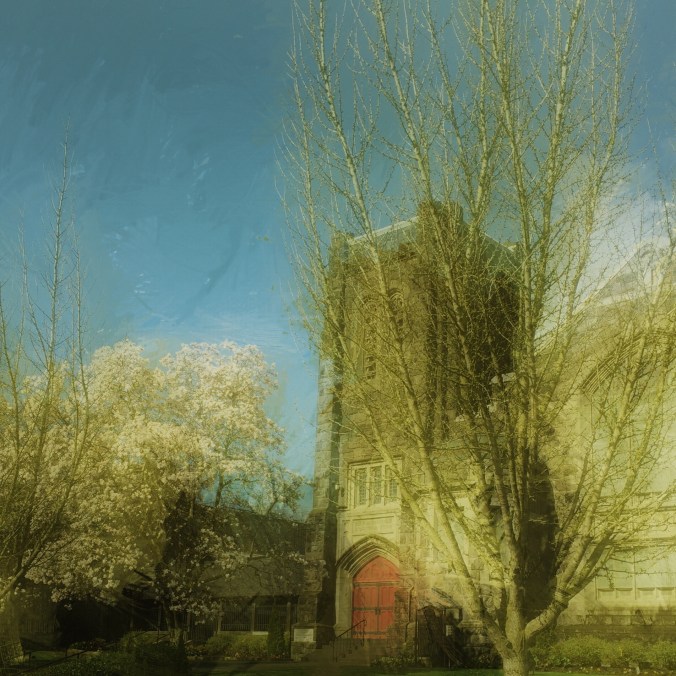
And then the acolytes’ wicks are lit, and we start down the aisle.  We sit down and while the prelude finishes, I look out at the congregation, at the church.  There they are, the saints and sinners, my sisters and brothers and friends.  There they are, the sick, the grieving, the joyous, the angry, the wondering, the frazzled, the bored.  There they are, the sinews and ligaments and bones and muscles and cells of the body of Christ.  There they are, the church, surrounded by stained glass and pews and unbelievable music all of which adorn the church but aren’t church.  The people are church.

In the next hour we sing and pray and listen and speak.  Hopefully we laugh.  Often at least one person cries.  And when we leave after the benediction and postlude, and make our way home after a cup of tea or a meeting or lunch with the usual crowd, we take church to the streets, to our homes and work places and schools and the neighborhood. We present the pattern to the world: reflection, gratitude, response, song; hope. Church doesn’t need a building, though that makes it convenient.  Church needs people who are willing to say something about God and something about living as human beings and then figuring out the rest together.

We the church don’t always get it right but when we do, it’s pretty incredible.  Life-giving and life-saving.  Amen and amen.

img_7653

The place I call my church home


A necessary good

A few years ago an old friend of mine shared an article on Facebook, written by an atheist organization, which advocated for the removal of the tax exemption status that religious institutions enjoy.  I was a bit hurt that my friend did this, in part because she knows I am a pastor serving one of those tax-dodging religious institutions.  I commented on the article and said that if churches had to pay property taxes, most would close, and all those community groups that use our buildings for free or significantly reduced rents- 12 Step groups, non-profits, neighborhood associations, preschools – would have a hard time finding somewhere else to go.  She quickly apologized and said she was trying to make a different point.  It still stings a little.

In the last year I’ve had several experiences of people who identify as spiritual but not religious, or even just plain atheist, asking to use the church.  Some were services of some sort – a wedding, a memorial – actually, not a memorial; a celebration of life.  I’ve negotiated with families and couples in how many times we can say “God” and if we can refer to “Jesus” and whether or not there has to a reading from the Bible.

I’m just about done with the accommodating.  I don’t want to throw Jesus out with the  proverbial bathwater.

I think if you come to church for a wedding or a memorial, you should not be surprised if the pastor mentions God or Jesus.  That’s part of the deal.  I will no longer officiate at a non-religious wedding; a friend can get an online certificate or a justice of the peace can perform the ceremony.  I’ve got to have a little integrity about my call as a pastor.

I know that Christendom is in transition.  I know we must find new ways not only to tell the old story but more importantly to live out the old story.  I know many judge the church as outdated and irrelevant and self-absorbed, and that is often a fair critique.  But I also think that much of the judgment comes from ignorance, from people simply not taking the time to learn about what churches and people in churches do to contribute to a healthy neighborhood and society.

When did Jesus become the bad guy?  Maybe when the followers of Jesus strayed too far from his teachings.  Maybe when Constantine made Christianity the religion of the state.  Blame bad Christian music.  Blame really bad Christian art.  Blame us getting so caught up in the business of the church that we forgot about the call of the church.

Go.  Feed.  Pray.  Listen.  Study.  Hope.  Dream.  Risk.  Heal.  Lament.  Proclaim.  Share.  Believe.  Repent.  Forgive.  Teach.  Live.  Die.  Live again.

IMG_7653

Have barn, will put on show

Many years ago, I trod the boards.  I did theater, on stage and backstage, and not only that, I did musical theater.  I can still muster up a box step and a decent pair of jazz hands if necessary.  Those things aren’t usually needed for a worship service, but it’s good to be prepared.

On vacation this summer we had the opportunity to catch a bit of summer stock, a production of “Singin’ in the Rain” performed by the Playmill Theatre of West Yellowstone, Montana. To be truthful, I wasn’t expecting much.  It’s summer theater, and it’s in a remote corner of a lesser-populated state.  But I walked out of that theater delighted by so much, and reminded a bit of a life I once had.  Kudos, Playmill!

These kids – I think they were all young – had gumption and talent.  Before the show, the actors ushered the audience to their seats.  During intermission, those same actors (in character) sold fudge and ice cream and lemonade and popcorn to the audience.  I bought some fudge, and when the actor (who played the studio’s p.r. man) didn’t have the right bills, I told him to keep the change.  “Really?” he asked.  Could he maybe get me some water or something?  Sure, I said.  When he then tried to offer me change again, I told him not worry about it.  “Wow, thanks!” he said, not a trace of sarcasm or irony to be heard.  It was all of $5.00.

That cast could sing and dance with the best of them.  I doubt any of them will make it to Broadway, but I hope they have other aspirations.  They were gracious hosts and actors, and I could not ask for anything more.

Almost thirty years ago I was production stage manager for a summer theater in Princeton, New Jersey.  Among the cast and crew were some of the people most dear to me in all the world.  It was a lot of work, and there were the usual tensions, plus it was one of those summers when the 17-year cicadas were out.  It remains the funnest summer of my life.

My time in the theater trained me for ministry.  Sure, some people are trained in the mission field and some in the towers of academia, but doing shows gave me skills and insights I use every week in planning and leading worship, in working with a staff team, in providing hospitality and creating community.  The lights aren’t as strong, the dance rarely includes tap shoes, and the sermon is a bit long for a soliloquy, but it’s theater at its best.  Like all theater, it is good when it is most real and authentic.

Of course no one in the real world sings and taps during a rainstorm, or if they do, I’ve yet to see it.  But every time I step into the pulpit, I feel that excitement, the joy of saying something true and good and uplifiting.

Applause not necessary.

IMG_8235

With thanks to the theatre folk along the way: Tom and G’ann, Baranna, Virginia, Curt, Kirsten, Biz, Tom E, Amy, Louis, Kay, Carol, Annie, Ken, Emily, Linda, Amy, Miriam, Diana, Carol, Glen, Hans, Alan, Peter, David, Robert, Debbie, and so many others who I’m sure I’ve forgotten.  Break legs!

Mortal, after all

Yesterday I led a memorial service, a celebration of life, for a two-day old.  It was excruciating, as you might imagine.  It was also stunning and beautiful, as you might not imagine.  Pain was real and evident, but more present was the love that surrounded these two parents and these three grandparents.

That service came on the tail of four other deaths in our congregation, all women in their 90’s.  Those deaths were sad, but not unexpected, and really, not tragic. My colleague’s husband finally succumbed to the cancer he fought bravely and vehemently.  That was awful, too.

A long-time friend of mine – would I call him a friend? – lost his battle to ALS.  We went to junior high and high school and college together, but we didn’t run in the same circles and we never really hung out, except for long drives across Texas to out-of-town debate tournaments.  Still, his death has hit me hard.  Maybe I’m facing my own mortality.  Maybe I’m owning up to the fact that we are mortal, after all.

Add to that the violent deaths in St. Paul and Baton Rouge and Dallas, and Baghdad and Nice; aging parents and more cancer and random car accidents and plane crashes: mortality is announcing itself, loudly and proudly, and I want none of it.

My daughter is fed up too, maybe not with death but with the professional call of her parents to deal with death and dying.  It feels like all the time to her.  Evidently there is some sound I make, some short expulsion of air, and a way I say “oh no” that makes her look up from her book or computer screen and ask me, “Who died this time?”

That’s a question I never asked my parents when I was ten.  My grandparents were alive and healthy, as were my friends and their parents.  No one I knew had cancer; no one I knew got shot.  A cousin I didn’t know died in a motorcycle accident, but that’s it.

Why do we have to die?  I know the answer to that, and I don’t know the answer to that.  I also know that getting each other through the grief of death while we’re still this side of the grave is one of the highest callings we have, which doesn’t mean that it’s all pretty and lovely and tied up neatly with a sweet little bow.  Grieving and sitting with the grieving is most often awkward and inconvenient, messy, full of swear words and uncomfortable silence and wadded-up tissues and casseroles that will be reheated for the week.

But then sometimes the light breaks in, through the stained glass window of a sanctuary, or across the row of crosses at a cemetery, or glistening on the water where ashes are scattered.  Sometimes laughter sneaks in, in gallows humor or a hilarious memory. Sometimes some a minuscule thing happens, and the grief is eased an iota, and the future shimmers for a moment with hope – a mirage in the desert of sadness while we wait for the real oasis.

img_8401

The table

I have a thing about tables – end tables, side table, telephone tables, coffee tables, dining room tables, drop leaf tables, round, square, triangular.  I have a thing about tables.  It might have to do something with an appreciation of horizontal surfaces on which to put stuff.

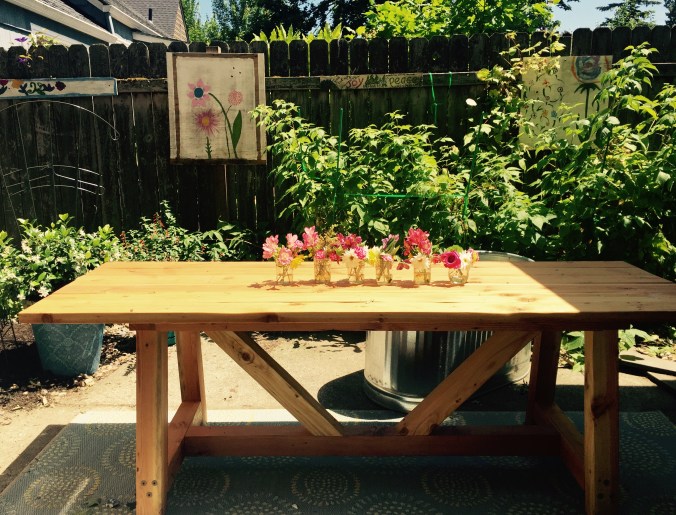
So when I had the opportunity to buy one of the communion tables built for the recent General Assembly of the Presbyterian Church (USA) I jumped at the chance.  I gave my best doe-eyed look to my husband, and told him we really could use it in the back.  I’m pretty sure it wasn’t the doe-eyes that won him over, but now it sits in our backyard.

The table was made out of our Pacific Northwest native wood, the Douglas Fir, the Pseudotsuga menziesii .  Its scientific name is derived from the pseudo prefix because the Doug Fir isn’t really a fir tree; the menziesii come from the name Archibald Menzies, who classified the tree before David Douglas, who named the tree after himself.  So you could say the table isn’t what it seems.

I wrote the communion liturgy that was used for one of the services at the table during GA.  The preacher/presider that day chose not to say all the words I wrote; I believe they did not suit, theologically-speaking.  I was a little miffed, to be honest.  But then I remembered it is a table of grace.

The table was transported from the Oregon Convention Center to our home a few miles away because of the strength of many and the generosity of a friend, who provided both muscle and pick up truck.  It is a table of friendship, too.

Its debut at our home was for a potluck dinner for all of us who were on the steering committee that provided hospitality for the General Assembly, and on that beautiful Thursday night, it was laden with wine and lemonade and iced tea and brats and chicken and pork and watermelon and crudites, and laughter, and stories, and gratitude.  It is a table of abundance.

Our child protested the arrival of the table in our small backyard – it takes up space she plays in.  It is a table of inconvenience.

But I love it.  I love where it has been, and who has stood behind it and broken bread and poured the cup.  I love who has gathered around it, and who will gather around it.  It is the holy in the ordinary, and I am reminded that the holy calls me to gracious, and generous, to be a friend.  I am also reminded that, like the table, the holy can be inconvenient at times, nudging us to let go of grudges, to rely on loaves and fishes, to find a way to squeeze one more person in.

It needs another coat of lacquer, according to its builder Michael.  A little care must be given for it to survive the long haul, not unlike all of us.

FullSizeRender


Living in the tension

“Mom, why do we have guns?” That’s the question my ten-year-old asked as we ran a few errands Sunday after church, when I had referred to the Orlando shooting in worship and she asked what had happened.

“Well, people used them to hunt so they could have food.” But that wasn’t quite right.  Not at all.  “People used them to kill each other in war.”

“Why do we have war?”

“Well, people see someone else as their enemy, as someone who wants to take what they have, as someone who is dangerous.  Or someone who has something they want.”

“Then why do we have enemies?”

Oh, child of mine, I didn’t ask those sorts of questions when I was ten.  The assassinations of the 60’s were not part of my childhood memory, nor was the Viet Nam war.  My first political awareness was Nixon’s resignation, and that didn’t involve guns at all.  My dad and brothers hunted; we had rifles and shotguns in the house that were always locked up and never loaded.  When we were held up at gunpoint at home when I was a teenager, no one thought about getting one of those guns and starting a shoot-out with our assailant.

Maybe the bigger question is why we have enemies.  That same Sunday, at the end of worship, two men experiencing homelessness came to the narthex seeking help.  That’s been happening a lot lately – there are so many people and not enough public bathrooms or soup kitchens or mental  health facilities or shelters.  There may not be enough time or kindness, either.

One of our deacons was talking with them very patiently and I interrupted the conversation.  I thought wearing the big black robe and the pretty green stole would give me some authority when I told them I was so sorry that we weren’t able to give them cash, but it didn’t. I listened.  We prayed.  I’ve remembered their names – A.J. and  Avery.  I’ve prayed for them all week.

Are A.J. and Avery my enemies?  Do I wish them harm? No.  Did I wish they’d go away so I could get off my feet and get a cookie and cup of coffee? Maybe; how horrible of me.  Do they wish they had guns so they could get what they need by force?  I doubt it.

It was an unsettled day, Sunday.  I was so aware of the tension of being safe because I’m a straight woman and the worry that someone might target our church because we have a rainbow on our sign.  I was aware of the tension that I’d had a nice shower in the morning, and put on clean clothes, and had breakfast and would have lunch as I talked with these men who hadn’t seen a shower or a full meal or a sober day in God knows how long.  I was aware of the tension in wanting my daughter to delight in the world while having to tell her the realities of the world.

The tension is still there, and my prayer is that nothing reaches the breaking point.  My prayer is that out of the tension comes something hopeful or healing, maybe even beautiful, the way a beautiful note is played over the taut violin string.

But maybe that isn’t up to me.  But maybe it is.

violin

We were visited

Aaron was in worship again on Sundayo.  I wasn’t surprised – I’d seen him around the building this week, and had commented on the nice green blazer he was wearing, to which he replied, “I’m a natty dresser.”

Aaron is a friend of our congregation, a man in maybe his 30’s who is experiencing addiction, homelessness, and lives with mental health issues.  He shows up for worship now and then; lately, on high holy days.  I’m beginning to wonder if he isn’t a messenger from God.

On Sunday the choir led most of worship.  We (I sang with them) presented portions of a rather extraordinary work entitled “Calling All Dawns” by Christopher Tin.  Twelve songs, incorporating sacred texts and poetry from many cultures, that describe the cycle of day, night, dawn; life, death, and rebirth. We sang seven of the songs, in Swahili, Japanese, Chinese, Polish, Hebrew, Farsi, and Maori.

I gave a short reflection, and wrangled the doctrine of the Trinity with the Bantu word and African ideal of ubuntu – “I am because we are.”  I think it worked.  Maybe not.  But it was my hope to weave together the context of the music with Trinity Sunday with our call to be community to each other and the world.  Oh, how we preachers stretch sometimes!

So after the service there was much hugging and complimenting and the usual handshaking.  As things started to clear out, I saw Aaron sitting by himself in the back pew in the transept.  I sat with him for a minute or two.

His eyes were watery; he had alcohol on his breath.  I asked him how he was.  “Fine. I guess.”  I asked him where he was sleeping these days. He gave me a look as if I should know better than to ask.  Then he said “On the sidewalk.”  I asked him if he had a tarp or a sleeping bag.  No.  Then he said, “A buddy of mine let me sleep on the floor of his house last night.  This guy – I don’t what he’s been through.  But he’s still really kind, still sort of innocent.  You know, it’s like you said.  Community.  We all need it.”

In the last year I have learned that two things can ground the most ethereal, theological, grand worship: a bald child who is battling cancer and a homeless man who comes to worship because he craves community.

Maybe God sent Aaron to us this morning to remind us that as much as we sing about following the way and praising God and living out peace, we must never forget that it begins in the pews and on the sidewalks that surround the church.

I wish I knew how to help Aaron.  I know how to give him cash and food; I know how to pay for a motel room for him.  I also know he would probably not be accepted into a shelter because of his addictions, and I know shelter spaces are too few in our city.  I wish we had better mental health practioners who worked with the homeless; again, the few we have are overloaded.

So for now, I do what is inadequate: I welcome him in church.  I call him by name.  I recognize him not only as a child of God, but as a messenger of God.

And the message is that we have work to do.

angel-849222_960_720