On killing cockroaches, and other things my dad did for me

It’s been seven and a half years since my dad died, and while I don’t really think about him every day, I do think of him often, and occasionally dream something that he’s a part of, and laugh about something I know he would find funny.

So Father’s Day is different now. Mostly I encourage our daughter to remember the day is coming; I also thank my husband and my brothers for being such great dads. If I’m in a mood, I will say to my husband, “Well, I don’t have to do anything for Father’s Day because my dad is dead.” Like I said – when I’m in a mood.

But today, Father’s Day, I’ve been thinking about my dad and a few memories stand out.

The first is when he taught me to ride a bike. It is a visceral memory, full of emotion, which must mean something since it happened 55+ years ago. We went to the parking lot of my elementary school in Morristown, New Jersey, my hot-pink, banana-seat bike in the back of the station wagon, just me and Dad. He did not believe in training wheels (later, when I was an adult, he would say that training wheels were for candy-asses.) He ran along side me as I wobbled along, holding the handlebars, not letting ago until I found my balance, and then he let go, still running beside me. I don’t know why this has stayed with me all these years. Maybe it has something to do with fear and courage and encouragement and protection and love all wrapped around the asphalt pavement of Hillcrest Elementary School.

The second memory is from my teen years, which were not the smoothest in terms of our relationship. We’ll leave that there but perhaps you can fill in your own blanks about rough patches with a parent. This story is not about that.

When I was eight we moved from New Jersey to Houston – the flatland of humidity and flying cockroaches. There are good things about Houston, but this story is not about that. Anyway, we had not had flying cockroaches in New Jersey and let’s just say they terrified me. Spiders? Bring ’em on! Flying cockroaches? More correctly, palmetto bugs – I would not enter a room where I could see one. It was my habit, when entering a room where there was a cockroach, to get my dad to come kill it, which he did. One night, after he had gone to bed, I went to the bathroom to wash up for the night. There, on the wall behind the toilet, was a big ol’ shiny cockroach. Dad had gone to bed. He hated being woken up. I knew I would not be able to brush my teeth, much less sleep in my connecting room, knowing that roach was just waiting to crawl all over me. So I went in to my parents’ bedroom, woke up my dad, told him the problem. He got up and told me to get a magazine or newspaper, which I did. He strode into the bathroom, whacked the cockroach which fell straight into the toilet, flushed it away, and wished me a goodnight.

He loved to tell me that story. I’m not sure if it had to do with my trusting him to take care of things or with his amazing aim, but it was one of his favorites.

The last memory is from my young adulthood. My parents had moved back to New Jersey and I was living and working in New York City. I had landed what I thought was my dream job – assistant to the artistic director of an arts organization, the perfect jumping-off spot for someone who wanted to go into arts administration, which I did at the time. After five months, my dream job had become a nightmare. I would wake up at 2am on Saturday nights worrying about it, wondering what I had forgotten to do, wondering what my boss would yell at me about on Monday.

I had gone to my folks’ house for the weekend and we talked about everything. Dad finally said to me, with all the wisdom of someone who had had his own career ups and downs, “No job is worth this, honey.” Not long after that, I quit as my boss was firing me, and while my future became less certain, my heart was much happier.

Seven and a half years ago, as Dad was nearing the end of his life, the time came for me to say goodbye to him. That remains the most excruciating thing I have ever done, and if you’ve had to do that, you understand. I told him I loved him, and I thanked him – for teaching me how to ride a bike, for killing cockroaches, for letting me know it was okay to walk away from something; for encouraging me never to carry a credit card balance and to set aside ten percent of every paycheck for savings (that didn’t happen); for being pleased as punch when I told him I was pregnant, for welcoming my husband and then our daughter into the family; for pointing out, every time we sat on the deck of the cabin, how beautiful the cottonwoods were shimmering in the breeze.

Now when I sit on the deck of the cabin, and look at the cottonwoods shimmering in the breeze, I laugh a little, and look up at the sky, and say thank you once again.
Love and Dust

Our daughter was born on Fat Tuesday, which meant I spent Ash Wednesday 2006 in a hospital room, recovering from a C-section and trying to figure out how to breastfeed. After experiencing the joy and fear of giving birth, I really did not need to remember that I was dust and to dust I would return. At the time, I felt more like I was made of blood and colostrum and placenta, which are very much things of birth.

That was the last time I was not marked with ashes on Ash Wednesday. This year I repeat that, for reasons that seem a bit inconsequential and maybe a little lazy. Last September I left the congregation I happily served for thirteen years, and I have not yet found a new worship home. To be honest, I haven’t looked for one yet. After serving congregations for thirty-one years, I need a break. I need to let go of all my expectations of how worship should happen, what fills me in worship. I need to empty myself of all of that, and then start fresh.

I imagine for many folks there is no need to be reminded that they are dust and to dust they will return. The world tells them that all the time. The White House tells them that in cruel tweets. Rude customers, impatient drivers, racists, misogynists – there is a message of death and hate that pervades so much of every day life. Why add ashes as another reminder?

I dare not speak for anyone , but I will say that there was something honorable and profound and horrific about making the sign of the cross on people’s foreheads. Honorable because they trusted me, their pastor, to say these true words with love. Profound, because death is so wrapped up in the mysteries of creation and incarnation and resurrection that mere words cannot begin to convey all that is meant by the ashy cross. And horrific, because the woman who has lost all her hair from her chemo treatments doesn’t need to be reminded that she will die, because the precious child, conceived by IVF after years of miscarriages, needs to live a full, long life, and not think about death for a long, long time.

Receiving the ashes is another thing. Sometimes a fellow pastor would mark me, and sometimes my fellow pastor/husband made the sign of the cross on my forehead. Sometimes a parishioner would make the sign. It didn’t matter who did it, though I always knew the person. Someone who loved me, or who worked to love me in that Christ-way, was telling me the truth that I would die some day, that all of us will die some day. On Ash Wednesday, that’s as far as we get in the story.

And so Lent has begun, and for me, without ashes. My daughter sent me a picture today of her and her friend who made it a point to go to chapel and get marked today. I’m a bit filled by that. A stranger told her that she is dust. While I clung to her in that hospital bed at the beginning of Lent nineteen years ago, now I let her go into the world, full of dust and life, to make her own way. For a long, long time, I hope.

So given the state of the world, perhaps this year I would offer these words:
“Remember you are made of love, and to Love you will return.”

The Passive Voice

The other night my husband and I went to an art show opening at the church I used to serve and left in September. It was quite fun, with beautiful art and old friends. Several people made it a point to say to me, “You are missed” which was lovely, and which got me to thinking.

Of late I’ve also noticed several social media posts which say something along the lines of “remember you are loved.” I wholeheartedly agree with that sentiment. I think it can be the difference between life and death for some people. I think it can melt the heart of grinches and open the eyes of Scrooges. And yet….

And yet I’m curious about the choice to use the passive voice. I enjoy writing and I hope to be a decent writer, and something my high school English teachers and preaching professors drummed into me floats up to the top of my brain and into my fingers on the keyboard: avoid using the passive voice. It’s less powerful. It’s murkier. And more than that, I think using the passive voice lets us off the hook.

Granted, to say “I love you” or “I miss you” is an act of vulnerability. It risks our not being loved back, or not being missed in return. “You are loved” or “you are missed” becomes this general statement, but I wonder who loves me and who misses me. Do you, the say-er or writer of these words? Or are you speaking on behalf of someone else? Or are you speaking for that anonymous ‘they’ that pervades the social world?

I don’t know, and I certainly do not mean to discount the kindness and grace of saying to another “you are loved”, “you are missed.” But maybe we can take an extra step, because I know for a fact that there are people out there in the world who, if told they are loved, would wonder who exactly loves them. It might mean so much more to have a real human being say to them, “I love you. I value you. I see you. I miss you.”

In these days of meanness and cruelty, of greed and power grabs, maybe one of the great acts of resistance we can do is to say clearly and actively to people that we love them. To do that is an act of kindness, and act of truth (hopefully!), and an act of resistance against the powers that say that some people are worthless, wrong, or forgettable.

I will not tell you I love you, the person reading this, because I do not know all of you. But I do appreciate your taking the time to read this Sunday morning’s musings. Be strong, and be courageous, and be well.

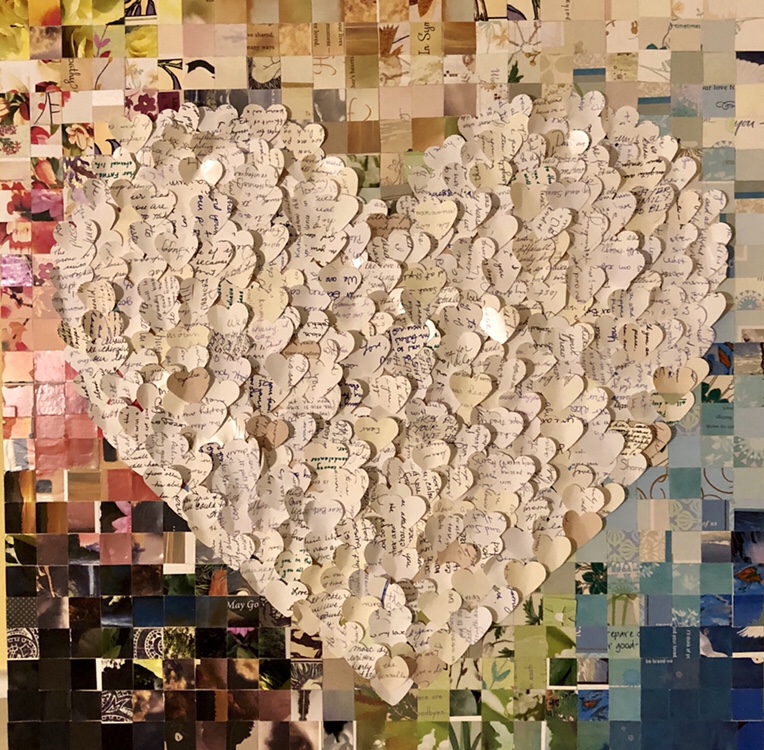
(One of three paper collages I made out of the sympathy cards I received after my father died. The love expressed in them continues to carry me through my grief. Today would be my dad’s 94th birthday; he told me he loved me, which is the world.)

Ashes, ashes, we all fall down

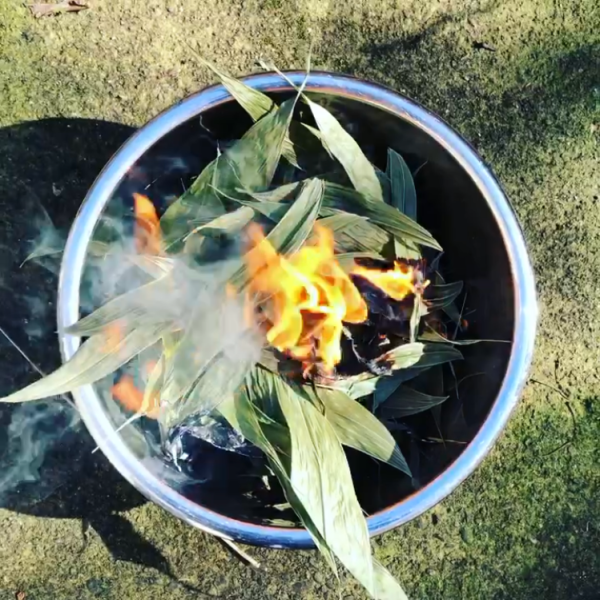
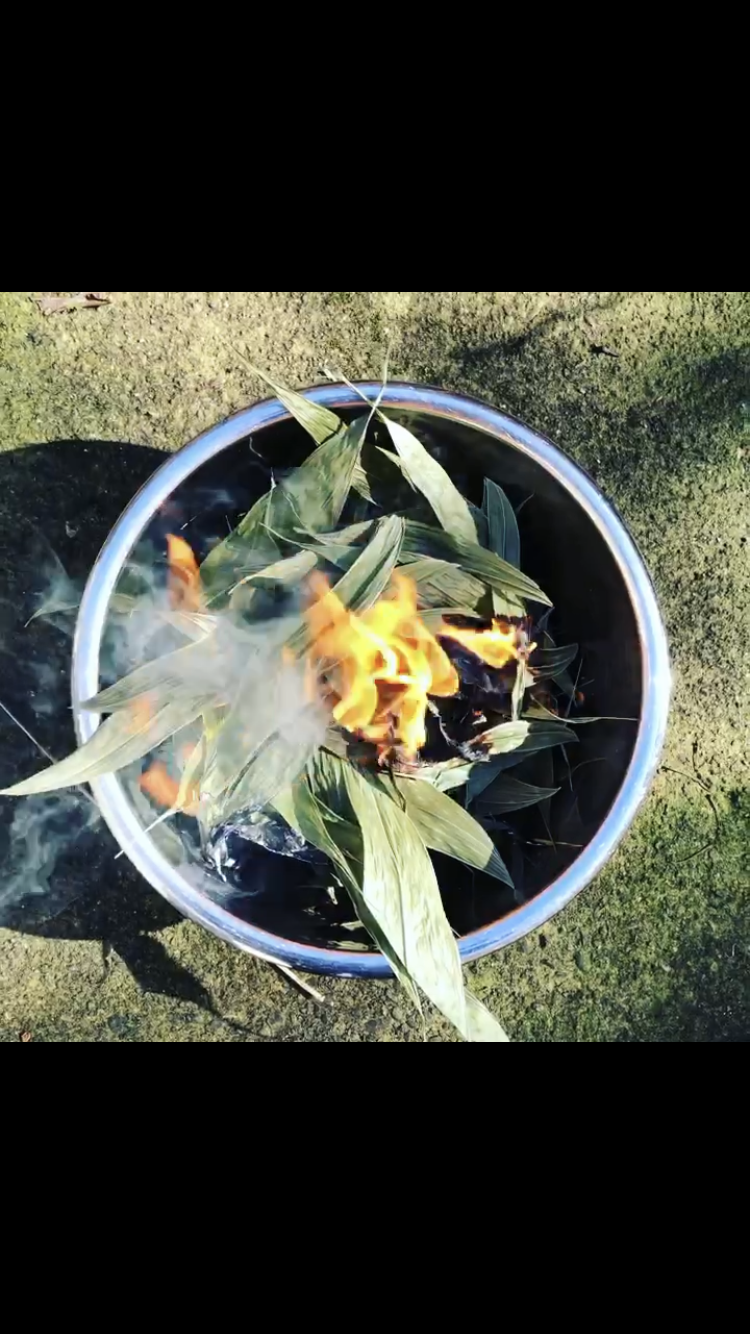
img_0596I ran home at lunch today to burn last year’s palm leaves.  It’s a funny smell and my neighbors might have wondered just what the minister next door was doing.  Nothing untoward, truly – unless you consider taking a symbol of honor and life (the palm) and burning it to ashes to remind people that they are oh, so mortal untoward.

Another Ash Wednesday is nigh upon us.  I think about my first Ash Wednesday as a pastor some twenty-five years ago.  Death seemed neither imminent nor scary, just a nice little comma in this journey with God.  But I stayed long enough in that first congregation to start loving those people, some of whom got sick, some of whom were dying as I drew a cross of ashes on their forehead.

Fast forward, as Ash Wednesday falls three days after what would have been my dad’s 89th birthday; as Ash Wednesday falls two days before my darling daughter’s 14th.  I fear death now.  I know the havoc it wreaks, the worry it brings, the dread not just of the slow march of dying but also the crushing emptiness of the one who is gone.

Yet here we are, making crosses out of ashes and saying to young and old, to hale and sick, to the faithful and doubting, mortals all, “Remember you are dust, and to dust you will return.”  Stern stuff, these ashes.

Here’s a little spoiler alert because I’m going to mention the end of The Good Place so if you haven’t seen it yet, don’t read any more, but happy Lent.

I thought that last episode was exquisite, with the prevailing realization that what made life so precious was the knowledge that it would end.  We would never know what would be our last sunrise to awaken to, what would be our last time to hear our favorite piece of music, what would be our last time to tell that old story and laugh and laugh.  I remember the last time I spoke with my dad – and I knew it was the last – and it’s still so hard to think about and to write about. I said goodbye, then joined my siblings where I sobbed and fell to the floor.

Remember you are dust, and to dust you will return.  Ashes, ashes; we all fall down.  We fall down in grief, in wonder, in agony, in worship.  We fall down in disbelief, maybe, that all this will end, that to the dust we will return.

But unless the seed falls to the dust, to the dirt, and dies, no new life will come.  Fall down we must.  Rise, we will.

Advent Vigil

232_Barrick_Advent_Purple_72_dpiFor Jack, Annie, Tom, and Grace

This is not the Advent I anticipated,
The one with three purple candles and one pink
The one with meditating on the birth of the Christ child
and pondering the meaning of the Incarnation
It isn’t that Advent

It is an Advent
with picturing my mother holding Baby Jesus
the way she holds any baby she can
And delighting in Him
And having a moment of joy

It is an Advent with a flurry of bushtits landing in the small tree in the courtyard
Angels in disguise
Chirping some song I assume to be good news though I cannot understand it
But they seem to happy in their trilling, and good news is in short supply
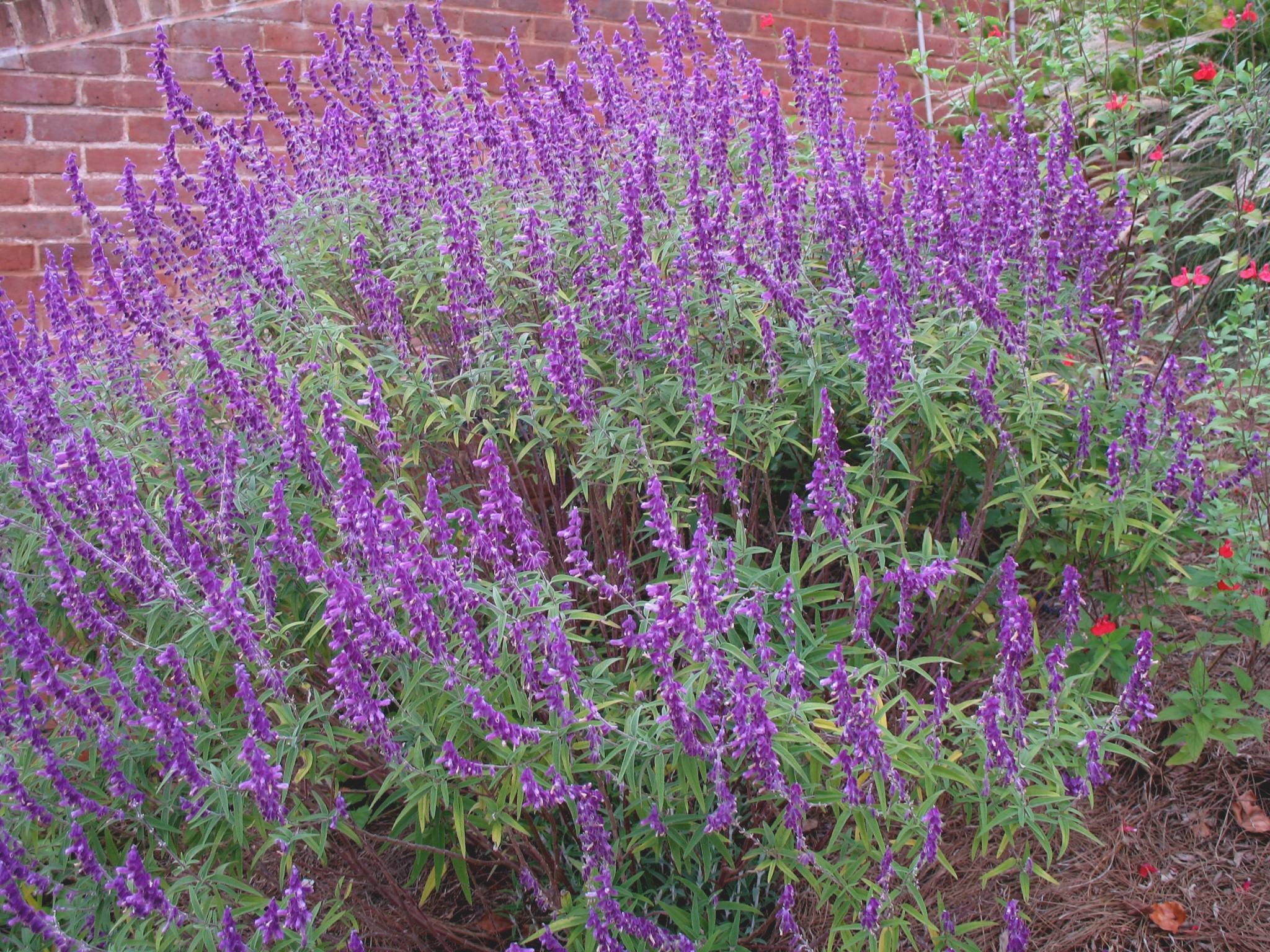
They’re gone when the hummingbird finds the Mexican Sage,
the one thing around here observing the purple of the season

It is an Advent with stars leading the way to places unknown
To people who have Gone On
With wondering if he’ll join the meteor shower and fly through the night sky
Or catch the tail of the too-close comet
And leave us

It is a season of waiting
For a death and not a birth –
But not an Eliot death.*
No one is clutching the old dispensation here
No one is really clutching anything

We are, rather, letting go of someone we have loved
Of someone who has loved us in return

It is a holy season
But not the one I expected

mexican sage

* T. S. Eliot, Journey of the Magi, excerpted:

All this was a long time ago, I remember,
And I would do it again, but set down
This set down

This:
Were we led all that way for
Birth or Death? There was a Birth, certainly,
We had evidence and no doubt. I had seen birth and death,
But had thought they were different; this Birth was
Hard and bitter agony for us, like Death, our death.
We returned to our places, these Kingdoms,
But no longer at ease here, in the old dispensation,
With an alien people clutching their gods.
I should be glad of another death.

The quick and the dead

Today I paid a visit at our local retirement high rise.  Here at church we refer to it as our south campus, what with a few dozen of our members living there.  In the past five years I’ve come to think of it as the place where people I love have died.  It’s a holy place, a sacred space.

It’s full of the quick and the dead, that place – our living saints (and a few curmudgeonly types) and ghosts, too, for me and I suspect for others.  I walk by an apartment that used to belong to someone else.  I take communion to folks on the nursing floor, and remember the overheated room where a saint experienced hospice care and left his earthly body.

I remember another saint whose husband died there, and her dismay when his body was taken out the back via the service elevator.  When she died, in the same building but a different room, the gurney holding her mortal remains was wheeled proudly through the lobby and out the front while her children sang “Immortal, Invisible, God Only Wise.”  I never hear that hymn without thinking of her.

My parents live in such a place in another state, and have long referred to it as “the last stop.”  I am glad they are there, taken care of by staff as needs arise, since none of us kids lives anywhere near them.  I remember when they first moved in how surprised they were that people kept dying.  I did remind them, gently (I hope), that it is the last stop.

In those places there is often a fine line between the quick and the dead.  Perhaps those places are thin, in the Celtic way, liminal places that contain both life and death.

I’m preaching this week about the story that took place on the road to Emmaus; that seven mile path was a thin place, liminal, a place of life and death.  The resurrected Jesus appears to be both quick and dead.  It’s a marvelous little story, and weird too, and there’s much to say about it and yet I find I want to say nothing about it, but simply to sit with it.  Maybe hovering between life and death and hanging out with the saints will do that to you.