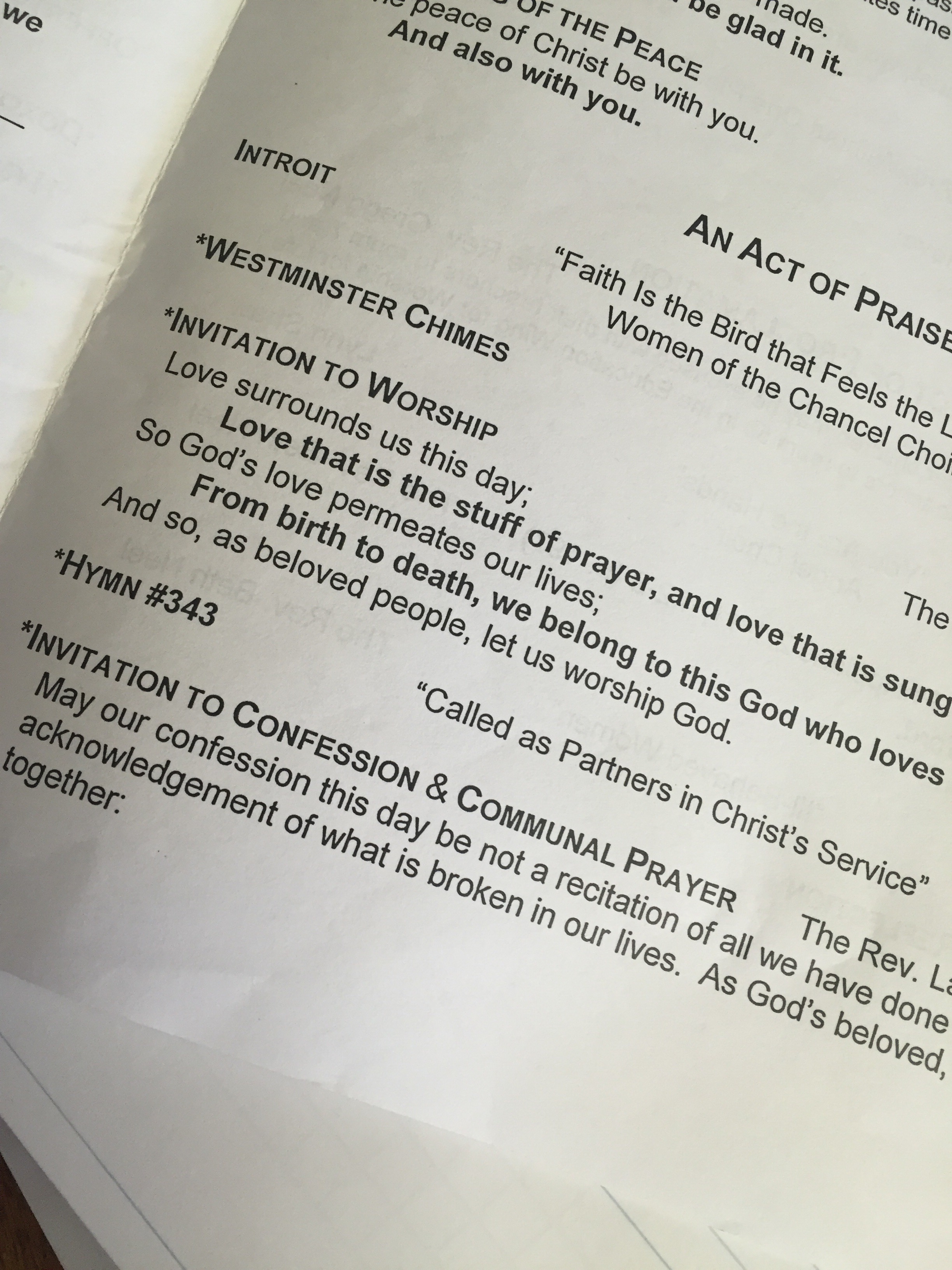
The table

I have a thing about tables – end tables, side table, telephone tables, coffee tables, dining room tables, drop leaf tables, round, square, triangular.  I have a thing about tables.  It might have to do something with an appreciation of horizontal surfaces on which to put stuff.

So when I had the opportunity to buy one of the communion tables built for the recent General Assembly of the Presbyterian Church (USA) I jumped at the chance.  I gave my best doe-eyed look to my husband, and told him we really could use it in the back.  I’m pretty sure it wasn’t the doe-eyes that won him over, but now it sits in our backyard.

The table was made out of our Pacific Northwest native wood, the Douglas Fir, the Pseudotsuga menziesii .  Its scientific name is derived from the pseudo prefix because the Doug Fir isn’t really a fir tree; the menziesii come from the name Archibald Menzies, who classified the tree before David Douglas, who named the tree after himself.  So you could say the table isn’t what it seems.

I wrote the communion liturgy that was used for one of the services at the table during GA.  The preacher/presider that day chose not to say all the words I wrote; I believe they did not suit, theologically-speaking.  I was a little miffed, to be honest.  But then I remembered it is a table of grace.

The table was transported from the Oregon Convention Center to our home a few miles away because of the strength of many and the generosity of a friend, who provided both muscle and pick up truck.  It is a table of friendship, too.

Its debut at our home was for a potluck dinner for all of us who were on the steering committee that provided hospitality for the General Assembly, and on that beautiful Thursday night, it was laden with wine and lemonade and iced tea and brats and chicken and pork and watermelon and crudites, and laughter, and stories, and gratitude.  It is a table of abundance.

Our child protested the arrival of the table in our small backyard – it takes up space she plays in.  It is a table of inconvenience.

But I love it.  I love where it has been, and who has stood behind it and broken bread and poured the cup.  I love who has gathered around it, and who will gather around it.  It is the holy in the ordinary, and I am reminded that the holy calls me to gracious, and generous, to be a friend.  I am also reminded that, like the table, the holy can be inconvenient at times, nudging us to let go of grudges, to rely on loaves and fishes, to find a way to squeeze one more person in.

It needs another coat of lacquer, according to its builder Michael.  A little care must be given for it to survive the long haul, not unlike all of us.

FullSizeRender


Living in the tension

“Mom, why do we have guns?” That’s the question my ten-year-old asked as we ran a few errands Sunday after church, when I had referred to the Orlando shooting in worship and she asked what had happened.

“Well, people used them to hunt so they could have food.” But that wasn’t quite right.  Not at all.  “People used them to kill each other in war.”

“Why do we have war?”

“Well, people see someone else as their enemy, as someone who wants to take what they have, as someone who is dangerous.  Or someone who has something they want.”

“Then why do we have enemies?”

Oh, child of mine, I didn’t ask those sorts of questions when I was ten.  The assassinations of the 60’s were not part of my childhood memory, nor was the Viet Nam war.  My first political awareness was Nixon’s resignation, and that didn’t involve guns at all.  My dad and brothers hunted; we had rifles and shotguns in the house that were always locked up and never loaded.  When we were held up at gunpoint at home when I was a teenager, no one thought about getting one of those guns and starting a shoot-out with our assailant.

Maybe the bigger question is why we have enemies.  That same Sunday, at the end of worship, two men experiencing homelessness came to the narthex seeking help.  That’s been happening a lot lately – there are so many people and not enough public bathrooms or soup kitchens or mental  health facilities or shelters.  There may not be enough time or kindness, either.

One of our deacons was talking with them very patiently and I interrupted the conversation.  I thought wearing the big black robe and the pretty green stole would give me some authority when I told them I was so sorry that we weren’t able to give them cash, but it didn’t. I listened.  We prayed.  I’ve remembered their names – A.J. and  Avery.  I’ve prayed for them all week.

Are A.J. and Avery my enemies?  Do I wish them harm? No.  Did I wish they’d go away so I could get off my feet and get a cookie and cup of coffee? Maybe; how horrible of me.  Do they wish they had guns so they could get what they need by force?  I doubt it.

It was an unsettled day, Sunday.  I was so aware of the tension of being safe because I’m a straight woman and the worry that someone might target our church because we have a rainbow on our sign.  I was aware of the tension that I’d had a nice shower in the morning, and put on clean clothes, and had breakfast and would have lunch as I talked with these men who hadn’t seen a shower or a full meal or a sober day in God knows how long.  I was aware of the tension in wanting my daughter to delight in the world while having to tell her the realities of the world.

The tension is still there, and my prayer is that nothing reaches the breaking point.  My prayer is that out of the tension comes something hopeful or healing, maybe even beautiful, the way a beautiful note is played over the taut violin string.

But maybe that isn’t up to me.  But maybe it is.

violin

We were visited

Aaron was in worship again on Sundayo.  I wasn’t surprised – I’d seen him around the building this week, and had commented on the nice green blazer he was wearing, to which he replied, “I’m a natty dresser.”

Aaron is a friend of our congregation, a man in maybe his 30’s who is experiencing addiction, homelessness, and lives with mental health issues.  He shows up for worship now and then; lately, on high holy days.  I’m beginning to wonder if he isn’t a messenger from God.

On Sunday the choir led most of worship.  We (I sang with them) presented portions of a rather extraordinary work entitled “Calling All Dawns” by Christopher Tin.  Twelve songs, incorporating sacred texts and poetry from many cultures, that describe the cycle of day, night, dawn; life, death, and rebirth. We sang seven of the songs, in Swahili, Japanese, Chinese, Polish, Hebrew, Farsi, and Maori.

I gave a short reflection, and wrangled the doctrine of the Trinity with the Bantu word and African ideal of ubuntu – “I am because we are.”  I think it worked.  Maybe not.  But it was my hope to weave together the context of the music with Trinity Sunday with our call to be community to each other and the world.  Oh, how we preachers stretch sometimes!

So after the service there was much hugging and complimenting and the usual handshaking.  As things started to clear out, I saw Aaron sitting by himself in the back pew in the transept.  I sat with him for a minute or two.

His eyes were watery; he had alcohol on his breath.  I asked him how he was.  “Fine. I guess.”  I asked him where he was sleeping these days. He gave me a look as if I should know better than to ask.  Then he said “On the sidewalk.”  I asked him if he had a tarp or a sleeping bag.  No.  Then he said, “A buddy of mine let me sleep on the floor of his house last night.  This guy – I don’t what he’s been through.  But he’s still really kind, still sort of innocent.  You know, it’s like you said.  Community.  We all need it.”

In the last year I have learned that two things can ground the most ethereal, theological, grand worship: a bald child who is battling cancer and a homeless man who comes to worship because he craves community.

Maybe God sent Aaron to us this morning to remind us that as much as we sing about following the way and praising God and living out peace, we must never forget that it begins in the pews and on the sidewalks that surround the church.

I wish I knew how to help Aaron.  I know how to give him cash and food; I know how to pay for a motel room for him.  I also know he would probably not be accepted into a shelter because of his addictions, and I know shelter spaces are too few in our city.  I wish we had better mental health practioners who worked with the homeless; again, the few we have are overloaded.

So for now, I do what is inadequate: I welcome him in church.  I call him by name.  I recognize him not only as a child of God, but as a messenger of God.

And the message is that we have work to do.

angel-849222_960_720

The grass withers, the liturgy fades

img_8041Does a prayer have staying power?  Does a litany change anything, or anyone?

There are prayers I treasure; I particularly love Cardinal Newman’s “O Lord, support us all the day long, until the shadows lengthen….”  When leading worship, I sometimes worry I will forget the Lord’s Prayer right in the middle.  I find comfort, before preaching, in saying the words out loud “may the words of my mouth, and the meditations of our hearts…”

Almost every week I write liturgy for the bulletin, usually a call to worship and a prayer of confession, maybe communion liturgy.  I spend a fair amount of time on it (and make it available elsewhere on this blog).  I enjoy the process; it adds the sense of poetry to my usual to-do list.  Some of the stuff I write isn’t half-bad, if I do say so myself.

But occasionally the thought comes: does this make a difference?  People get one shot at their part in the call to worship, and then we’re on to the opening hymn.  Did a word catch them?  Did a phrase redirect their thoughts?  Do the words of confession that I put together resonate at all with at least one person in the pews?

Lately I’ve decided that the liturgy – or at least the liturgy in our Presbyterian worship – is momentary.  The grass withers, and the liturgy fades, but the word of the Lord will stand forever.

And maybe that’s not bad.  A petite-four is a momentary thing; so is a sidewalk drawing.  Which is not to say those things aren’t beautiful, brief though they are.  If everything were eternal, we’d be overloaded.

Maybe liturgy is like KonMari for worship – something non-essential that is done with once uttered.  I think I’m okay with that.

But I’ll write on, not for eternity, but for the moment.

Free concert, Thursday night

Evidently we’ve been reaching out to our neighbors without meaning to do so. It’s the latest church trend – unintentional evangelism.

Every Thursday, our choir rehearses in our fellowship hall, a large and acoustically great space on the second floor of the education wing.  With fifty or sixty singers gathered, the room gets a little stuffy, so we open the windows that face 16th Street and the apartment building across the road.

Last fall, through sheer coincidence, we learned that some of our neighbors gather together in one of the apartments to have a beer or a glass of something and to listen to the choir rehearse.

How great is that?

Now I love our choir, as a group and as individuals, and while there are a few stellar voices in it, there are also plain ol’ regular good voices in it too, but when they come together – magic. That’s the thing about choirs, isn’t it; the sum is greater than the parts.  (I love it when math doesn’t work.)

The choir and our music director have been kind enough to let me sing with them for the major work they’re doing in May, pieces of Christopher Tin’s Calling All Dawns. I’m learning to sing in Swahili and Polish and Maori.  My brain is very excited about all of this.

I wonder what our neighbors think when they hear us singing strange words like “baba yetu” or “kia hora”.  Do they know we are singing a prayer?  Do they know we are singing about peace?

I suspect that our neighbors will not show up on Sunday to hear the final product of any rehearsal.  I’m okay with that because maybe showing up on Sunday isn’t the point.  They do put up with a lot from us – occasional construction, taking up a lot of on street parking on Sunday morning, people showing up for help at strange hours.

Maybe our free Thursday night concerts are one way to thank them for being our neighbors, no strings attached.  Peace, friends.

OpenWindowSm

PS: The Portland Gay Men’s Chorus rehearses in the same space on Monday nights – it’s a two-fer!

At the Center

(this is revised from a sermon I preached in 2011 on Romans 8:26-39; I recently reread, and thought it might be  helpful to someone today)

It’s such an elusive question: what is love? Hollywood gets it wrong more often than not; poets tend to get it right. The rest of us muddle through, experiencing those shining moments when we know we are in the midst of love, only for that moment to end and leave us wanting more.
I am drawn to what Jean Vanier said about love. “To love someone is not first of all to do things for them, but to reveal to them their beauty and value, to say to them through our attitude, ‘You are beautiful. You are important. I trust you. You can trust yourself.”
Love is revealing to another his beauty, her value. Love as revelation from one to another, revelation that opens up vistas rather than shading them over.
So what happens if we make that our working definition of love and stick it onto Paul’s gorgeous words from Romans 8? It might mean that nothing can impede God in Christ from revealing to all of us our beauty and value.
But it doesn’t feel that way most of the time, does it? It feels as though the world is telling us, over and over and over again, that the creation is ugly, that people are ugly, that there is no value or meaning in anything other than acquisition and might and trendiness. The powers, as Paul calls them, strip away all sense of holy beauty and value. The powers tempt us every day, and we don’t have to look far to see them.
The powers tell us that we are conquerors, and we believe them. We have conquered discomfort, and if we don’t feel well we pop a pill, if we’re hot we turn on the air conditioning, if we’re in a hurry we buy a Big Mac at the drive through and eat in the car. And so we wonder why there is addiction, and a hole in the ozone, and obesity and litter and pollution.

The powers tell us we are conquerors. We have conquered weakness. If the enemy strikes, build a bigger weapon and strike back harder. If you don’t have enough room, take someone else’s space, their land, their country. If the battle isn’t going your way, use civilians as decoys, shields, and hostages. And still we are aghast about war, horrified by violence, and despair over endless cycles of retaliation.
The powers tell us we are conquerors. We have conquered the personal demons of loneliness. There’s a great commercial running on TV right now for Toyota, in which an adult child talks about her parents’ boring life while she has 763 friends on Facebook; meanwhile her parents are out in their Forerunner joining a big group of friends for a bonfire and cookout. The internet provides community for some, but not physical presence. And still we shake our heads as we gaze at the dining room table, covered with mail and books instead of placemats and silverware and meals shared by friends.
The powers are those forces that tell us we can rely on ourselves and don’t need anyone else, that we don’t have to wait to get what we want, and that we can use whatever force necessary to make our individual lives better. The powers are so seductive and offer us lives exactly as we want them.
And then I am reminded of something Ralph Waldo Emerson once wrote in his journal. “You shall have joy, or you shall have power, said God. You shall not have both.” I wonder if Emerson had been reading Paul the day he wrote that. You shall have joy or you shall have power. Presented on paper, the choice seems easy. Or does it?
How do we choose – how do we make any of those crucial life decisions? What do we do when we come to one of those big crossroads, and we have to choose between power and joy? Are we ready, prepared, to make that decision? Or do we find ourselves flailing?
It may depend on whether or not one has a sense of what is at the center of life. What is at the center of your life, in the middle of your heart of hearts? What motivates you to get out of bed in the morning? What enables you to risk ridicule or ostracism, to stand up for something you believe in? What encourages you to put one foot forward when you are dog-tired and weary beyond all reckoning and utterly drained? What is at the center of your very soul?
It’s clear what was at the center of Paul’s soul: the love of God in Christ Jesus. Paul wrote a lot, and he wrote a lot of things that I disagree with or struggle with, but I have to give him this: he knew God’s love. He knew that God loved him, that God saw the beauty and value in him that had nothing to do with credentials or success. He knew that God trusted him. And so when he was stoned by enemies in one town, or shipwrecked, or thrown into jail, he knew he had the love of God deep in his heart. I imagine that as he went to his death, he knew that love of God.
How many of us can say the same thing for ourselves? How certain are you, on any given day, of God’s unconditional love for you? How certain am I, on any given day, that God sees my beauty and value? Most of us have that sense – until we start listening to the powers, to the culture, to the media, to those voices that tell us other things. But the truth is that we are all in the same boat, this boat that sometimes sails smoothly with deep confidence in love, and sometimes is tossed about by doubt and temptation.
I love the way poet Gwendolyn Brooks describes this in her poem “Infirm”.

Everbody here
is infirm.
Everybody here is infirm.
Oh. Mend me. Mend me. Lord.
Today I
say to them
say to them
say to them, Lord:
look! I am beautiful, beautiful with
my wing that is wounded
my eye that is bonded
or my ear not funded
or my walk all a-wobble.
I’m enough to be beautiful.
You are
beautiful too.

How was it possible, almost two thousand years ago, for Paul to write words that have such resonance today? We feebly struggle, and the Spirit shares our sighs and enables us to form those struggles into prayer. We hope that God is working in the good and the bad, in the beautiful and ugly, making all those things work together for some holy purpose. We pin our hope on God, who knows what sacrificial love is. We see our hope in Jesus Christ, who strides through all our hardship and danger and threat, through all those things to you and to me.
The world would have us be conquerors, but Paul tells us we are more than conquerors. We are more than conquerors. We are more than consumers. We are more than victors. We are more than victims. We are more than taxpayers. We are more than young, old, saggy, taut, smart, thick, Republican, Democrat, straight, queer, right, wrong, strong, weak. We are more than all those things. We are more than conquerors, because we are the Beloved.
We are the Beloved, and as Paul tells us, there is not one thing in the whole of creation that can change that. A child might ask a parent “will you ever stop loving me” and the parent says, no. So we might ask God “will you ever stop loving us?” And the resounding answer: No. Will you ever find us ugly? No. Will you ever find us worthless? No.
Paul tells us that God’s love is at the center, at the center of creation, at the center of the universe, at the center of each day we live our lives. God’s love is at the center. Every day God reveals our beauty and worth to us, and that impacts how we live with each other.
Every congregation has God’s love at its center. Some churches act like they don’t know that, or like they’ve forgotten it, but still, God’s love is the center, the anchor, the cornerstone of every congregation. So if we still use Jean Vanier’s words about love, we could say that at the center of every congregation is the revelation of the beauty and value of the people within and beyond the walls.
It’s easy to reveal beauty and value of another when we are all in one accord. It get tricky when we disagree, and when we disagree for noble reasons, and when we disagree with passion. I say this not because this is a congregation in terrible conflict; it is not. But we do face some interesting, God-given challenges, and how we work together and face those challenges is crucial.
In our decisions, will we choose power or joy? How will we hold in tension our very human disagreements and this divine call to love, to reveal beauty and value to and with each other?
The guy who rolls his eyes every time we sing your favorite hymn? He is beautiful.
The visitors who dare to sit in your pew? They are beautiful.
The woman whose car bumper sticker express everything you don’t believe in? She is beautiful.
Those kids who squirm and crawl under the pews and wave to their parents during the moments with children? They are beautiful.
The dear friend whose aging has taken a toll on mind and body and spirit? He is beautiful.
The acquaintance whose off-hand remark struck you at your very core? She is beautiful.

They are all enough to be beautiful.
You are beautiful too.
You are priceless.
You are more than conquerors.
You are the beloved. Thanks be to God.
Easter

If it were the scent of spring
It would be the smell of packed dirt turned over, making room for those hearty early flowers,
Or the cut-back fern, prelude to the unfurling of her frond,
Or the smell of rain – not winter’s relentless rain, but the playful rain, hiding and seeking with the equally playful sun, not yet too old and mature for a good romp
Or daffodils and daphne.
But not lilies. Please, dear Lord, not the lilies. They are too brash and self-important.

Or if it were a sound
It’s the quiet of waking before everyone else
The whispered drip and gurgling steam of the coffee maker
The light scratch of the plastic Adirondack against the pavement outside
The silence of a lightening sky
The occasional dog jingling by, and a gently panting human.

Or if it were a feeling
It’s the scratch of crinoline in a dress no one wants to wear but everyone wants to see
The pinch of elastic under the chin, holding that hat on for dear life,
The feeling of that girl, miserable in her curls and sagging tights who’d rather be in the mud and the rain eating chocolate from plastic eggs.

It is the nap in the afternoon, and waking anew.

It is in the evening that it sinks in
In that dwindling light before sundown, slanting through the flowering plum

Then with the brass of the day past
Only then, after the celebration
(Those bossy lilies found a good home)
Then do I whisper:
Indeed. He is risen.

mud3

Trump as Lenten Discipline

In my Ash Wednesday meditation, I admitted that I wasn’t all that good at spiritual discipline, or even following through on a particular Lenten practice, but my hope this Lent was to do two things: to be more kind to my family, and to learn more about the people who support Donald Trump is his campaign for the presidency.

As I understand it, one option for a Lenten practice is to do something that is not sustainable for the long haul.  I do hope that I will carry on a greater effort at kindness for my family; so far, it has been delightful and not too trying.

And learning more about the supporters of Donald Trump has been interesting and thought provoking.  And a little depressing.  Here’s what I have gleaned: that his supporters tend to be white, male, and blue collar workers with not much education past high school, if that.  There is nothing wrong with being a white male, or a blue collar worker, or having ended formal education at high school.  Some of the people I love most dearly in the world fit in those categories.

What is hard about all of this is realizing that I don’t know most of these people, that I don’t run in any of the same circles that they do, therefore I have little chance of changing their minds.  Because I would really like to change their minds.  I have this romantic little fantasy that if we could just sit down and talk and have a rational conversation, I could show them that Donald Trump will not bring back what they have lost, or what they think they have lost.

Yet reason will not prevail, I fear.  My hunch is that their support of Mr. Trump comes from a deep place of anger and loss that may have begun when Barack Obama was elected president but probably began decades before that.

Still, Jesus calls me to reach out to those on the margins, and I think the supporters of Donald Trump feel that they have been on the margins of the American Dream for too long.  I would argue with that, but am I called to argue or to listen?

In the end, I am comforted that Donald Trump only has one vote, and I only have one vote, and I know I will not use it for him.  Lent will end soon, but I suspect I will continue to read about this presidential race and the candidates and their supporters.  I suspect, too, that I will not find much hope in any of that.

I find my hope elsewhere.  I am ready for Lent to be done and for Easter to arrive.

abstraction white rose number 3

Abstraction White Rose Number 3, by Georgia O’Keeffe

Liturgy-Time Continuum

I know how it’s supposed to go: you save the palms from Palm Sunday, maybe stick a few in the Easter bouquet, and then store them for a good ten months until burning them for the next year’s Ash Wednesday service.  As I did just a few weeks ago.

The palm leaves were good and dry, as opposed to the year before when we couldn’t find any of the old ones and tried microwave a few leaves off the decorative palm tree in the parlor to dry them out enough so we could burn them into ashes.  Some friendly advice: don’t try this at home, at church, or anywhere. It doesn’t work.  Besides, your local Catholic supply store will have ashes for you.

This year I was prepared for the beginning of Lent.  On Fat Tuesday I brought my nice, dry, dead palm leaves home and gathered up a metal bowl, some matches, and a pitcher of water (just in case.)  I went to the concrete slab out back, put the leaves in the bowl, and dropped the lighted match.

It was so cool, watching the flames lick the leaves, starting off small and almost going out only to burst out.  I decided to do it again, and to film it with my trusty phone.  It was so much fun I did it a third time, and now have ashes enough to last me for the next decade.

I posted the video of the leaves burning because I found the image mesmerizing, especially in slow motion.  And then I got to thinking about Pentecost, because who doesn’t think about Pentecost on Fat Tuesday?  There was something holy about the the small tentative flame seeking something to catch fire to, then growing, then growing so much as the breeze picked up that I worried it might get out of control, then dying down, then turning the leaves to mere gray husks that fell apart with a tiny breath.

Do the flames of Pentecost die down by Ash Wednesday?  Does the Spirit grow to an alarming rate, only to leave behind the dregs of what she touched eleven months later?

God’s time is not as linear as we might like.  There are births in Lent, and flames on Christmas.  There is death at Easter, and ash on Pentecost.  The whole liturgical calendar is simply a construct, a way to help us remember that God’s Spirit ebbs and flows, or at least our recollection of it does.

Here we are, in the middle of Lent, and the daffodils are already blooming where I live.  Easter is so early this year that some of my friends will be putting their lilies out in the snow.  Nature has her own timeline, of course, and occasionally she and the liturgical calendar dance in step, only to have a falling out, and we are left with Easter bunnies hopping over snow drifts and the solemnity of Lent marked by audacious daphne and crocuses.  Heck, we even sang a few alleluias in worship last week.

Maybe all time and all seasons, natural or human made, are hallowed.  Time belongs to God; it is we who made the calendar.

The forgiveness racket

My child has figured out that there’s no winning in forgiveness.   I was hoping we could have put that off a little longer, like the Santa Claus and birds-and-bees talks, but no.  It turns out that these days they’re teaching empathy at school, so when someone, say, teases you, you can get mad and you can get hurt, but you are also supposed to try to figure out what’s going on with them that would make them do that thing to you.  And then, if you live in our house, you also have to work on forgiving them.

I realize there are adults who could stand to learn this lesson, adults like me, for example.  I also realize that forgiveness is pretty much the cornerstone of what Jesus had to say.  And I believe that the only way families and marriages and societies survive with spontaneously combusting on a bad day is by the power and practice of forgiveness.

Still, it’s a hard lesson for at least one nine-year-old I know.  Because she now also realizes that the onus of forgiveness lies with the one who got hurt.  It’s so NOT FAIR, as she would say.  Yes, I would say, it is so not fair.  There’s no guarantee that when you forgive someone they won’t turn around the next day and be mean or hurtful again. The hurt person has to become the bigger person and dig up some empathy and work on staying in relationship with that other person, even if “staying in relationship” means not pouring water all over their diorama and not tripping them when they walk by.  It’s the elementary school version of reconciliation.  But it’s a start.

I believe this lesson about forgiveness will come in handy one day, when she has to forgive me for something truly awful that I’ve done, as opposed to the unpardonable sins of giving her the mom look in church or embarrassing her in front of her friends by saying hello.  It may also come in handy some day – and the lesson may actually stick – some day when I forgive her for something awful that she did.  Because I suspect that day is coming, and in the less than distant future.

So we’ll work on the injustice of forgiveness.  Maybe I’ll learn something, too.

o-FORGIVENESS-facebook