The Dinner Party

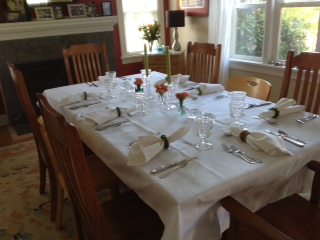
photo (1)We’re having six lovely people over for dinner tonight, which means that I have been frantic for about three weeks.  This is nothing new.  How do I clean the house, cook the food, look presentable; dust the floorboards, wash the front exterior windows, really clean the hardwood floors in the dining room, find a menu that is tasty and delicious and doable, with the right blend of flavors, textures, and colors, find the time to shower and do something with my mop of hair and remember to put on lipstick; vacuum thecobwebslivingontheceilingswipethehandprintsoffthedoorjambscleanthestainlesssteelappliances makesure iknowifanyguestsareglutenfreeorallergicorhaveastrongpreferenceagainst porkormushrooms orasparagusormakesurethedogstays outofthehouseandshouldiwear askirtorculottesoradressorpants andwhatearringsdoiwearand willanyonenoticei fimwearingmy tennishoes?

Frantic.  Yes.

I do love to have people over for dinner but we haven’t done that much lately.  Or house is smaller than our last one and it gets rather cozy when more than four show up.  Our seven year old tolerates a bunch of grown ups.  And then there’s the puppy, who simply has not understood this week why I do not allow what’s left of Giraffe’s innards to remain in bunches strewn through the house.

I love having people over and I love the fuss.  Because our guests tonight are slightly older than my husband and I, I’m using the good stuff, and it’s a thank-you dinner, so I’m using the good stuff.  I love using the good stuff, because the communion of saints is with me.  Whitney and John gave my the linen tablecloth as a wedding present.  My in-laws gave us their cut glass water glasses.  My parents downsized and gave me back the Waterford votives we gave them for their twenty-fifth wedding anniversary.  I’m using our wedding china and crystal for dinner, and my father-in-law’s mother’s china for dessert.

I love having people and I love the fuss – up to a point.  I find myself teetering on the edge of Crazy, and I don’t want to fall off that particular cliff because deep down I know this really is all about hospitality.  Our guest won’t care one whit if there’s a cobweb in the corner, or if one of the puppy’s chew toys is left in the bathroom.  They won’t care if the wine is so-so and food lukewarm. What they will remember is if they felt welcomed, and if there was good conversation, and if we were enjoying ourselves as well.

So during this day of cleaning and chopping and prepping, I’ve been thinking about communion this Sunday.  I think about the women who are so great about making sure the communion cloth is centered, if there is the right number of plates and chalices.  I think about them crowding into our little sacristy, laying out bread pieces and sharing their relief that it’s intinction this month and they don’t have to fill all the little juice glasses. I think about communion as hospitality, knowing that those who come for this particular holy meal probably wouldn’t notice if the tablecloth were off-center or a little stained.  They wouldn’t care if they had to wait a moment while the bread plate was replenished.  What they might remember was that a pastor called them by name, and offered them the bread of life and cup of blessing, and with two small tastes something inside them was sated.

Of course, bread and juice is a lot simpler than pork tenderloin, wild mushroom bread pudding, roasted asparagus, and panna cotta.


Praying for a miracle

candleOnce a month our congregation offers an evening service of healing and wholeness in the Taize style of worship.  I attended the service for the first time last night – for the first time, not because I don’t have those to pray for who are seeking healing and wholeness, but because, really, my colleague is beautifully suited to lead that service and usually at 5:30 on a Saturday night I don’t want to be in church.

But I went last night, in part so that I could experience it but also because a few of us were staying afterwards to decorate for the Pentecost service today.  It was a lovely service and I’m glad I was there as it feels that there is a lot to pray about right now .

So the choir is leading some of the Taize songs, and my mind wanders in a good way.  I start thinking about a friend of mine who has been diagnosed with cancer, and the prognosis is so-so.  I start thinking that I would like a miracle for this friend, which gets me thinking about miracles in general.

Once in my life I prayed for a miracle.  A very dear parishioner in the first congregation I served was in a coma.  It was a cardiac thing, an utter surprise for this healthy, relatively young, fabulous, beautiful, kind woman. She lay in a coma and I stood by her bedside and prayed for a miracle, that she would come out of the coma, that they would shrink her enlarged heart, that her husband and sons would enjoy decades more with her.  But the miracle didn’t happen, and eventually she died and it was awful.

I haven’t prayed for a miracle since, but last night as I was thinking about my cancer-diagnosed friend, I thought about miracles again. What if there was some rule that you could only get one miracle granted in the course of your lifetime?  Would I hoard it for myself or my child or my husband, save it for a rainy day? Or would I be burdened by the miracle and offer it up the first ripe opportunity, and not be weighed down by the decision of when to use it?  Would I not pray for the miracle and then regret it the rest of my life?

I know people who have experienced miracles.  I know people who have experienced answers to prayer that they would call miraculous.  I’ve only prayed for a miracle once, and it didn’t happen.  And I know that should not be proof that God doesn’t grant miracles (or perform them?  I’m not sure what verb to use.)  But it’s hard to ask for something and get a ‘no’ and then be willing to ask again; harder to do that again and again and again.  It leads to a world of disappointment and not a little bit of doubt about the good intentions of the Divine Creator.

Meanwhile the choir finished their Taize song and we had moved on to other prayers.  I didn’t pray for a miracle last night.  Instead, I went to light a candle, for my friend, and for a few others.    I added a little light in the darkness, and in that moment, that felt better than a miracle.

Wandering – but lost?

It’s just one of those ministry days.  A meeting here or there, a little pastoral care, some reading to prep for class, checking the calendar to make sure I’m not missing anything.  And two encounters with homelessness that have gotten me to thinking but not drawing any conclusions.

Our congregation participates in a Portland project allowing people experiencing homelessness to sleep in their cars overnight in our parking lot.  It’s not a great solution; it’s a pretty terrible one, but sometimes it’s the best choice some folks have.  We work with a shelter that provides a temporary “home” for families and helps them find more permanent homes, and today I met with a family that will be our parking lot guests until a space at the shelter opens.

If you met these people at McDonalds or Safeway, you wouldn’t think twice about where they lay their heads at night.  A mom, a dad, a rambunctious two-year-old boy, a sweet girl almost one and almost walking.  They were on their way to renting-to-own a house; turns out it was a swindle, and they lost all their money.  They’ve been sleeping in their car for six weeks.  They go camping when they can so they can stretch out in their tent and let the kids run around outside.  Mom and Dad are the biological parents of both kids.  He’s had the same swing-shift job for three years.  She is well-spoken and a very attentive and patient mother, taking classes. And they call their Xterra home, at least for now.  We’ll provide them with a porta-potty, a designated parking space, access to showers and laundry, and prayers.  And probably some diapers and gas cards and cookies, if I know my congregation.

This afternoon I was waiting outside the church entrance with the parents and some of the kids in our children’s choir.  They are on their way to the local university to be real-live subjects for college kids studying to be music teachers.  It’s become an annual outing, and the kids love it.  Riding light rail, going to college, performing for young adults, plus pizza and a movie at the end.  Woo hoo!  Good times.

So we’re outside waiting when a man who is obviously homeless starts coming down the sidewalk.  “Obviously homeless” – that’s telling.  And judgmental of me.  And descriptive.  He had scraggly facial hair, random layered clothes that were stained and too loose.  Shoes that have seen more than I have in my lifetime.  He had that look in his eyes that made me want to usher all the kids inside.  But I’m trying to be a role model here so we stayed and acted non-anxious.

He catches my eye and says something to me that I think is “what time is it?”  I don’t have a watch or phone, and tell him I don’t know.  He asks another mom there “what time is it?”  She tells him 3:30.  He says something else, and she is patient and kind and says, “I’m sorry, I don’t know.”  Then he sees my husband, the co-pastor with me.  He goes nose-to-nose with my husband, tricky because there is a cigarette (unlit) dangling out of his mouth.  He gets a bit belligerant, and the kids notice.  My husband very patiently, very calmly starts to move him along the sidewalk while the rest of us do usher the kids inside.  Now my daughter is beside herself, worried that this man will punch her dad.

My husband comes back; he’s fine.  He comforts my daughter.  The kids all want to know about his guy.  What’s wrong with him?  Why did he act that way? I am blessed to have great adults around.  We say things like “his brain works differently”  “we don’t know what he thought he was seeing” “he’s someone who needs help”.

I don’t even know how to draw a lesson out of these encounters, except to say that many people wander, but not all of them are lost.  But some of them are lost, and have been for a while, and it will take a lot more than cookies and kindness to help them find their way home.

The Pitfalls of Mother’s Day

As I lay in bed snuggling my daughter tonight, I started thinking about people I know for whom tomorrow is going to be difficult – the mother whose daughter was just diagnosed with cancer.  The husband and two daughters whose wife/mother died suddenly earlier this year.  The friend whose relationship with his mother is strained because of deep-held and widely different understandings of what sin is.  The mother of a preschooler and an infant who posted one of those things on Facebook this week about the utter frustration about not being able to get it all done.  The mother who was first to find her daughter’s body.  The woman whose daughter has made bad choice after bad choice, who was treated savagely this last month.

But then there’s the first-time mom, a woman I knew in her twenties, who glows in every picture she posts.

Flowers, chocolates, and sweet cards can’t make up for all the fraught-ness of Mother’s Day.  I dread Mother’s Day in church, knowing that for some it’s right up there with Easter and Christmas and for others it’s a day to avoid the worship and sweetness and light.  Before I met my husband, when my own hope to become a mother was slipping away, silently and ashamedly, I was leading prayers one Mother’s Day.  At the first service, a well-intentioned person asked prayers for all those women who had hoped to become mothers who never did.  I felt as though he had shined a klieg light on all that I was trying to suppress that day.  I made it through that service, and then collapsed. My good colleagues covered for me, but it was excruciating and humiliating.

Why all the fraughtness? Why is Mother’s Day the be-all-end-all for some and the nadir of existence for others?  Does Father’s Day carry the same peculiar heft?  Maybe it goes way back to a time when a woman’s worth was measured by her ability to bear children, especially those of the male variety.  Maybe it has to do with the different emotionality of women (which, I suspect, isn’t really all that different from the emotionality of men.)

But maybe in the end it’s because Mother’s Day is really about life, but pinpointed and concentrated.  Mother’s Day reminds us of how we’ve been loved in this life.  Mother’s Day reminds us of hopes fulfilled and crushed.  Mother’s Day magnifies the grief and the joy, the disappointment and the exhaustion.

This morning my daughter and I painted the door to our garage.  I really wanted to do it by myself, so I could get it right; she really wanted to do it with me, because she loves me and loves to be with me.  Seven years into this mother-thing, I have figured that part out.  It’s not about being perfect; it’s not about the flowers and chocolate and matching apron and oven mitts that I know are waiting for me tomorrow.

It is about the moments, the little moments of squirting paint, and getting out splinters, and shouting and making up.  The grief and the disappointment and the frustration lurk around the corner.  But we got our door painted today, on Saturday, and as far as I’m concerned, I’ve already had a great Mother’s Day.

So raise a glass or a mug tomorrow to someone you love – someone who’s here, or someone who’s gone; someone who is your mom or someone who is your hero; someone who’s load is unbearable, or someone who radiates joy in every fiber of his being.  Raise a glass to the good, however it comes, and whoever it looks like for you.photo

Blessed to be a blessing

So it’s Monday morning and I’m on my way to Starbucks.  In my defense, I usually don’t visit Starbucks on a Monday morning, but there was a lot of gardening and the ensuing sore muscles yesterday, and the child woke me up at 2:30, and biology woke me up at 4:30, and the puppy woke me up for good at 5:30, and this week’s liturgy just needed a boost of caffeine.

So I’m on my way to Starbucks, a two-minute walk from the church, and I pass a guy pushing a grocery cart with a big garbage bag in it, which I assume is filled with cans and bottles he’s planning to recycle for the 5 cent rebate.  I’m on a mission for coffee, but I do think to myself, “God, bless that man” as I walk by.  But in the seconds after I pass him, before I get to Starbucks, I think to myself, “Maybe God wants me to be a blessing to him.”  And I go in and order my tall latte.

I have brought $3.oo with me; the coffee is $2.65 and I put the change in the tip jar.  I’m chatting with the barrista who’s foaming the milk and I hear the guy come in.  “Have you seen my friend who was pushing the thing?  Has he come out yet?”  No, says the barrista.  But then his friend comes out of the loo – an older gentleman wearing an Oregon State cap, pushing one of those walkers that has a basket and a padded seat.  The gentlemen leave.

I get my coffee, go outside, and pass them by.  They nod to me, and I’m expecting them to ask me for a dollar or two and I regret having only brought was was necessary for the coffee.  But they don’t ask me for anything; I’m pretty sure they don’t even notice me.  We end up  next to each other at the light and cross the street together.  The guys are chatting away, oblivious to my theological musings.  And on my way back to the office, I think to myself, “Who’s to say that man isn’t meant to be a blessing to me?”

May there be caffeine and the blessing of strangers for you today.

shoppingcartguy

At Least It Wasn’t a Bake Sale

auction paddleMy husband and I recently attended the annual auction at our local school.  It was a good event.  The parent volunteers  who planned it did a great job.  It had a groovy theme.  Many teachers and staff were in attendance, as were many parents, grandparents, aunts, uncles and friends of the students.  The food was good, the wine was fine.  And a lot of money was raised.

But two things about the auction have not sat well with me.  One, I hate the fact that here in Portland (and likely in other places) we have auctions to raise money to pay for things like a music teacher, or this year, for I-pads for the students.  (Not one per student, but about two dozen; this is a public school after all.) I won’t spend this post talking about funding public education, although I could.

The thing that really did not sit well with me was the class divide at the auction, and the bigger problem it points out.  It’s not cheap (at least by my standards) to go this thing.  It’s $50 per ticket, and for some families in our school, that is simply too much.  And then once you get there, there are lovely items to bid on at the silent auction (another $25 minimum), free wine but beer and cocktails to pay for, and then the live auction, which was great, but the $4,800 (not including air fare) Canyon Ranch weekend for two was beyond our means.

I hate the fact that not all the families at the school could afford to participate even if they wanted to.  But it points to a larger issue about gentrification in our neighborhood, captured by the Fifth Grade Art Project.

Most classes at the school made an art object for the auction; some were part of the silent auction, some were part of the live auction.  Three of the kindergarten classes had items in the live auction.  They were darling, each of them.  The kids and their teachers did a great job with them. One of them was hot – it was quite the bidding war and it went for an astounding $3,800.  And that is great, great for the student artists, great for the school.

Then the fifth grade art project went up for bid.  I thought it was just as great as the kindergarteners’.  Starting bid: $500.  No takers.  Not a one.  None.  Nobody.  Nadie.  Pas de personne.  So the auctioneer lowered the opening bid: $200.  I was crushed.  I felt so awful for those fifth graders and their parents.  A few paddles raised, and it went for $250.

And here’s what my husband said: it’s all about the changing demographics in our neighborhood.  Two years ago we bought a home in a nice neighborhood that’s on the upswing; we could not afford to buy it now.  Younger families with more money are moving in, and moving out are families that are a little older who can no longer afford the upkeep or the property taxes.  They move out, out east, out north, where the prices are still manageable and the taxes not exorbitant.  They move out, and maybe don’t even bother to buy but just rent.

There’s a developer at work in our up-and-coming neighborhood, a guy who takes modest, 1,200 square-foot bungalows, tears down all but one wall (so that it can be considered a “remodel”) then builds up a 4,000 square foot house on a lot smaller than a quarter acre.  One of those went up down the street from us, and has sold for twice what our house is worth.

I love our neighborhood and I love our school.  I love the cherry trees in bloom, and the vegetable gardens people plant in their front yards.  I love the friendliness of the place.  I love our school.  I love the kids and the teachers and I love the fact that in a not-very-diverse Portland, there is diversity of race and class.  But I don’t like the changes that are happening, maybe because they all feel out of control.  And maybe because we are part of the pogo-31problem.  We bought our house from a flipper, who bought it out of a foreclosure, prettied it up, and sold it for a nice profit.  We have met the enemy….

Back to the auction.

Every year at this event during the live auction there is a special appeal.  This year the appeal was for I-pads.  The staff made a fantastic video showing 1) how outdated the current computers were (oooo!  a 1990’s Mac!) and 2) the ways that I-pads could help the educational process especially among the youngest learners.  And the auction began.  First category: those willing to make a gift of $1,000.

And the paddles went up – about ten of them.  I had tears in my eyes, despite all my misgivings about the event.  I had tears in my eyes because I thought, “Oh thank God, these kids are going to have a chance.”  Next category: $500.  Another $3,000.  Next category: $100.  I looked at my husband, and up went our paddle.  All in all, about $30,000 was raised in this special appeal for I-pads.  I still get teary thinking about it.  These kids – all of them – are going to have a chance.

But will they be able to stay in the neighborhood?

Word Nerd at the Doctor’s Office

So I went to see my doctor (actually my nurse practitioner) yesterday because I’ve been having some stuff that might feel like arthritis and I’ve had a really, really, really sore throat.

I don’t wait long, the nurse calls me in, first stop the scale – yay! 40 pounds by their measure!

Onto the exam room. The nurse verifies my name and birthdate, and why I’m there. She asks me about my pain – where does it hurt? Well, I think to myself, it doesn’t really hurt. “Hurt” is not the right word to describe what I feel. “Ache” is a better word. My ankle and my knee and my hip ache. But she doesn’t ask how much it aches, she asks how much it hurts.

And then, because I’ve been having this internal conversation and have evidently been a little slow on the uptake, she shows me this handy “pain level” chart with smiley faces on it. Now I know they have to do this. I once served as a lay person on an Institutional Review Board, a group of medical and non-medical folks who review the protocols and consent forms for new drugs and devices and procedures. So I know that those things have to be written so that a person with an eighth-grade level education can understand it.

But smiley faces? Really?

I point to the smiley faces that is more of a wavy line that a curve and describe my pain as a 7.5.20130419-151237.jpg

But then I go inside my head again. My pain doesn’t look like a circle with two dots for eyes and a wavy line for a grimacing mouth. Then again, my pain does not look like Edvard Munch’s The Scream. Nor does my pain feel like what St. Teresa20130419-151304.jpg felt as the cherubim stabbed her into ecstasy in Bernini’s sculpture at the lovely little Santa Maria della Vittoria in Rome. Put that on your chart.

My pain is not absent as it would be in a lovely Fragonard painting; there is no peace in my body that mimics a classic Dutch landscape.20130419-151331.jpg

If the nurse had asked, “Which painting in the great repertoire of Western art most evokes the ache you feel in your ankle, knee, and hip?” I would have been happy to ponder that and answer. “Why, thank you, Nurse Shelly. My ache is best represented by Rembrandt’s self-portrait of 1669. He’s not wincing, but there are shadows around the eyes and a set-ness to the mouth that evoke some ongoing pain and sleep-interrupted nights.” And then Nurse Shelly and I might get into a conversation about the evolving nature of Rembrandt’s self-portraits. But we don’t. She notes in my chart that I pointed to the wavy-line mouth smiley face, then tells me the nurse practitioner will be right in.rembrandt self 1669

My only consolation in all of this is that my nurse practioner asked if the symptoms in my leg started at the same time as my sore throat because the two might be related, except she didn’t say “at the same time.” She used the word “concurrently.” I was so happy, and answered her right away, because my little brain did not need to imagine synonyms or paintings that would better describe it all.

Of course, they still don’t know what’s wrong with me….

ps: If you are my mother reading this, it’s probably just a virus and nothing serious, so please don’t worry

How Much Va Va in the Voom?

hubba-bubbaThere’s this saying among people losing weight:  “Nothing tastes as good as being thin feels.”  I would like to go on record as stating that I do not believe this is true.

Pringles taste awfully good.  So does chocolate, in any form, but especially melted.  So does a good pizza, or hamburger, or frites when they are very salty and greasy and crisp.  You can add your list of things that taste better than being thin feels.

But truth be told, I’m not really sure what being thin feels like, although I do know what it feels like to lose weight and have people tell you that you look great and then gain weight and have people say nothing.  That feels good and bad, but not as good as  m&m’s.  It’s been a LONG time since I could be called “thin” in any way.  But I have lost a lot of weight in my life time, and I have gained all of it back again.  I’m in a losing phase right now, and I must admit that I feel better.  Exercise is easier.  My back and hips don’t hurt as much.  I have better energy and stamina.  But I crave, crave, crave salty crunchy things.

It’s a mental game, this losing weight thing, so I set bench marks:  10% of my weight lost.  15% of my weight lost.  Down to my pre-pregnancy weight.  Down to what I weighed when I started college.  Moving my BMI from obese to overweight.  20% of my weight lost.  50 inches lost.  Pants size in the single digits.

None of that feels as good as half a bag of tortilla chips.

But it is a mental game, so I try a lot of different motivational tactics.  The ones struck-through I have disregarded.

God wants me to be a healthy temple for the Spirit.    People will respect me more if I’m not fat.

I am tired of feeling gross.   I want to be around for my daughter and possible grandchildren.

I need to set a good example for my congregation.

It will only get worse.

So this time around, the motivation is totally for myself.  I want to feel better, and I want to be healthy enough to live a good long while so I can be a great mom to my adult daughter and maybe a great grandmother to her children.  But how far do I go with this diet?  How much weight do I lose?  What’s enough?

For me, today, at age 48.5, this is enough: a BMI in the overweight category.  A size 12 pants.  A total weight loss (this time) of 67 pounds.  That’s my goal, and I’m halfway there.   That will keep enough va-va in the voom, because a few curves look good on me, and a few curves make me feel like me.

And maybe, with 67 fewer pounds on me, and a few curves to make me feel like me, the occasional serving of Pringles will be just fine.

But the chocolate croissant is another matter.choc croissant

Easter Post-Mortem

lemon pledgeWell, it is finished, and by “it is finished” I do mean Holy Week and Easter.  And for all the pastors and preachers and church musicians and church secretaries out there, I say “Phew.”  Of course, Jesus rose from the grave in spite of our best efforts, but there you are, God accomplishing God’s work without the help of us ministry professionals.

Easter is over, and the post-mortem has begun.  Yes, the services ran long.  Yes, the microphones were a little wonky at first.  Yes, we changed some traditions and yes, we did not change some traditions.  Yes, there were flowers and no, not everyone has picked theirs up yet.  Yes, there were dyed eggs and yes, one child did smush his all over the chancel steps.  Yes, the restless little girl waiting to be baptized did eat said smushed-up egg on the chancel steps while her parents promised on her behalf to turn from the ways of sin and renounce evil and its power in the world.  Yes, there were crowds, and  yes, there were enough regular-size bulletins but not enough of the large print.  And yes, God provided us in Portland with a perfect, 72 degree, blue-sky day.

So here it is, bright Monday, and I awoke at a charming 4:30 am today.  I am such a Calvinist.  No rest for the wicked despite all of yesterday’s efforts.  It is bright Monday (as our Orthodox brethren and sistren call it) so that means it is Accomplish the Semi-Annual Dusting of My Office day.  That always feels like an appropriate response to resurrection: to clean, to wipe off the old dust (which, a friend reminded me, is mostly dead skin cells.  Bleh.)  I hung up my robe, I organized my stoles by color, I finally put away the Christmas creche which had been tucked behind the couch since December.  I bagged up old throw pillows for Goodwill, washed the dirty coffee cups, put all the sermon-prep books back on shelf, and pulled out the Lemon Pledge and dust rags.

I’m not sure  that cleaning as a response to the resurrection is what Jesus had in mind.

Anyone who has been to our home will confirm that I am not a clean freak.  I like things picked up, but if I get to cleaning every week or two, that’s good enough for me.  So it’s not like I’m always walking around with my arsenal of Murphy’s Oil Soap, Lemon Pledge, white vinegar, bucket and rags at the ready.  But I love to clean the office on the Monday after Easter; I think of it as a spiritual discipline.

I mean, if Jesus went to all that trouble to rise from death, and folded up those linen cloths neatly (with or without the imprint of his face on them) and gave us shiny, new, eternal life, the least I can do is clean my office, fold up the prayer shawl that was crumpled up on the couch, and give the impression that things are in pretty good shape.

There’s an understatement: after the resurrection, things are in pretty good shape.  Except that not really.  Crap still happens.  People still practice their bad juju on the innocent.  Death still appears victorious and sting-filled.  The dust will come back, and sooner than I want.

But I offer what I can in response to the new life.  I clean, and I will clean again, though not soon enough.  I am grateful for the spring, knowing that the perfect 72 degree, blue-skied yesterday means a rainy, rainy April awaits us.  I am convicted by the gift, and at least for today, try to live generously in response.

After the resurrection, things are on their way to being in pretty good shape.  And my dusting is part of that.  Thanks be to God.

Triduum

WAFT

They say that smell is the last sense to go.

And if

the last thing I could smell before I died was freshly baked bread

I might say that I would die a happy woman.

The smell changes, from the spongy-saucy tang of yeast

to something whole and warm and comforting

butter and honey only make it all the more sublime, swooped

on while almost too hot to touch.

Bread of life

ACHE

I don’t really want to think about Good Friday this year.

too much death of late –

Children and teachers at an elementary school.  Two beloved parishioners.  A college roommate.  Two infants.

Enough, I say.  Enough of you, death.  Get you gone, go away, don’t come back, leave the people I love alone.

That is the point, of course.

Death comes and takes us all away.

We scour the empty places

but they remain unfilled.

WAIT

Manet’s two angels captured it, adorned in their cobalt blue wings;

one dressed in the color of dried blood, weeping.

The other, in burnt orange, hair lifted by an unseen breeze,

waiting

watching the horizon for

Life.

Waiting for the eggs to cook so we can dye them.

Waiting for the child to go to sleep so we can prepare her easter basket.

Waiting for that last burst of inspiration for the sermon.

Waiting for Easter to come.

Waiting for God to do the work of God.

Waiting with

impatience and

hope and

a sense of the familiar.

Manet's Dead Christ with Angels

Manet’s Dead Christ with Angels