The Daughters of Zelophehad: Numbers 27
“Then the daughters of Zelophehad came forward. Zelophehad was son of Hepher son of Gilead son of Machir son of Manasseh, of the clans of Manasseh, son of Joseph. The names of his daughters were Mahlah, Noah, Hoglah, Milcah, and Tirzah. They stood before Moses, Eleazar the priest, the leaders, and all the congregation, at the entrance of the tent of meeting, saying, ‘Our father died in the wilderness; he was not among the congregation of those who gathered themselves together against the Lord in the congregation of Korah but died for his own sin, and he had no sons. Why should the name of our father be taken away from his clan because he had no son? Give to us a possession among our father’s brothers.’
Moses brought their case before the Lord. And the Lord spoke to Moses, saying, ‘The daughters of Zelophehad are right in what they are saying; you shall indeed let them possess an inheritance among their father’s brothers and pass the inheritance of their father on to them. You shall also speak to the Israelites, saying: If a man dies and has no son, then you shall pass his inheritance on to his daughter. If he has no daughter, then you shall give his inheritance to his brothers. 1 If he has no brothers, then you shall give his inheritance to his father’s brothers. And if his father has no brothers, then you shall give his inheritance to the nearest kinsman of his clan, and he shall possess it. It shall be for the Israelites a statute and ordinance, as the Lord commanded Moses.'”
Years ago, when I was in seminary, we were studying the Hebrew Scriptures. At some point in the semester the professors assigned us an article by Dr. Katharine Doob Sakenfeld, Professor of Old Testament Literature and Exegesis Emerita at Princeton Theological Seminary, having previously been William Albright Eisenberger Professor of Old Testament Literature and Exegesis. This story – unknown to me – took place during the Exodus, as the people who have been wandering the wilderness are about to enter the promised land. Well, the article opened my eyes, not only to this story of five sisters who plead their case before Moses and Eleazer, but also to the possibility of feminist biblical interpretation. Whether this story is historically true, which it is likely not, it is a curious thing that in all of the Torah, the story of these sisters – Malah, Noah, Hoglah, Milcah, and Tirzah – is included.
Is it a dangerous passage, this story of women challenging the patriarchal rule that only sons can inherit land? Does granting women access to things that historically belonged to men and men only open the floodgates to women doing all sorts of things that might give them power? What does this story tell us about the lives of women in ancient scripture? And how does this ancient story speak to the lives of women today?
I wish this story ended beautifully, all tied up with a neat bow, but it doesn’t. At first, Moses consults God who says yes, these women may inherit their father’s land. That’s Numbers 27. But jump ahead to Numbers 36 and we learn the inheritance comes with a condition: that the five sisters marry only within their own tribe, so that the land does not end up with someone outside the family. Of course.
A few years ago I discovered the work of Dr. Wilda C. Gafney, (The Right Rev. Sam B. Hulsey Professor of Hebrew Bible at Brite Divinity School of Texas Christian University), a biblical scholar who writes from the Womanist tradition. She, too, is interested in the stories of women in scripture, but from the perspective of Black women. Her writing has inspired me to consider even more women in the biblical stories, to look deeply at their lives, and to consider what they might say to us today. If you’re willing to face some Hebrew and academic terms that might be unfamiliar, I heartily recommend her book Womanist Midrash: A Reintroduction to the Women of the Torah and the Throne.
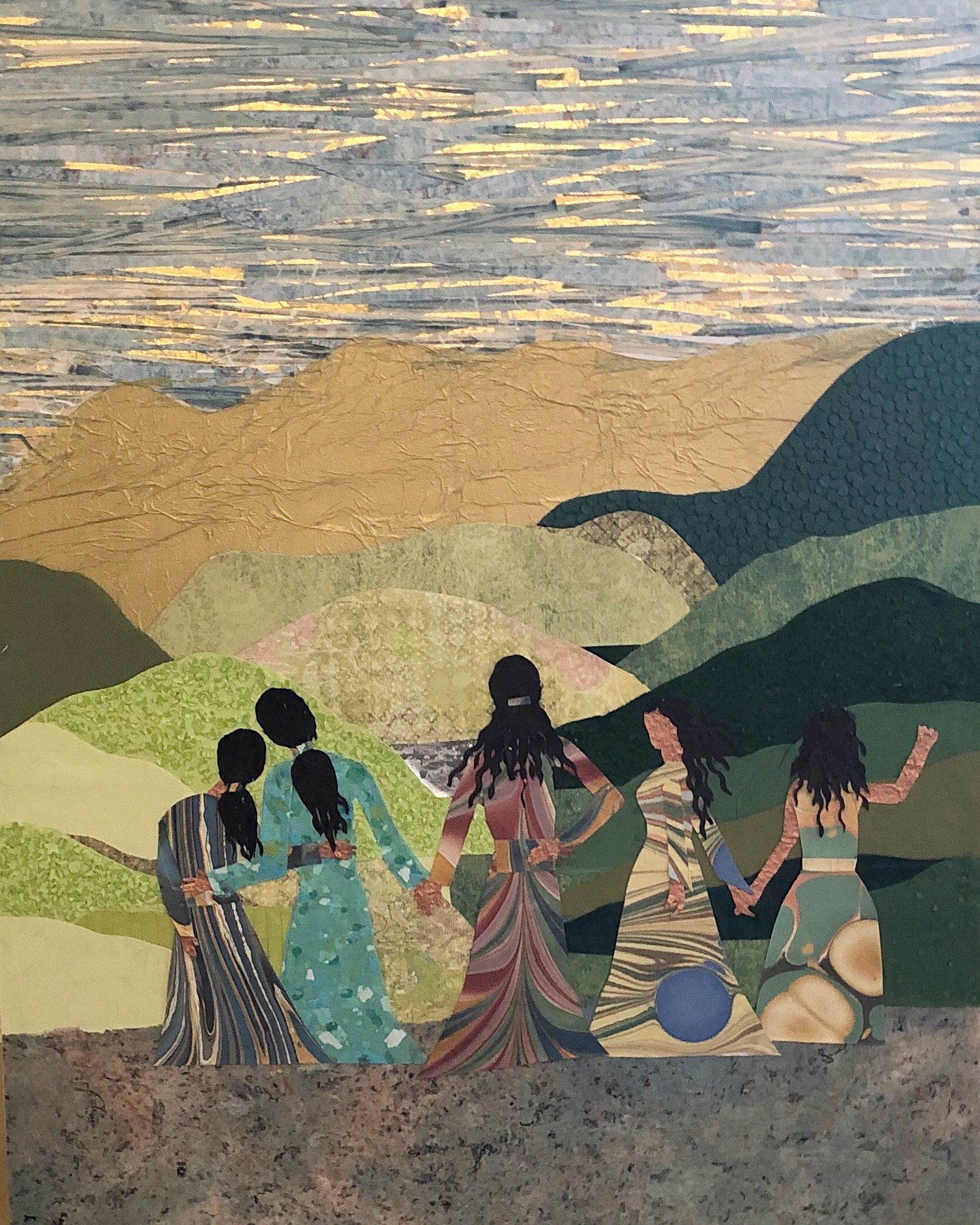
Anyway, I will get to the point. Since that Old Testament class in 1989, the daughters of Zelophehad have stuck with me. A few years ago I was working on an art series, “Unknown and Unnamed: Women of the Bible” and made this picture, “The Five Sisters Who Inherited Their Father’s Land.” It’s been a fan-favorite of my ten fans, and I have promised my own daughter I will not sell it.
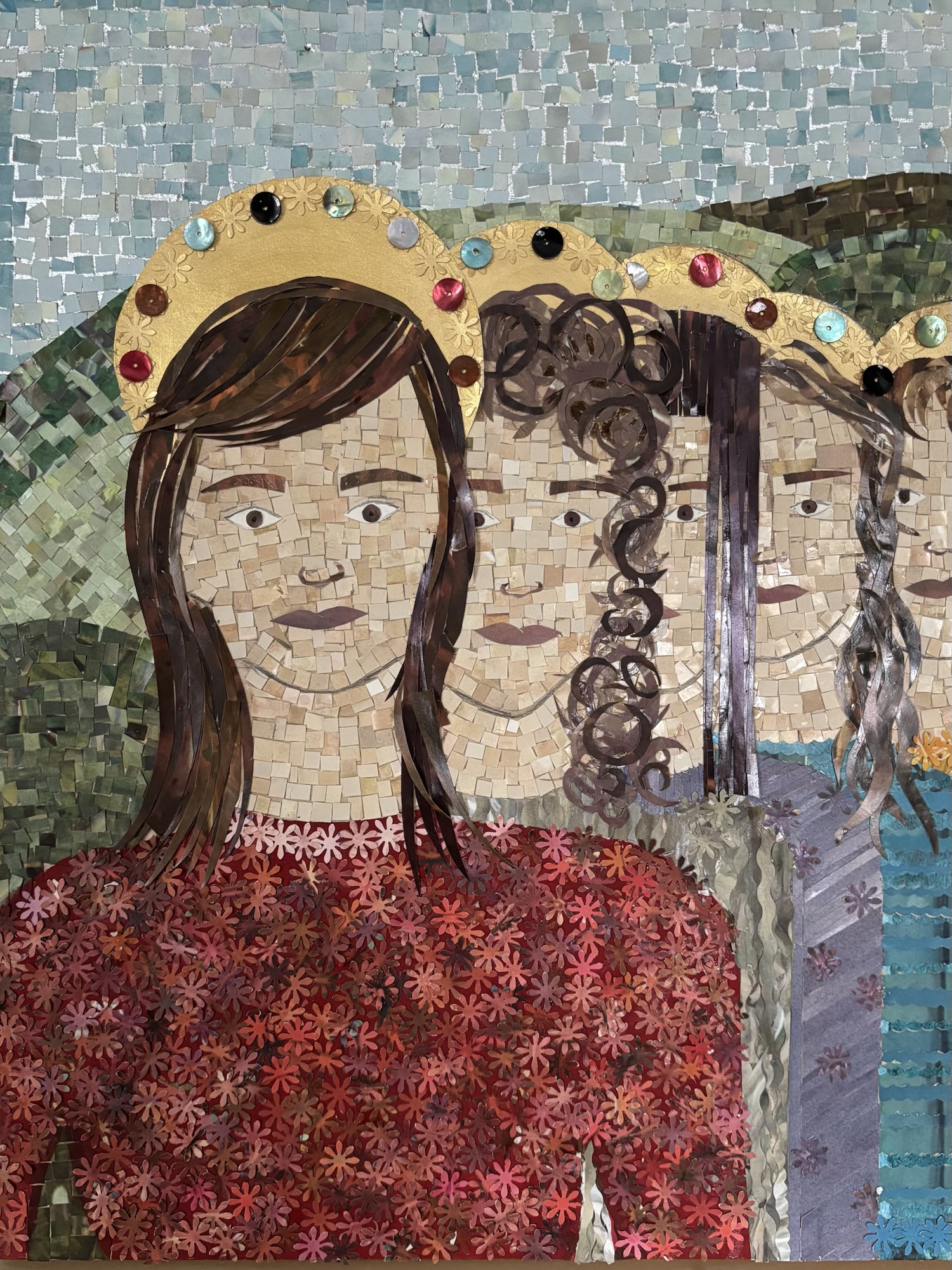
More recently I’ve been motivated to create some new Matron Saints, and the first of this new batch is “Malah, Noah, Hoglah, Milcah, and Tirzah (the daughters of Zelophehad), Matron Saints of Those Who Challenge the Patriarchy.”
Why has this story stuck with me? In part because I get so very frustrated and enraged by the power games of the patriarchy which still exists today. I am cautious about criticizing cultures that are not my own, so I’ll stick with the U.S. I see patriarchal power plays in the culture, in politics, and I see them far too often in the church, even in my own beloved denomination of the Presbyterian Church (U.S.A.)
So if there’s a chance that women might receive something previously withheld from them, or better, receive it without condition, I want to celebrate that. I want to celebrate women being acknowledged as being gifted, compassionate, strong, emotionally intelligent, intellectual, wise, brave, capable of making decisions about their own bodies, and willing to make good trouble. I want to hear the stories of women who have been denied, of women who’ve given up because that wall of patriarchy is twenty feet thick and make of diamonds and steel. I want to know men who are willing to step away, step down, so that a woman might have an opportunity otherwise denied them.
I want the descendants of Malah, Noah, Hoglah, Milcah, and Tirzah to be emboldened to speak up not only for themselves but for other women as well. I want us to make as happy an ending as possible for the story of women. I echo what Marie Shear once said: Feminism is the radical notion that women are people. May it be so.
My thanks to Drs. Robert Coote and Marvin Chaney, my Old Testament professors at San Francisco Theological Seminary, to Dr. Sakenfeld and Dr. Gafney for their rich and inspiring work, and to all the women out there who keep on going.
 Hold Fast to What Is Good
Every time I get a notification that you’ve posted, I light up because I know you’re going to speak life, and this post is no exception. I’ve been trying to carve out space and intention in my life for true koinonia—the real, earthy, smelly, busy, messy dance of community. The thought that these five sisters may have washed clothes, baked bread around the fire, cared for a dying father, and all of it together, just makes me feel in step with these women throughout history whose faith wasn’t always exciting or shiny. Thank you.