The other night my husband and I went to an art show opening at the church I used to serve and left in September. It was quite fun, with beautiful art and old friends. Several people made it a point to say to me, “You are missed” which was lovely, and which got me to thinking.
Of late I’ve also noticed several social media posts which say something along the lines of “remember you are loved.” I wholeheartedly agree with that sentiment. I think it can be the difference between life and death for some people. I think it can melt the heart of grinches and open the eyes of Scrooges. And yet….
And yet I’m curious about the choice to use the passive voice. I enjoy writing and I hope to be a decent writer, and something my high school English teachers and preaching professors drummed into me floats up to the top of my brain and into my fingers on the keyboard: avoid using the passive voice. It’s less powerful. It’s murkier. And more than that, I think using the passive voice lets us off the hook.
Granted, to say “I love you” or “I miss you” is an act of vulnerability. It risks our not being loved back, or not being missed in return. “You are loved” or “you are missed” becomes this general statement, but I wonder who loves me and who misses me. Do you, the say-er or writer of these words? Or are you speaking on behalf of someone else? Or are you speaking for that anonymous ‘they’ that pervades the social world?
I don’t know, and I certainly do not mean to discount the kindness and grace of saying to another “you are loved”, “you are missed.” But maybe we can take an extra step, because I know for a fact that there are people out there in the world who, if told they are loved, would wonder who exactly loves them. It might mean so much more to have a real human being say to them, “I love you. I value you. I see you. I miss you.”
In these days of meanness and cruelty, of greed and power grabs, maybe one of the great acts of resistance we can do is to say clearly and actively to people that we love them. To do that is an act of kindness, and act of truth (hopefully!), and an act of resistance against the powers that say that some people are worthless, wrong, or forgettable.
I will not tell you I love you, the person reading this, because I do not know all of you. But I do appreciate your taking the time to read this Sunday morning’s musings. Be strong, and be courageous, and be well.
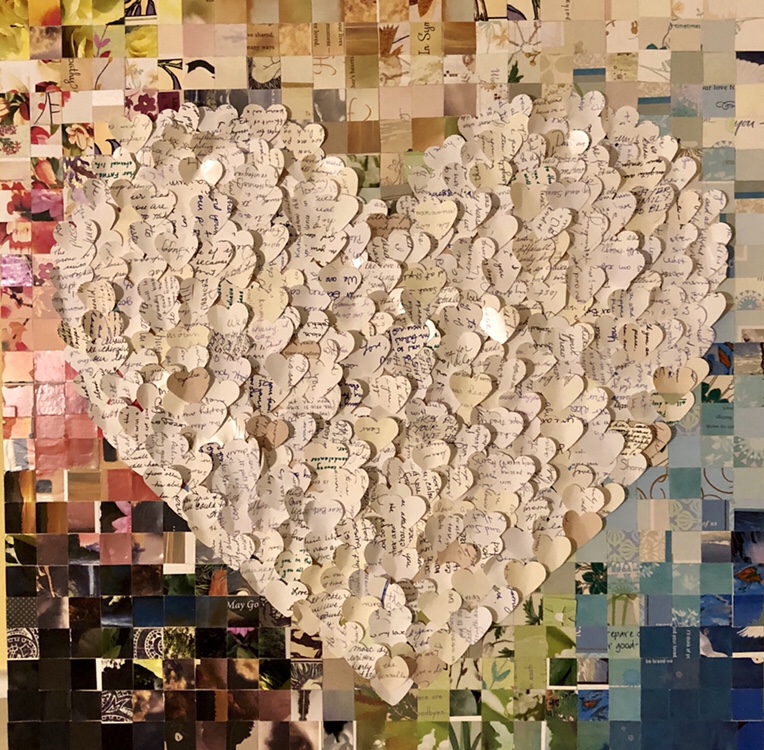
(One of three paper collages I made out of the sympathy cards I received after my father died. The love expressed in them continues to carry me through my grief. Today would be my dad’s 94th birthday; he told me he loved me, which is the world.)


 Hold Fast to What Is Good