Trees and other things

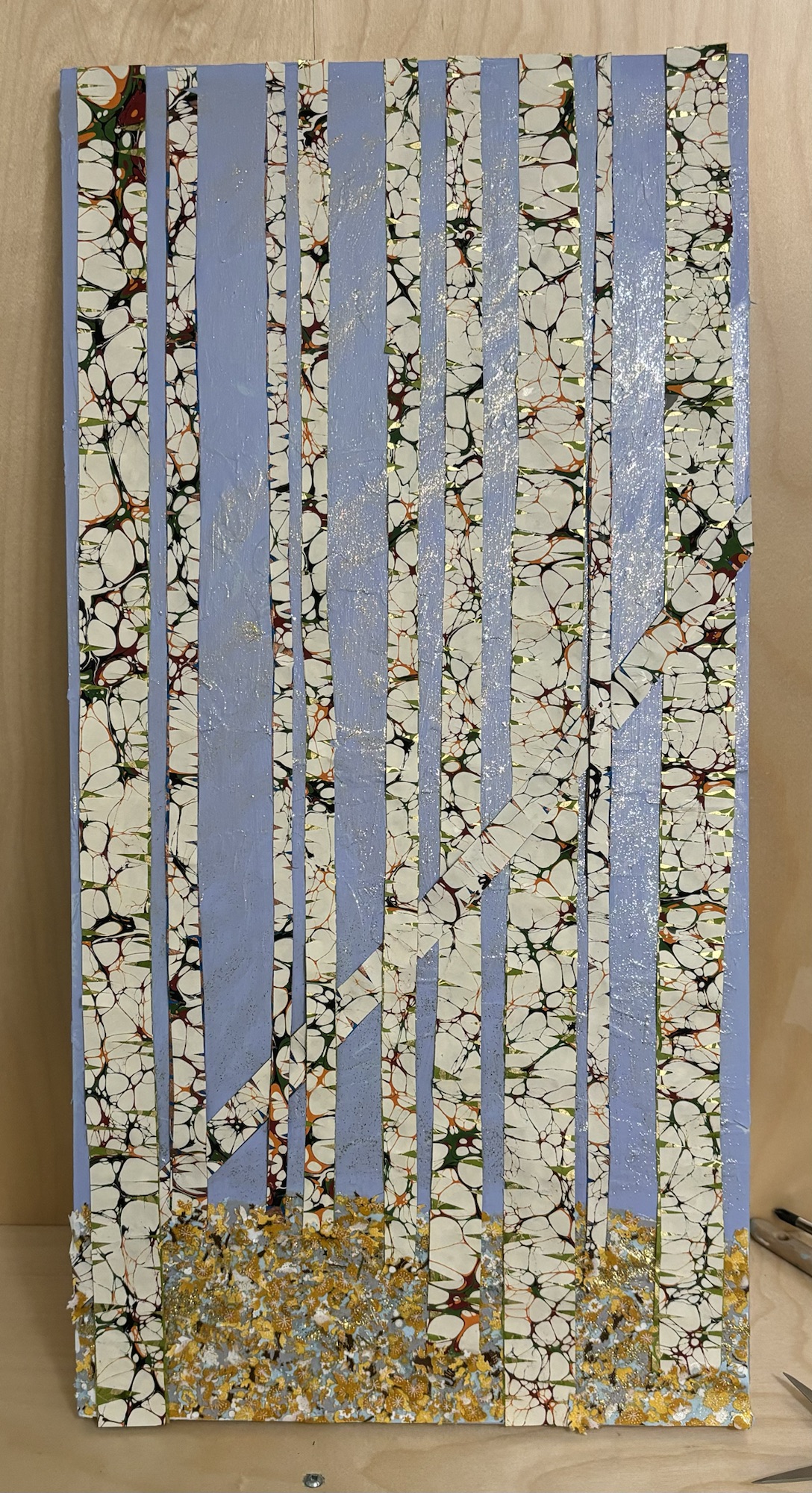
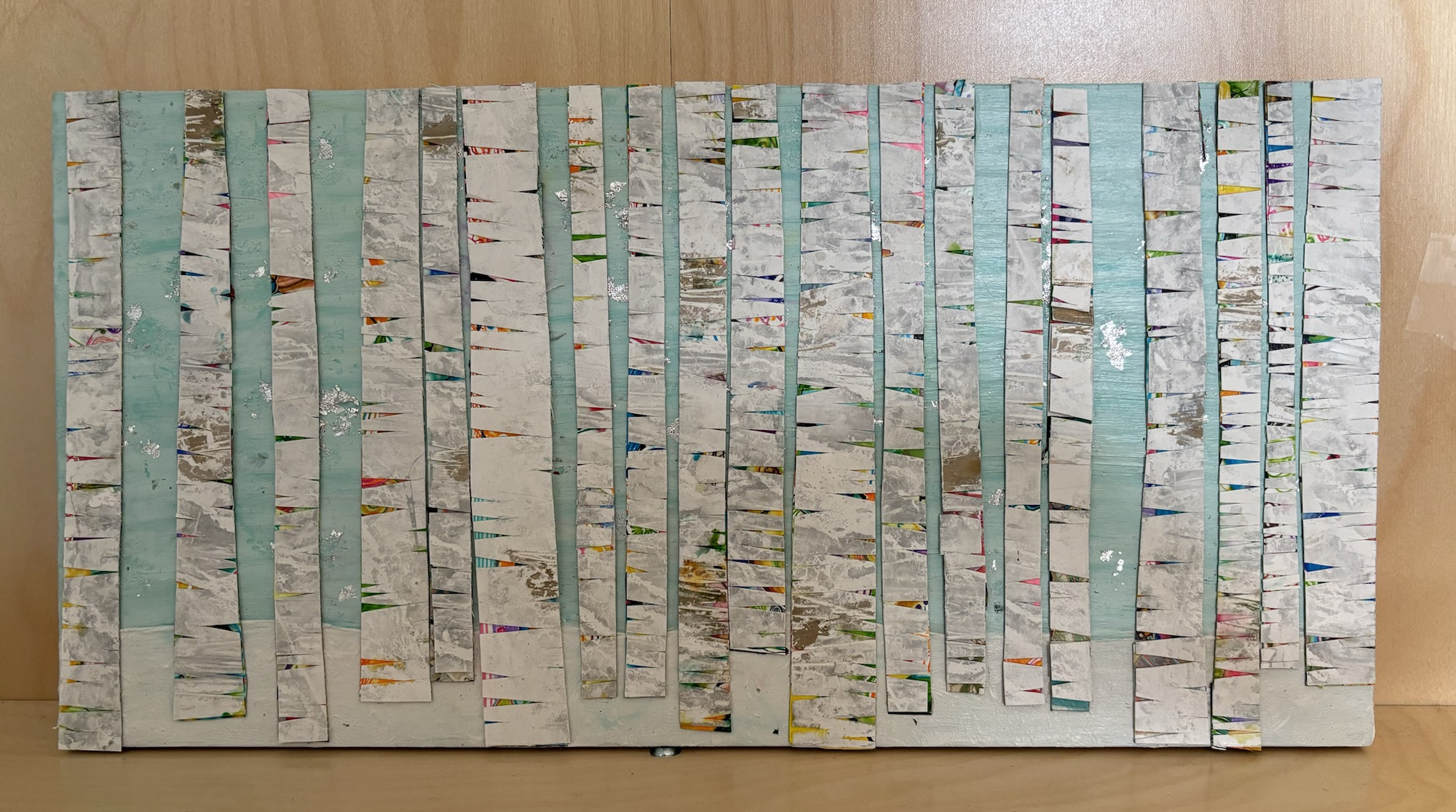
I’ve been on a tree kick lately, art-wise. I think they’re birches, but they may be aspens. They’re not exactly accurate.

I was inspired to make my own trees (paper collage) after seeing the beautiful liturgical banners my friend Nanette created of birches – or aspen – after our clergy group met at Rocky Mountain National Park, where the dining room is decorated with images of aspen (probably not birches.)
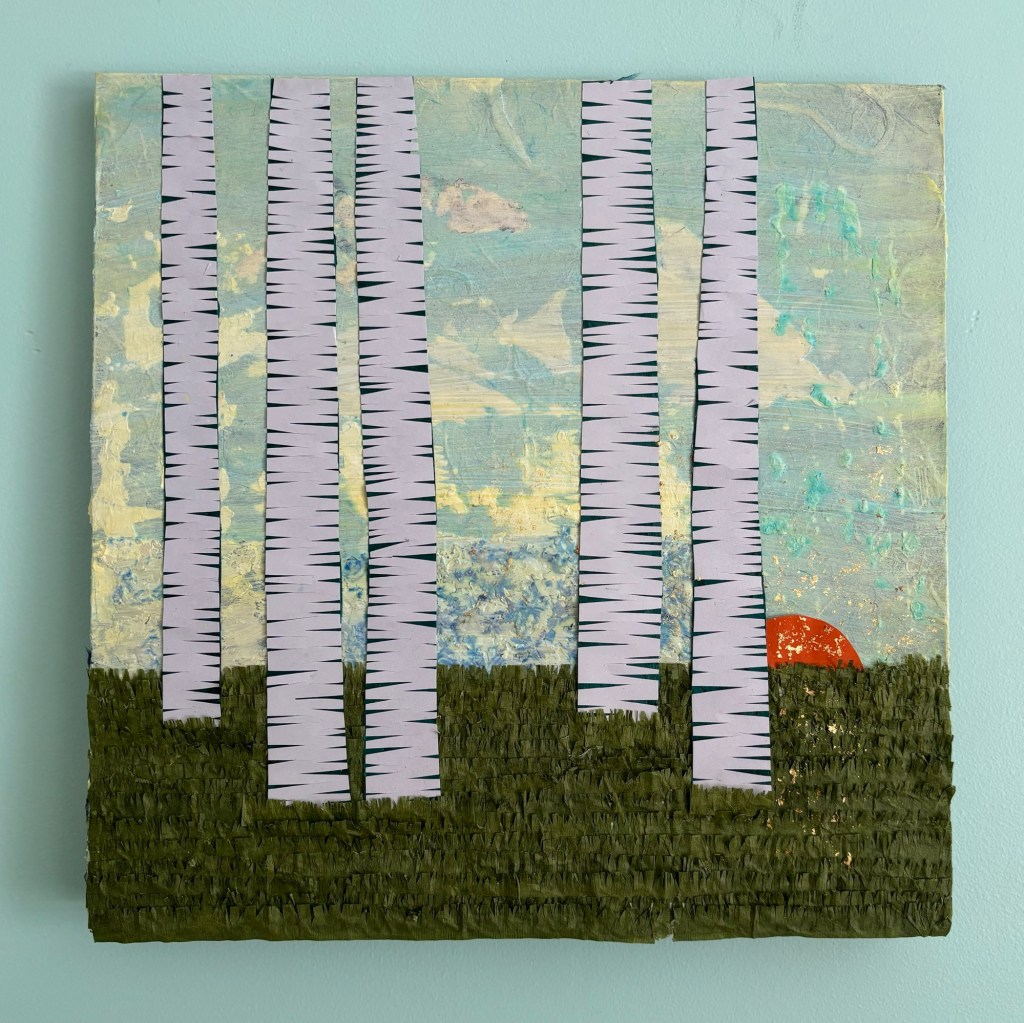
To be honest, usually my art reflects something that’s going on inside, so as I’m currently working on my fourth tree picture, I’ve wondered why trees are speaking to me right now, beyond the inspiration from my friend.
A few years ago I had the pleasure of reading The Hidden Life of Trees: What They Feel, How They Communicate by Peter Wohlleben. He opened my eyes to a world I had never known and I was struck by the way trees not only live in community, but thrive in community. As Tim Flannery writes in the foreward, “…the most astonishing thing about trees is how social they are. The trees in a forest care for each other, sometimes even going so far as to nourish the stump of a felled tree for centuries after it was cut down by feeding it sugars and other nutrients, and so keeping it alive. Only some stumps are thus nourished. Perhaps they are the parents of the trees that make up the forest of today…. The reason trees share food and communicate is that they need each other. It takes a forest to create a microclimate suitable for tree growth and sustenance. So it’s not surprising that isolated trees have far shorter lives than those living connected together in forests.”

Then I understood my current fascination with trees. Community is not only fun, and wanted, it is utterly essential for our thriving. I write this three days after the presidential election, at a time when my communities, my circles, are feeling as though they have been clear cut. Devastation. Death. Disregard. All in the name of profit or greed or power. A tree cares about none of those things. I would say a tree is amoral, except that we assign moral value to community and trees are communal beings.

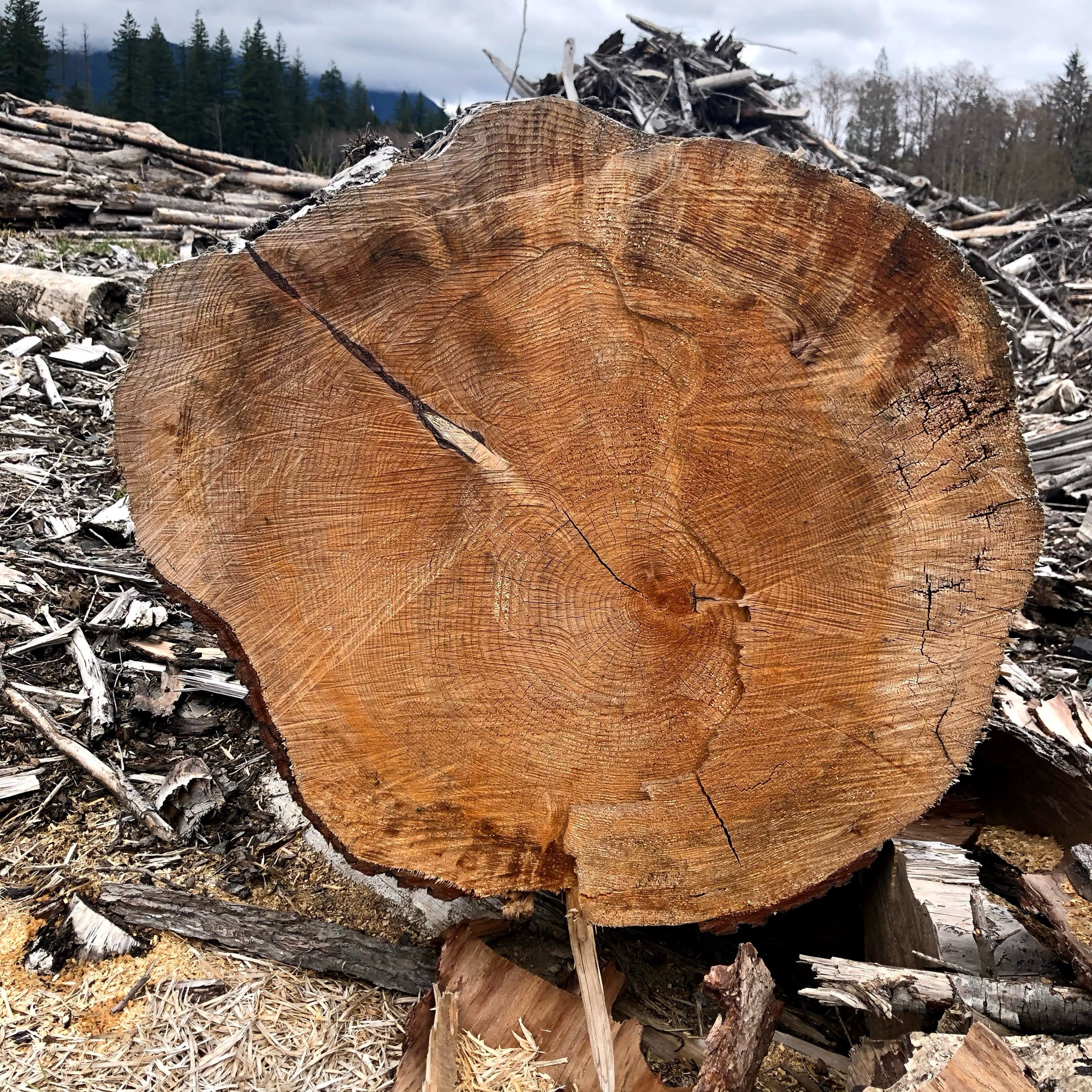
The other thing that struck me about trees is that they have muscle memory of a sorts, wood memory. We see it in the rings they make after they have died or we have chopped them down. We can tell what sort of year it was by the width of the ring – a year of growth, maybe, or a year of drought or some other calamity.
img_1315_original-1

If you cut us in half, right above the belly-button, you won’t see rings. But we carry muscle memory, and gray hairs, and wrinkles in our brow that won’t go away. We carry bags under our eyes, and extra flesh around our middle after indulging in necessary comfort food and drink. We carry stressed-out hearts, and headaches that won’t go away, and are not all that surprised when our blood pressure, like our weight or our bad cholesterol, goes up and up.

Well, then, what are we to do. A sentence, not a question, because I’m not sure anyone is really in a place to answer that yet, and I have a sinking suspicion that any answer would be premature. So for now, I will be like a tree. I will give thanks for my many communities, and however I can, be a resource, a friend, a helpmeet to all those. I hope that my community grows larger, like a forest that is untamed.

If you can, in the next few days, go wander among the trees for a bit. Breathe deeply. Listen to them. Smell their mid-autumn scent. Kick up their leaves. Be inspired. Be like a tree, and take care of your forest.
img_2577-1

The architecture of trees and other things

It’s the time of year when the falling leaves expose the beauty of the bare branch. As much as I love the new leaves of spring, and the lush leaves of summer, and the reds and golds at the height of fall, I really do enjoy seeing the leafless trees.

The branches are beautiful – elegant like a ballet dancer’s hands, or bumpy and bent like the hands of an old man who’s lived with arthritis far longer than he ever wanted.

I appreciate seeing the structure of the trees, their architecture, understanding a little about how the trees grow and support the weight of leaves and nests.

The devastation of the fires in California have revealed a different kind of architecture; you might call it the architecture of deconstruction. Among the ashes we see a chimney, a bathtub, a puddle of chrome where a fender used to be.

When the flames ravage, all that is left is that which seems incongruous and unnecessary. The flames mock the chimney and the bathtub. A cozy fire at night is magnified into something apocalyptic. The water in such a tub would do nothing more or less than boil in the midst of flames.

I wonder, too, what we are seeing in the architecture of our nation. Midterm elections laid bare the structure of our democracy. But is it the architecture of support, of the values of liberty and justice for all, constructive values? Or have we seen the deconstruction of our values, voter suppression and apathy about the political process? Does the harsh rhetoric of campaign ads and rallies undo us, consume all that is good so that all that is left is incongruous and unnecessary – red, white, and blue bunting crumpled up on the ground?

Well. I think about these things.

I worry about our national identity. So sometimes I take heart in the example of the seasons. Yes, the leaves fall and the trees are laid bare, but spring will come as sure as the sun will set tonight and rise again tomorrow. But sometimes my deep sorrow for all those affected by the fires reflects my sorrow for these United States. So much of what is beautiful and good – care for the stranger and the vulnerable, a willingness to tell the truth at the cost of losing power – has been burned away and what is left is useless.

Maybe when it comes to things political, we are not passive observers. We cannot change the course of the seasons. Very few of us can stop the devastation of these fires. But maybe we can do something to change the American conversation.

I hope we can.

To the planter of trees

tree_lined_street_lgTwo of my frequent routes include an arcade of trees.  One is at an intersection I drive by every day, the other on 99E heading south towards Milwaukie.  Neither is very long – one just a block, the other maybe a quarter-mile.  But even in winter, when the branches are bare, the trees form this graceful archway that we drive through.

As I went though one the other day, I started wondering about the person or persons who planted those trees.  Were they young?  Did they see the fruits of their labor?  Did they measure carefully the space between the trees, imagining how far apart they needed to be so their branches could grow without touching?  Did they plant them hoping that in eighty years, one hundred years, the trees would still be alive, healthy, providing a bower for motorists?

It seems to me that planting trees is a pretty selfless act.  You may get to watch a sapling get strong, but you will likely not live to see it in its prime.  And planting trees is an act of hope, too – hope that someone else will take up the care of the tree, that in the future when the planter is gone someone will look at the tree and offer thanks.

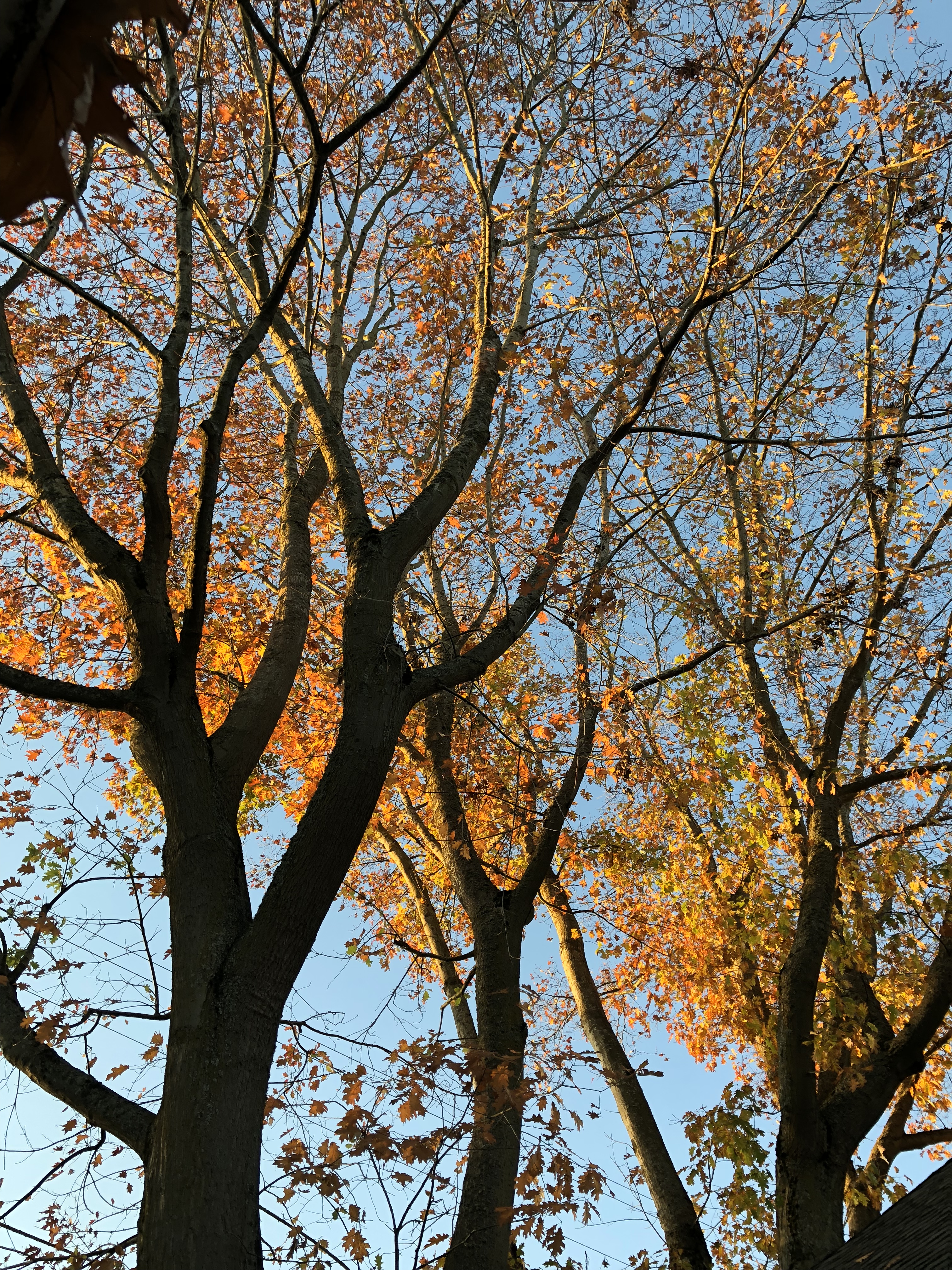
We have two enormous oak trees on the west side of our house.  I imagine they were planted when the house was built in 1925.  They are now two and a half times as tall as our house, and they are beautiful, whether with bared branches or in the lush fullness of summer.  They are beautiful and more often than not I do not appreciate them.  February is the one time of the year when they aren’t dropping something.  Come spring, it will be helicopter seed pods, then green acorns in the summer.  In the fall the brown acorns drop, aided by feuding squirrels.  Once the acorns are done, the leaves turn brown and drift down; we are very generous and share our leaves with the neighborhood.  In the chill of winter things are still unless there’s a wind storm, in which case we have branches adorning our yard and roof.

laugh inI wish I appreciated our two oaks more than I do.  They provide habitat for squirrels, and I think the crows are doing their own version of Laugh In in them.  They shade half the house, a relief in the relentless sun of summer.  But they are messy and trimming them is not cheap.  Their root system means that we have a basement in only half the house.

Would I cut them down if I could? That’s the question, isn’t it.  It would make our lives and landscaping easier.  We wouldn’t have to wear our bike helmets when we dine al fresco.

Would I cut them down if I could? No.  No, I wouldn’t.  They are things of beauty, among the most grand in the neighborhood.  The crows make me laugh.  The squirrels drive the dog nuts and give him something to do when we’re gone for the day.  The shade is lovely.

And there’s something plain wrong about cutting down a magnificent healthy tree – the inconvenience to us is far outweighed by the patience it took for that tree to go, the hearty conversations with neighbors in the fall when we’re all raking the leaves, the sheer beauty of something that towers over our man-made home.

So, to the planter of trees, our oaks, the trees that line the avenues: thank you.  Thank you for your foresight.  Thank you for your dream.  Thank you for your part in creating something beautiful that maybe you never saw.  Thank you for the trees.

iphone pix 7 12 228