On killing cockroaches, and other things my dad did for me

It’s been seven and a half years since my dad died, and while I don’t really think about him every day, I do think of him often, and occasionally dream something that he’s a part of, and laugh about something I know he would find funny.

So Father’s Day is different now. Mostly I encourage our daughter to remember the day is coming; I also thank my husband and my brothers for being such great dads. If I’m in a mood, I will say to my husband, “Well, I don’t have to do anything for Father’s Day because my dad is dead.” Like I said – when I’m in a mood.

But today, Father’s Day, I’ve been thinking about my dad and a few memories stand out.

The first is when he taught me to ride a bike. It is a visceral memory, full of emotion, which must mean something since it happened 55+ years ago. We went to the parking lot of my elementary school in Morristown, New Jersey, my hot-pink, banana-seat bike in the back of the station wagon, just me and Dad. He did not believe in training wheels (later, when I was an adult, he would say that training wheels were for candy-asses.) He ran along side me as I wobbled along, holding the handlebars, not letting ago until I found my balance, and then he let go, still running beside me. I don’t know why this has stayed with me all these years. Maybe it has something to do with fear and courage and encouragement and protection and love all wrapped around the asphalt pavement of Hillcrest Elementary School.

The second memory is from my teen years, which were not the smoothest in terms of our relationship. We’ll leave that there but perhaps you can fill in your own blanks about rough patches with a parent. This story is not about that.

When I was eight we moved from New Jersey to Houston – the flatland of humidity and flying cockroaches. There are good things about Houston, but this story is not about that. Anyway, we had not had flying cockroaches in New Jersey and let’s just say they terrified me. Spiders? Bring ’em on! Flying cockroaches? More correctly, palmetto bugs – I would not enter a room where I could see one. It was my habit, when entering a room where there was a cockroach, to get my dad to come kill it, which he did. One night, after he had gone to bed, I went to the bathroom to wash up for the night. There, on the wall behind the toilet, was a big ol’ shiny cockroach. Dad had gone to bed. He hated being woken up. I knew I would not be able to brush my teeth, much less sleep in my connecting room, knowing that roach was just waiting to crawl all over me. So I went in to my parents’ bedroom, woke up my dad, told him the problem. He got up and told me to get a magazine or newspaper, which I did. He strode into the bathroom, whacked the cockroach which fell straight into the toilet, flushed it away, and wished me a goodnight.

He loved to tell me that story. I’m not sure if it had to do with my trusting him to take care of things or with his amazing aim, but it was one of his favorites.

The last memory is from my young adulthood. My parents had moved back to New Jersey and I was living and working in New York City. I had landed what I thought was my dream job – assistant to the artistic director of an arts organization, the perfect jumping-off spot for someone who wanted to go into arts administration, which I did at the time. After five months, my dream job had become a nightmare. I would wake up at 2am on Saturday nights worrying about it, wondering what I had forgotten to do, wondering what my boss would yell at me about on Monday.

I had gone to my folks’ house for the weekend and we talked about everything. Dad finally said to me, with all the wisdom of someone who had had his own career ups and downs, “No job is worth this, honey.” Not long after that, I quit as my boss was firing me, and while my future became less certain, my heart was much happier.

Seven and a half years ago, as Dad was nearing the end of his life, the time came for me to say goodbye to him. That remains the most excruciating thing I have ever done, and if you’ve had to do that, you understand. I told him I loved him, and I thanked him – for teaching me how to ride a bike, for killing cockroaches, for letting me know it was okay to walk away from something; for encouraging me never to carry a credit card balance and to set aside ten percent of every paycheck for savings (that didn’t happen); for being pleased as punch when I told him I was pregnant, for welcoming my husband and then our daughter into the family; for pointing out, every time we sat on the deck of the cabin, how beautiful the cottonwoods were shimmering in the breeze.

Now when I sit on the deck of the cabin, and look at the cottonwoods shimmering in the breeze, I laugh a little, and look up at the sky, and say thank you once again.
Easter Thoughts, A Little Early

This year, I will be leading the Vespers service at a local retirement community on Easter Sunday, and as is my wont, I started looking through old Easter sermons that could be brushed up a little for this upcoming occasion. As I went through them, I kept tearing up. Why? Happily, not because they were terrible, but because they offered a word of hope, and I hadn’t realized how much I needed to hear about hope, even from myself a few years back. It was hard to read the ones I offered during the pandemic, from my home or from an empty sanctuary, remembering the uncertainty of that time and the losses upon losses.

And though Easter is still shy of two weeks away, I offer the conclusion to one of them, if you’re a preacher in need of some hope or joy. I don’t claim that any of my words would even win a preaching prize (which is really a silly thing, after all) but sometimes you need a little bump to get you going.

In the meantime, Lent is still with us, and given all that’s happening, it may feel as though Lent is still with us after April 21. Even so, God always gets the last word, and Love always wins. Here you go.

Joy is the jitterbug meeting the waltz, and Rembrandt and Dr. Seuss comparing notes, and hope disguised as a gardener. And you? And I? What is our joy?

Joy is when the rains cease
Joy is when the baby squeals
Joy is the march
Joy is the old friend who shows up
Joy is the peace accord
Joy is the casserole
Joy is the grave cloths neatly folded away
Joy is the mountain decked in so much snow
Joy is the full table with everyone there
Joy is the story told again and again
Joy is the joke with life as the punchline
Joy is the fern unfurling
Joy is the empty tomb
Joy is the daphne and lilac and lavender
Joy is the gift that will not be taken back
Joy is life, and more life, and life after that.

My husband and I on Easter Sunday, 2021, getting ready to celebrate drive-through communion in the church parking lot.

Love and Dust

Our daughter was born on Fat Tuesday, which meant I spent Ash Wednesday 2006 in a hospital room, recovering from a C-section and trying to figure out how to breastfeed. After experiencing the joy and fear of giving birth, I really did not need to remember that I was dust and to dust I would return. At the time, I felt more like I was made of blood and colostrum and placenta, which are very much things of birth.

That was the last time I was not marked with ashes on Ash Wednesday. This year I repeat that, for reasons that seem a bit inconsequential and maybe a little lazy. Last September I left the congregation I happily served for thirteen years, and I have not yet found a new worship home. To be honest, I haven’t looked for one yet. After serving congregations for thirty-one years, I need a break. I need to let go of all my expectations of how worship should happen, what fills me in worship. I need to empty myself of all of that, and then start fresh.

I imagine for many folks there is no need to be reminded that they are dust and to dust they will return. The world tells them that all the time. The White House tells them that in cruel tweets. Rude customers, impatient drivers, racists, misogynists – there is a message of death and hate that pervades so much of every day life. Why add ashes as another reminder?

I dare not speak for anyone , but I will say that there was something honorable and profound and horrific about making the sign of the cross on people’s foreheads. Honorable because they trusted me, their pastor, to say these true words with love. Profound, because death is so wrapped up in the mysteries of creation and incarnation and resurrection that mere words cannot begin to convey all that is meant by the ashy cross. And horrific, because the woman who has lost all her hair from her chemo treatments doesn’t need to be reminded that she will die, because the precious child, conceived by IVF after years of miscarriages, needs to live a full, long life, and not think about death for a long, long time.

Receiving the ashes is another thing. Sometimes a fellow pastor would mark me, and sometimes my fellow pastor/husband made the sign of the cross on my forehead. Sometimes a parishioner would make the sign. It didn’t matter who did it, though I always knew the person. Someone who loved me, or who worked to love me in that Christ-way, was telling me the truth that I would die some day, that all of us will die some day. On Ash Wednesday, that’s as far as we get in the story.

And so Lent has begun, and for me, without ashes. My daughter sent me a picture today of her and her friend who made it a point to go to chapel and get marked today. I’m a bit filled by that. A stranger told her that she is dust. While I clung to her in that hospital bed at the beginning of Lent nineteen years ago, now I let her go into the world, full of dust and life, to make her own way. For a long, long time, I hope.

So given the state of the world, perhaps this year I would offer these words:
“Remember you are made of love, and to Love you will return.”

The Passive Voice

The other night my husband and I went to an art show opening at the church I used to serve and left in September. It was quite fun, with beautiful art and old friends. Several people made it a point to say to me, “You are missed” which was lovely, and which got me to thinking.

Of late I’ve also noticed several social media posts which say something along the lines of “remember you are loved.” I wholeheartedly agree with that sentiment. I think it can be the difference between life and death for some people. I think it can melt the heart of grinches and open the eyes of Scrooges. And yet….

And yet I’m curious about the choice to use the passive voice. I enjoy writing and I hope to be a decent writer, and something my high school English teachers and preaching professors drummed into me floats up to the top of my brain and into my fingers on the keyboard: avoid using the passive voice. It’s less powerful. It’s murkier. And more than that, I think using the passive voice lets us off the hook.

Granted, to say “I love you” or “I miss you” is an act of vulnerability. It risks our not being loved back, or not being missed in return. “You are loved” or “you are missed” becomes this general statement, but I wonder who loves me and who misses me. Do you, the say-er or writer of these words? Or are you speaking on behalf of someone else? Or are you speaking for that anonymous ‘they’ that pervades the social world?

I don’t know, and I certainly do not mean to discount the kindness and grace of saying to another “you are loved”, “you are missed.” But maybe we can take an extra step, because I know for a fact that there are people out there in the world who, if told they are loved, would wonder who exactly loves them. It might mean so much more to have a real human being say to them, “I love you. I value you. I see you. I miss you.”

In these days of meanness and cruelty, of greed and power grabs, maybe one of the great acts of resistance we can do is to say clearly and actively to people that we love them. To do that is an act of kindness, and act of truth (hopefully!), and an act of resistance against the powers that say that some people are worthless, wrong, or forgettable.

I will not tell you I love you, the person reading this, because I do not know all of you. But I do appreciate your taking the time to read this Sunday morning’s musings. Be strong, and be courageous, and be well.

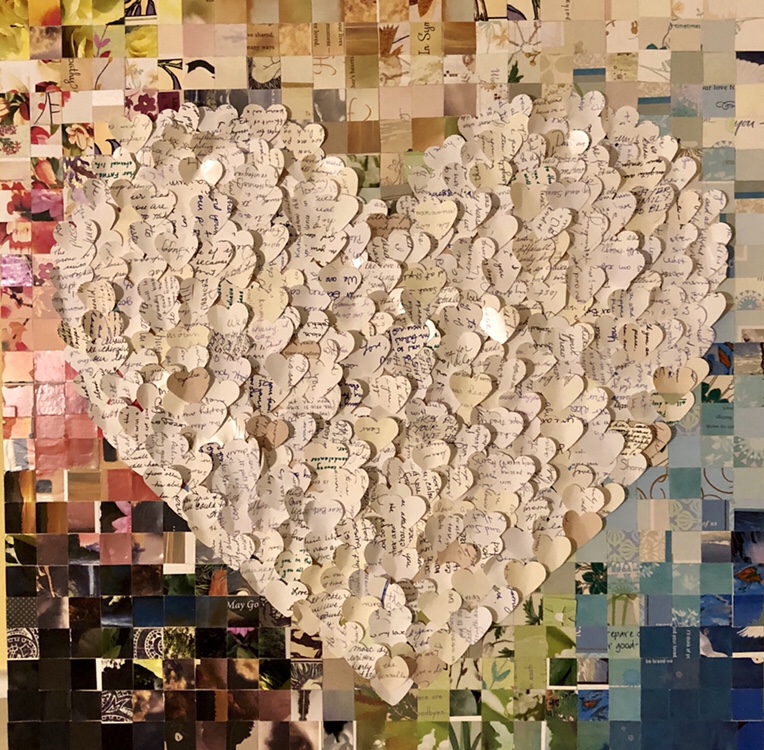
(One of three paper collages I made out of the sympathy cards I received after my father died. The love expressed in them continues to carry me through my grief. Today would be my dad’s 94th birthday; he told me he loved me, which is the world.)

Delighting In

A group of seven amazing women have joined me this Lent for a discussion of the book This Here Flesh by Cole Arthur Riley. If you haven’t yet read it, stop reading this blog, order it from a bookstore or library, and begin to savor it. The book is like chocolate mousse – rich and beautiful and something to be savored slowly, like mousse or a really good Cabernet.

Anyway, last night as we discussed the book our conversation wandered off a bit, as happens. We were talking about how someone so young – Arthur Riley is in her early thirties – can write with such depth of wisdom. Maybe she is an old soul. But we also talked about how the love her father and grandmother showed her affected her. And then we wandered off in our conversation.

I am the parent of a teenager. I am blessed – as is my daughter – to have known some of her friends since they were all kindergartners. I know and love their parents. I have enjoyed watching them grow up and navigate all sorts of things we navigate – the onset of periods, the waning and waxing of friendships, latent talents emerging or big talents fading away – and things I never had to navigate when I was a teenager – mobile phones, social media, climate change.

As I watch these friends and my own child thrive and struggle, I want to tell them that everything will be okay, even though I know that isn’t true. Sometimes things aren’t okay and never will be. Sometimes the person is killed by the cancer. Sometimes the breaks in the relationship are unmendable. Sometimes the wildfires can’t be stopped. So resiliency matters, being able to weather the storm, being able to get back on one’s feet, or at least get out of bed.

One of the women in the book discussion group is a pediatrician and knows better than I the things that kids face, and the need to develop resiliency. A key to that, in my opinion though I think she would agree, is knowing that someone delights in you.

Who delights you? What awkward tween delights you? What child waving hi brightens your day? Who makes you smile when you think of them? And have you told them that, in so many words? And when you tell them that, do you make sure they know that your delight in them is unconditional?

Here’s the thing about resiliency and delight: they go hand-in-hand. Resiliency isn’t about pulling oneself up by the bootstraps. Resiliency requires community, connection, knowing that you aren’t alone. Resiliency requires that you have cheerleaders, coaches, people who remind you of how delightful you are, even when you are in the midst of suffering or shame or grief.

Because we will all know suffering. We will all know shame. We will all know grief. That we all will know those things (if we haven’t already) is a bond we share. And maybe when you can’t get out of bed and all the colors look faded and nothing tastes good, you don’t want to hear that Auntie Jane adores you. But maybe Auntie Jane will show up with a bowl of Campbell’s chicken noodle soup, and bring it to you in bed, and listen to you, because she delights in you.

So please, please: if there is someone you delight in, tell them or show them, especially if they are going through a hard time. Especially if they are a child or teenager, because they have been through it with Covid in ways we’ll never understand. Especially if they are a human being.

You, by the way, are delightful. Thank you for reading this.

This mortal coil

I’ve been thinking about death this morning; doesn’t everyone this time of year?

It was three years ago today that my dad died. I was not with him, but my mom and sister, faithful women that they are, were there. I was at the pediatrician’s office with my daughter. While we were in the waiting room, my sister texted that the hospice nurse said it wouldn’t be long. After that, I turned off my phone until we got home. And there was the message: Dad died.

Three years out the pain is different – less acute, more wistful. I think about my dad, and so many others, who were so full of life and now… aren’t. I don’t mean that facetiously or sarcastically. It’s just that we live and then we all die and that is terrible and normal.

This time of year I think a lot about incarnation, too; doesn’t everyone?

I have those moments of wondering why in the world God would choose to become incarnate, to take on this mortal coil only to have to shuffle it off in a mere thirty-three years. I wonder why God would choose to take on frail flesh, with skin that gets cut, and bones that break, and heads that ache, and hearts that ache. Honestly, it makes no sense, but then again, very little about faith does make sense. That’s what makes it so interesting and fun.

I try to make friends with death, given its inevitability and omnipresence, but it’s hard. Maybe my real struggle is with incarnation. Why this form of creation? Why create stunning elm trees so vulnerable to fungus? Why polar bears that die out as earth warms? Why the engineering and biological marvel of the human body that only lasts four score or so years?

Honestly, I don’t know. It does seem to be a significant design flaw.

Or is it?

One of the things I loved about the ending of The Good Place (semi-spoiler alert here) is the realization that things are meaningful because they don’t last forever. Our finity defines us, and that is not a bad thing but may in fact be the best thing.

I don’t want Christmas to last forever. I don’t want this pandemic to, either. There are people who I hope to have around for a long time, and people who I wish had lived a few more years. But that isn’t up to me. (It’s not up to you, either….)

So then, what shall we say? Eat, drink and be merry, for tomorrow we perish? All we have is the present? Love them now, don’t wait till they’re gone away? Life is short, and we have but little time to gladden the hearts of those who sojourn with us? (Henri-Frederic Amiel)

All of the above.

Well, that’s probably enough melancholy musing for this day. Be well. Hug yourself. Call someone who needs to know that you love them. And indeed, be swift to love, and make haste to be kind. (Amiel again.)

Love to the loveless shown that they might lovely be.
Oh, who am I, that for my sake
My love should take frail flesh and die.

Embodied

What will we embody?  Hate?  Hope?  Fear?  Love?

I.
For the past several years, our Saturdays mornings or afternoons were spent in north Portland, squeezing in a parking place among minivans, SUV’s, and the occasional Prius, unfolding the chairs and cheering on the girls’ soccer team.  Delta Park was filled with soccer parents and students and coaches, sometimes playing in the rain and sometimes playing in the glorious fall.

This past Saturday morning there were no soccer games; COVID-19 took care of that.  But the park was cordoned off with concrete barriers and police cars, waiting the arrival of the hate group, the Proud Boys.  To the best of my knowledge, they assembled and then left.  But I wonder what they embody.  I wonder if they sense they carry hate in their bodies.  I wonder if they sense they carry fear, too.

II.
On my walk this morning I was listening to Brene Brown’s podcast conversation with Sonya Renee Taylor, author of the book The Body Is Not an Apology.  (Listen to the podcast here.) I discovered the book last year while preparing for a retreat I was leading on women and their bodies and fell head over heels with Taylor’s message of radical self-love.  There’s too much in it to capture in a few sentences here, so go find yourself a copy and get ready to work and to love.

Anyway, Brene Brown discovered Sonya Renee Taylor when one of Taylor’s quotes exploded in social media and was misattributed to Brown.  Like so many others, I found the quote a sort of call to arms – calling our arms and all of our bodies to take seriously this time we are in, and to take seriously how we are being changed, body and soul, by this pandemic.

Here’s the quote: “We will not go back to normal. Normal never was. Our pre-corona existence was not normal other than we normalized greed, inequity, exhaustion, depletion, extraction, disconnection, confusion, rage, hoarding, hate and lack. We should not long to return, my friends. We are being given the opportunity to stitch a new garment. One that fits all of humanity and nature.” 

III.
Last week my friend Leslie died.  She was a quiet, warm, bright, compassionate, shy woman whose body grew cancer cells in her bladder.  I hate that she died; I hate that she died from cancer, and I hate that because of this damned virus I didn’t realize that the last time I saw her would be the last time I would ever see her.  She embodied an honest and lumpy faith, and a sensitivity and empathy borne from the things life throws at you.  I don’t know if she felt like her body betrayed her with those errant cells.  She embodied so many things that I cherish, and I feel that her body betrayed her.

IV.
In the early days of COVID-19, I too took up the call to bake away and, with hardly any effort at all, put on five pounds.  That was not good, especially when I learned that one of those mysterious “underlying factors” that make COVID so lethal is obesity.  So I’ve been working on the scale going the other way, and have lost thirty pounds.  I’m enjoying this rediscovery of my body and its shape.  Let’s be clear: I will never be a bikini model.  Scars from a C-section and a hip replacement ended that option.  In this time, I had a big a-ha, especially for someone who has probably lost over three hundred pounds in her life (not all at once – in my many attempts at weight loss.)

The a-ha: maybe walking every day and eating healthy things is pleasurable and not a drudge.  Seriously, you would think I’d’ve figured that out.  But no.  Reframing that has really improved my outlook and has been a good coping mechanism during pandemic and the surge in demand for racial justice and the political dumpster fire in which we find ourselves.

V.
What will we embody when this is all over, when there’s a vaccine, and an election, and (please, God) a peaceful transfer of power?  What are we embodying right now?  I know that I carry fear in my shoulders, and hate in my throat.  I also carry hope in my calves and love in my hands.

I think we have a choice about what we carry, and I’m not proud that I carry hate and fear, but to quote Michelle Obama quoting Mr. Trump, it is what it is.  To let go of those things, to choose not to carry them any more, would seem to be about letting go of control and power too.  I know I embody those things as well.

VI.
I’m one of those Christians who is irregular in her theological outlook.  I don’t read the Bible literally but I do believe in the bodily resurrection of Jesus which prefigures the resurrection of human beings and the redemption/resurrection of the whole of creation.  I believe that God created the physical world and called it good and meant it.  I believe we were created to embody joy and care and wonder.  I believe the world would be a better place if we did embody joy and care and wonder.

Meantime, let’s stitch that new garment Ms. Taylor wrote about.  A dress of the softest, drapiest fabric that enhances all that we embody.  Sweatpants unseen in the Zoom meeting that ready our legs to go walk the walk.  A garment worthy of royalty for the likes of you and me.  Embodied and adorned – that’s what we are.  That’s what we will be.

Love to the loveless shown

Well, our friend Aaron showed up in church this morning.  As is his custom, he made his way to the sacristy, exited into the choir loft, and came down the three stairs to the chancel where my husband/co-pastor Gregg met him and escorted him to the front pew.  He sat with Aaron for a minute, then came back to the chancel, but in his place, one of our deacons sat with him and got him a hymnal in case he wanted to join in on “My Song Is Love Unknown.”  As we sang those words “love to the loveless shown that they might lovely be” I watched Gregg and then Gail sit with Aaron, and make him feel welcomed and maybe even loved.

Sometimes I think that maybe Jesus is showing up with us as Aaron.  Every now and then Aaron appears.  Sometimes he’s sober, sometimes he’s not.  Sometimes he asks for a little help and sometimes he just needs to be with our people.  It always feels like a test: will this be the week Aaron does something that simply is not acceptable and we have to ask him to come back when he can observe the community norms?  Will this be the week that someone who doesn’t know Aaron’s story with us is mean or harsh to him?  Will this be the week when he removes his disguise and we realize that Jesus was testing us with the “Love Your Neighbor/Do This To One of the Least of These” exam?

Two weeks ago I preached about hunger and feeding people as a means of reconciliation.  We were writing Bread for the World letters after worship that day, and it all seemed to fit.  The statistics about world hunger are pretty depressing, as much because we waste 1/3 of all food produced as because millions of children are nutritionally comprised.  Here in Portland, a third of all students in Portland Public Schools face food insecurity on a regular basis.  I shared all of that with my well-fed, food -secure congregation.

The next day I get a text from one of the members of the family who is living in their car in our parking lot (with the church and neighborhood’s permission.)  They haven’t eaten in two days – could we help out with a gift card to the grocery store?  I heard Jesus whispering in my ear, “I was hungry  – did you or did you not give me something to eat?”

I came home this afternoon to my lovely house and made myself a peanut butter and jelly sandwich.  I looked around at all our space, and up at the ceiling under the new roof we just got, having driven home with a car full of gas.  Who am I, to have so much when others have little or nothing?  Who am I to not face the demon of substance abuse or mental illness?  Who am I to not be confined by my bad choices?

I don’t know if it’s the luck of the draw, privilege, injustice, prejudice, will, disposition, but lately it feels like Jesus keeps showing up in the guise of those considered by some to be the least of these.  Do I greet him with love?  Do I offer him grace?  Do I ignore him because it’s messy and hard to engage?

I tell myself I do what I can.  We help our parking lot guests out with grocery gift cards.  We have meals with them, but not as often as I think we ought.  We do their laundry, and sometimes that feels like doing ministry more than anything else I do in the week.

They are lovely people, our parking lot guests and Aaron and all of them.  I fear they don’t know that about themselves, and I fear they don’t know that God sees them as lovely, if they even think there is a God.  What they know is that there is this church with people who treat them with kindness.  I hope.

But my relative privilege and my relative wealth – this brand new roof over my head, this ability to buy food whenever I want it – recall another line from the hymn:

“Oh, who am I, that for my sake, my Love should take frail flesh and die?”

Maybe this is really about love

“I wonder who he’ll go see first.  His sister, maybe, or his best friend.  His parents? Maybe.  Or his in-laws.  Or maybe he’ll look for one of his heroes.  But I think Dad will see his sister first.”

I indulge myself in those sorts of thoughts occasionally, setting aside everything I ever learned about theology and Biblical exegesis.  I miss him, so I allow myself to envision my dad wandering around the cloudy expanse of heaven, finding the people he missed so much, those whose deaths left a void in his life, a void that is now gone.

I think that for myself, too – whom would I seek out?  Dad, obviously.  And my aunts, grandparents.  A college roommate.  A woman named Joanna, from the first congregation I served, whose unexpected death after ten awful days of waiting still strikes me to the core.  My cat Bud who was as precious to me as any person.

I don’t know what heaven will be like, if there is a heaven and if I get there.  But I’m not ready to let go of these people, so I cling so tightly to this idea that there is more that awaits us beyond the grave.  Many people I know don’t agree with me on this point, and that’s okay.  I mostly believe in a physical afterlife, and many people I know who believe there is something beyond the grave don’t agree with me  on that point.  That’s okay, too.  None of us will know till we die.

A wise friend of mine, who’s kept track of my grieving, shared that she thinks the second year after losing someone is harder than the first.  I’m testing out her hypothesis.  It feels like Dad has been gone a long while.  The year of firsts is over, but now it’s the year of seconds – the second birthday without him, the second Christmas, the second anniversary.  And that will be followed by the third and fourth and tenth and twentieth. Each anniversary is just a reminder that he is gone, I’ve lost him, he’s not coming back.

So I let myself imagine I’ll see him again, and I imagine he’s having a great time, and he doesn’t miss us because time is different there in heaven, and he’s catching up.

Maybe this is about grief.

It is about grief.

But it’s about love, too – wanting good things in life and life beyond death for those we have loved.  So I hope he has reconnected with his sister and best friend and parents and everyone.

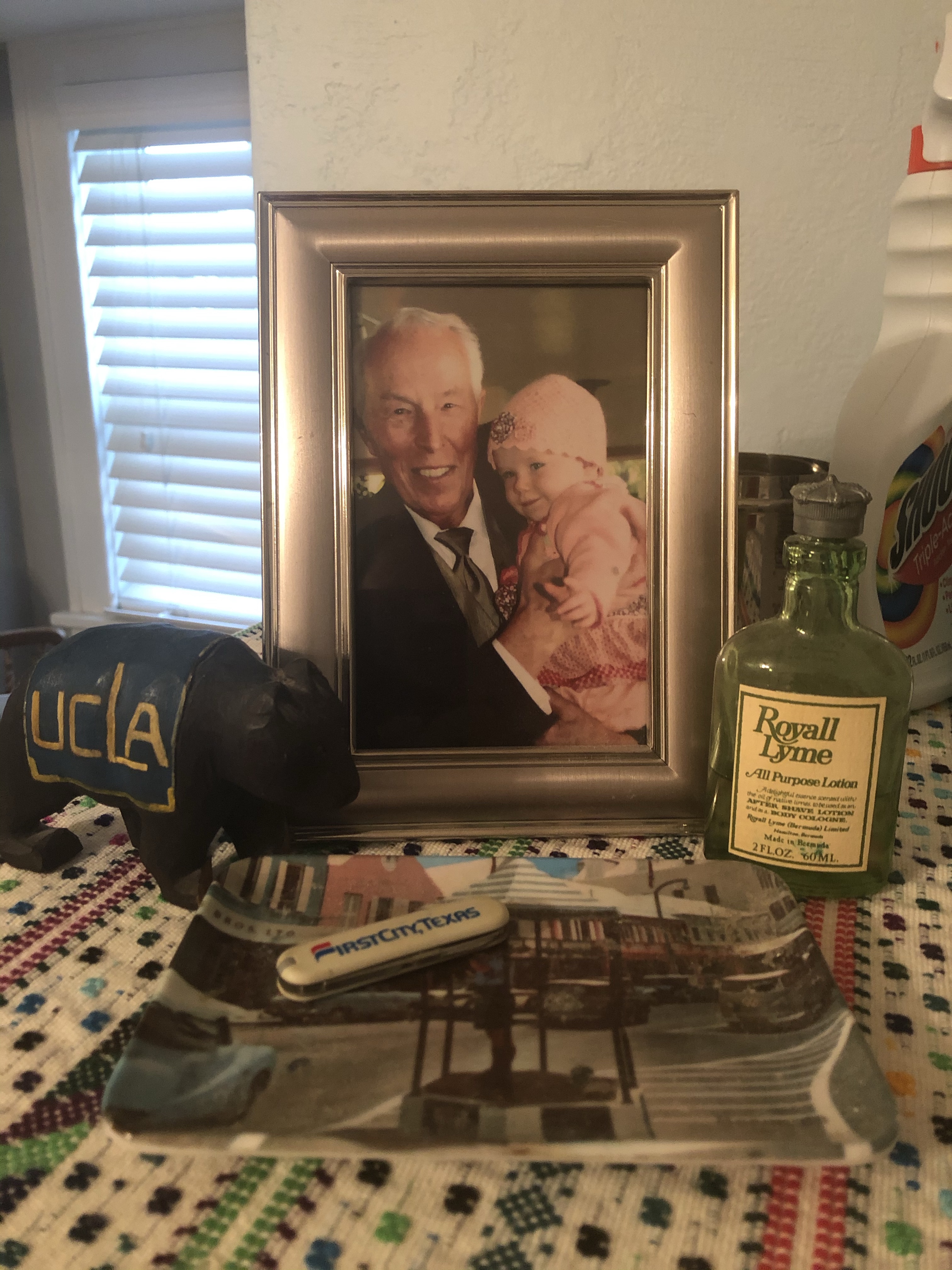
On my dresser I have a little shrine to Dad – a photo of him holding my daughter when she was a baby, at my brother’s wedding.  The frame is flanked by a bottle of Royall Lyme, his aftershave of choice, and a small carved UCLA Bruin.  In front of the frame is a little plastic tray he brought me from Bermuda, and it holds a pocketknife with the emblem of a bank he once worked for.

I say good morning and good night to Dad every day. He doesn’t say anything back.  But I like to think that some day I’ll see him again, face to face, and we’ll say good morning to each other, and this heart of mine which has been cracked up a bit will be all mended up.

Love and grief; what a strange dance they have this side of the door.

royal lyme

Thanks, Mom, with love

I have always appreciated Mom – at least the way I remember it!  I’m sure there were a few adolescent years when the appreciation lay buried deep, but that same appreciation blossomed fully when I became a mother myself.  That’s when I realized that I grew up in a house with a superhero.

In the past few months, my appreciation and love for my mom has changed.  It’s as though it has been burnished by grief and devotion, with a rich patina that can come only from experiencing together sorrow and loss and a recognition of love.

At first Mom was surprised when we all came after we heard that Dad was dying.  We weren’t surprised to do that at all – that’s how we had been raised by the two of them.  You show up.  You wait for each other.  You leave pretense at the  door.

So we were all there, gathered at his bedside.  We four kids would go to our own rooms for the night, but Mom slept in Dad’s room, on the most uncomfortable cot in the world.  She didn’t complain.  She wanted to be there with him and for him, as she had been for 58 years.

And then – I can hardly write this – she stood with us as each of us had to say goodbye to Dad.  Three of us left before he died. I know how I felt when I left his room for the last time; leaving him was the hardest thing I have ever done.

But Mom was there for me, and for my brothers, as we each said goodbye and then cried and cried.  In her grief, in her exhaustion, she was still Mom.  She was still there for us, holding us, comforting us, being present with us in the rawness of grief.

So this year especially, I am grateful for my mother.  I am grateful for her humor and her wackiness, for her generosity and wisdom, and especially grateful for her devotion to Dad through it all, and for her presence with us in those bewildering days in December.

“Thank you” seems such an inadequate thing to say, and “I love you” does too.  The words are paltry, but all that is behind them is not.

Thank you, Mom.  I love you.

Family pix 001