Easter Thoughts, A Little Early

This year, I will be leading the Vespers service at a local retirement community on Easter Sunday, and as is my wont, I started looking through old Easter sermons that could be brushed up a little for this upcoming occasion. As I went through them, I kept tearing up. Why? Happily, not because they were terrible, but because they offered a word of hope, and I hadn’t realized how much I needed to hear about hope, even from myself a few years back. It was hard to read the ones I offered during the pandemic, from my home or from an empty sanctuary, remembering the uncertainty of that time and the losses upon losses.

And though Easter is still shy of two weeks away, I offer the conclusion to one of them, if you’re a preacher in need of some hope or joy. I don’t claim that any of my words would even win a preaching prize (which is really a silly thing, after all) but sometimes you need a little bump to get you going.

In the meantime, Lent is still with us, and given all that’s happening, it may feel as though Lent is still with us after April 21. Even so, God always gets the last word, and Love always wins. Here you go.

Joy is the jitterbug meeting the waltz, and Rembrandt and Dr. Seuss comparing notes, and hope disguised as a gardener. And you? And I? What is our joy?

Joy is when the rains cease
Joy is when the baby squeals
Joy is the march
Joy is the old friend who shows up
Joy is the peace accord
Joy is the casserole
Joy is the grave cloths neatly folded away
Joy is the mountain decked in so much snow
Joy is the full table with everyone there
Joy is the story told again and again
Joy is the joke with life as the punchline
Joy is the fern unfurling
Joy is the empty tomb
Joy is the daphne and lilac and lavender
Joy is the gift that will not be taken back
Joy is life, and more life, and life after that.

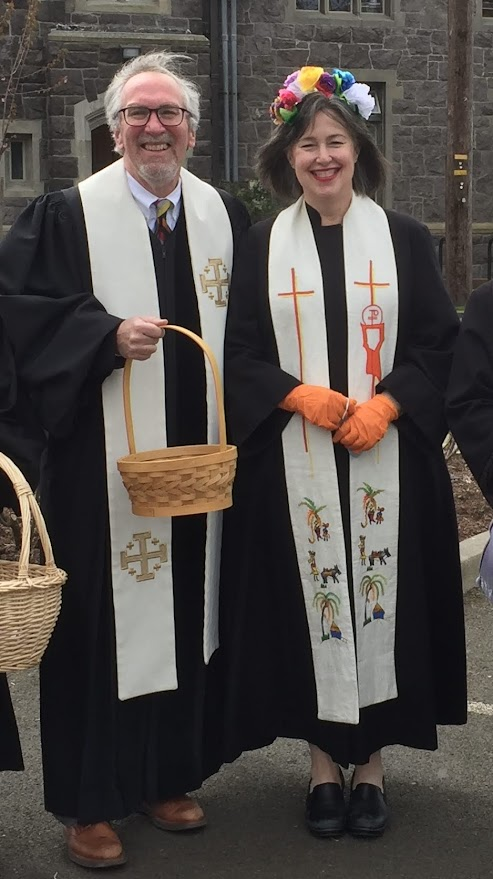
My husband and I on Easter Sunday, 2021, getting ready to celebrate drive-through communion in the church parking lot.

Women, Ancient and Present

The Daughters of Zelophehad: Numbers 27
“Then the daughters of Zelophehad came forward. Zelophehad was son of Hepher son of Gilead son of Machir son of Manasseh, of the clans of Manasseh, son of Joseph. The names of his daughters were Mahlah, Noah, Hoglah, Milcah, and Tirzah. They stood before Moses, Eleazar the priest, the leaders, and all the congregation, at the entrance of the tent of meeting, saying, ‘Our father died in the wilderness; he was not among the congregation of those who gathered themselves together against the Lord in the congregation of Korah but died for his own sin, and he had no sons. Why should the name of our father be taken away from his clan because he had no son? Give to us a possession among our father’s brothers.’

Moses brought their case before the Lord. And the Lord spoke to Moses, saying, ‘The daughters of Zelophehad are right in what they are saying; you shall indeed let them possess an inheritance among their father’s brothers and pass the inheritance of their father on to them. You shall also speak to the Israelites, saying: If a man dies and has no son, then you shall pass his inheritance on to his daughter. If he has no daughter, then you shall give his inheritance to his brothers. 1 If he has no brothers, then you shall give his inheritance to his father’s brothers. And if his father has no brothers, then you shall give his inheritance to the nearest kinsman of his clan, and he shall possess it. It shall be for the Israelites a statute and ordinance, as the Lord commanded Moses.'”

Years ago, when I was in seminary, we were studying the Hebrew Scriptures. At some point in the semester the professors assigned us an article by Dr. Katharine Doob Sakenfeld, Professor of Old Testament Literature and Exegesis Emerita at Princeton Theological Seminary, having previously been William Albright Eisenberger Professor of Old Testament Literature and Exegesis. This story – unknown to me – took place during the Exodus, as the people who have been wandering the wilderness are about to enter the promised land. Well, the article opened my eyes, not only to this story of five sisters who plead their case before Moses and Eleazer, but also to the possibility of feminist biblical interpretation. Whether this story is historically true, which it is likely not, it is a curious thing that in all of the Torah, the story of these sisters – Malah, Noah, Hoglah, Milcah, and Tirzah – is included.


Is it a dangerous passage, this story of women challenging the patriarchal rule that only sons can inherit land? Does granting women access to things that historically belonged to men and men only open the floodgates to women doing all sorts of things that might give them power? What does this story tell us about the lives of women in ancient scripture? And how does this ancient story speak to the lives of women today?


I wish this story ended beautifully, all tied up with a neat bow, but it doesn’t. At first, Moses consults God who says yes, these women may inherit their father’s land. That’s Numbers 27. But jump ahead to Numbers 36 and we learn the inheritance comes with a condition: that the five sisters marry only within their own tribe, so that the land does not end up with someone outside the family. Of course.


A few years ago I discovered the work of Dr. Wilda C. Gafney, (The Right Rev. Sam B. Hulsey Professor of Hebrew Bible at Brite Divinity School of Texas Christian University), a biblical scholar who writes from the Womanist tradition. She, too, is interested in the stories of women in scripture, but from the perspective of Black women. Her writing has inspired me to consider even more women in the biblical stories, to look deeply at their lives, and to consider what they might say to us today. If you’re willing to face some Hebrew and academic terms that might be unfamiliar, I heartily recommend her book Womanist Midrash: A Reintroduction to the Women of the Torah and the Throne.


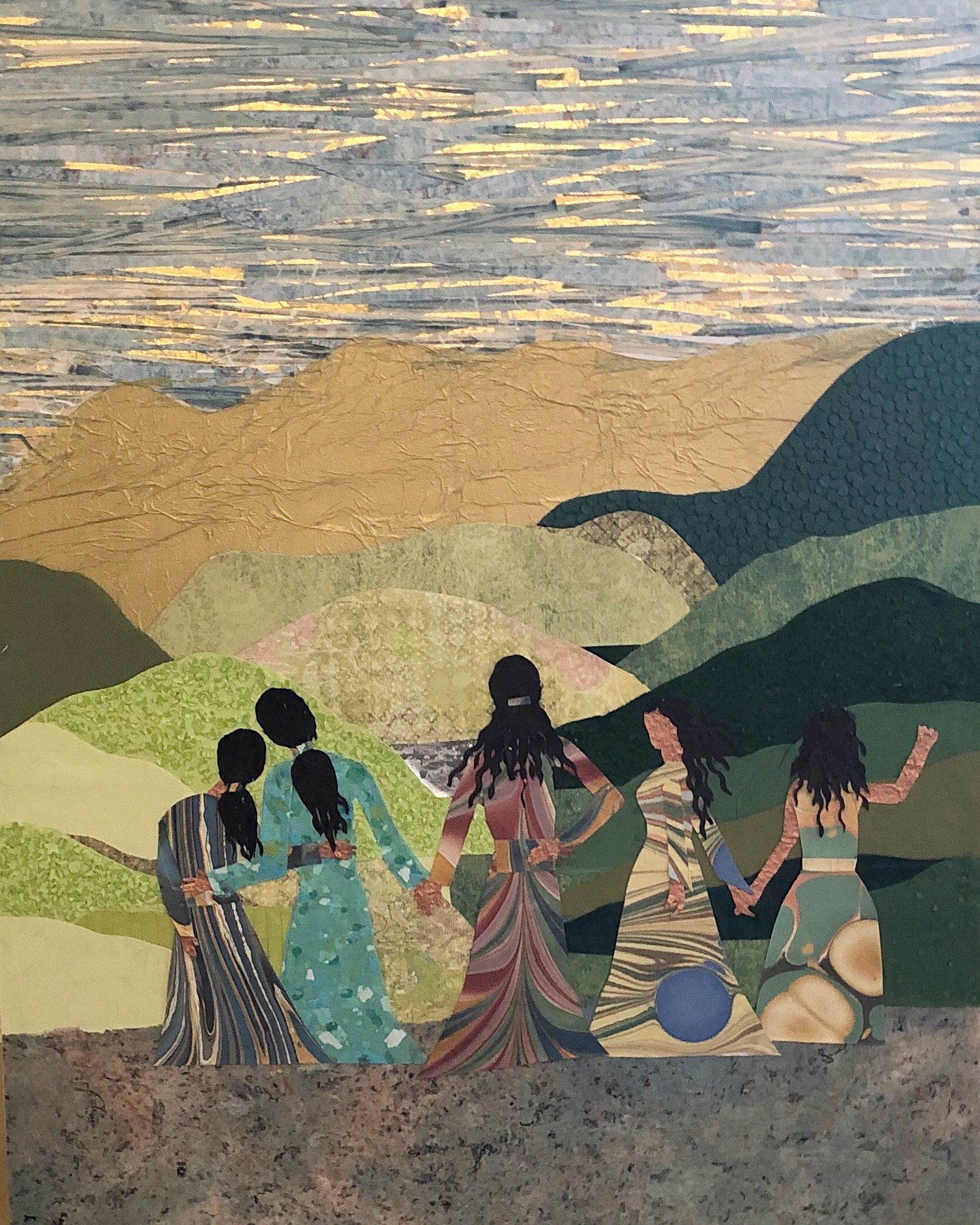
Anyway, I will get to the point. Since that Old Testament class in 1989, the daughters of Zelophehad have stuck with me. A few years ago I was working on an art series, “Unknown and Unnamed: Women of the Bible” and made this picture, “The Five Sisters Who Inherited Their Father’s Land.” It’s been a fan-favorite of my ten fans, and I have promised my own daughter I will not sell it.


More recently I’ve been motivated to create some new Matron Saints, and the first of this new batch is “Malah, Noah, Hoglah, Milcah, and Tirzah (the daughters of Zelophehad), Matron Saints of Those Who Challenge the Patriarchy.”


Why has this story stuck with me? In part because I get so very frustrated and enraged by the power games of the patriarchy which still exists today. I am cautious about criticizing cultures that are not my own, so I’ll stick with the U.S. I see patriarchal power plays in the culture, in politics, and I see them far too often in the church, even in my own beloved denomination of the Presbyterian Church (U.S.A.)


So if there’s a chance that women might receive something previously withheld from them, or better, receive it without condition, I want to celebrate that. I want to celebrate women being acknowledged as being gifted, compassionate, strong, emotionally intelligent, intellectual, wise, brave, capable of making decisions about their own bodies, and willing to make good trouble. I want to hear the stories of women who have been denied, of women who’ve given up because that wall of patriarchy is twenty feet thick and make of diamonds and steel. I want to know men who are willing to step away, step down, so that a woman might have an opportunity otherwise denied them.


I want the descendants of Malah, Noah, Hoglah, Milcah, and Tirzah to be emboldened to speak up not only for themselves but for other women as well. I want us to make as happy an ending as possible for the story of women. I echo what Marie Shear once said: Feminism is the radical notion that women are people. May it be so.

My thanks to Drs. Robert Coote and Marvin Chaney, my Old Testament professors at San Francisco Theological Seminary, to Dr. Sakenfeld and Dr. Gafney for their rich and inspiring work, and to all the women out there who keep on going.
Love to the loveless shown

Well, our friend Aaron showed up in church this morning.  As is his custom, he made his way to the sacristy, exited into the choir loft, and came down the three stairs to the chancel where my husband/co-pastor Gregg met him and escorted him to the front pew.  He sat with Aaron for a minute, then came back to the chancel, but in his place, one of our deacons sat with him and got him a hymnal in case he wanted to join in on “My Song Is Love Unknown.”  As we sang those words “love to the loveless shown that they might lovely be” I watched Gregg and then Gail sit with Aaron, and make him feel welcomed and maybe even loved.

Sometimes I think that maybe Jesus is showing up with us as Aaron.  Every now and then Aaron appears.  Sometimes he’s sober, sometimes he’s not.  Sometimes he asks for a little help and sometimes he just needs to be with our people.  It always feels like a test: will this be the week Aaron does something that simply is not acceptable and we have to ask him to come back when he can observe the community norms?  Will this be the week that someone who doesn’t know Aaron’s story with us is mean or harsh to him?  Will this be the week when he removes his disguise and we realize that Jesus was testing us with the “Love Your Neighbor/Do This To One of the Least of These” exam?

Two weeks ago I preached about hunger and feeding people as a means of reconciliation.  We were writing Bread for the World letters after worship that day, and it all seemed to fit.  The statistics about world hunger are pretty depressing, as much because we waste 1/3 of all food produced as because millions of children are nutritionally comprised.  Here in Portland, a third of all students in Portland Public Schools face food insecurity on a regular basis.  I shared all of that with my well-fed, food -secure congregation.

The next day I get a text from one of the members of the family who is living in their car in our parking lot (with the church and neighborhood’s permission.)  They haven’t eaten in two days – could we help out with a gift card to the grocery store?  I heard Jesus whispering in my ear, “I was hungry  – did you or did you not give me something to eat?”

I came home this afternoon to my lovely house and made myself a peanut butter and jelly sandwich.  I looked around at all our space, and up at the ceiling under the new roof we just got, having driven home with a car full of gas.  Who am I, to have so much when others have little or nothing?  Who am I to not face the demon of substance abuse or mental illness?  Who am I to not be confined by my bad choices?

I don’t know if it’s the luck of the draw, privilege, injustice, prejudice, will, disposition, but lately it feels like Jesus keeps showing up in the guise of those considered by some to be the least of these.  Do I greet him with love?  Do I offer him grace?  Do I ignore him because it’s messy and hard to engage?

I tell myself I do what I can.  We help our parking lot guests out with grocery gift cards.  We have meals with them, but not as often as I think we ought.  We do their laundry, and sometimes that feels like doing ministry more than anything else I do in the week.

They are lovely people, our parking lot guests and Aaron and all of them.  I fear they don’t know that about themselves, and I fear they don’t know that God sees them as lovely, if they even think there is a God.  What they know is that there is this church with people who treat them with kindness.  I hope.

But my relative privilege and my relative wealth – this brand new roof over my head, this ability to buy food whenever I want it – recall another line from the hymn:

“Oh, who am I, that for my sake, my Love should take frail flesh and die?”

Handing over what is not mine, or, Learning to let go

I was up worrying the other night.  It happens.  Worry is a spiritual gift I received from my mother, and I have worked hard to perfect that which was passed on to me.  I also work not to pass it on to my daughter, but I worry that I am failing in that.

Anyway, I was worrying the other night when what I really wanted to be doing was falling asleep.  It was the end of a long day, the house was quiet, all other living creatures under our roof were asleep, and there I was, worrying.  Someone once defined worry as “misuse of the imagination.”  Yes, it is.  Finally my desire to sleep won over my need to worry, and I decided to hand it all over to Jesus.

Now I really don’t consider myself that kind of Jesus person.  I usually don’t hand it over to the Lord, nor do I think that he walks with me or talks with me in the “In the Garden” sort of way.  My prayers tend to be to God, not to Jesus.  I mean, I’m good with him, but I do like to keep my distance.  But that night I decided I really needed to hand it all over to him.  So I pictured what I was handing over, and it was a spherical-shaped thing, a tangle of worries that might best be represented by barbed wire, lima beans, the insoles of my daughter’s summer Keens, and all those random electronic cables you stick in a drawer because you have no idea what they’re for.  Roll all that up into a ball, and those were the worries I wanted to hand over to Jesus.  Lucky him.

So I did.  In my mind’s eye I pictured handing him this messy, sharp bundle, and I pictured him taking it.  And then a funny thing happened.  As soon as he took it, it turned into a beach ball- one of those big plastic, colors-in-pennant-shapes beach balls.  It was like he was taking all my worries so very lightly, like he was saying, “Hey, I know there’s stuff that’s getting you down but I think we should go play on the beach.”

What the hell, Jesus?

Okay, not really.

But somehow, it worked.  He took my ball of lima beans and barbed wire and turned it into a beach ball and I fell asleep.  Not only that, but that night I dreamed I was about to marry George Clooney.  (I did confess that to my husband the next day and assured him that George Clooney was no match for him.)

The next day I had coffee with a friend who is a 12-stepper.  I am remarkably proud of her, and often inspired by the rigorous and truthful way she looks at her own living.  We talked about whatever step it is where you let go and let God, and she talked about the deep meaning the serenity prayer has for her.  While I listened, I was having my own internal conversation about letting go and the whole Jesus-turned-my-worry-into-a-beach-ball thing.  Here’s where I ended up.

Sometimes, in order to sleep, in order to get the rest our bodies, minds, and souls need, we have to let it go.  (Apologies for cueing that particular song.)  It’s not always ours to keep, the things we worry about.  But sometimes, after that rest, we take some of it back.  Some of it is mine to carry, or to deal with, or to wrestle with.  But maybe when I take it back, there are fewer lima beans and more grains of sand.

a-beach-ball-ron-dahlquist

Help me, Baby Jesus- you’re my only hope!

stormtrooper-costumes-christmas-coupleA few recent conversations have gotten me to thinking about the large Load of Expectations people carry around with them this season. It’s a bit crazy making, really.  Here are a few:

That I will purchase The Perfect Gift for a someone in my life, and they will love it so much.

That our gathering (family or friends, co-workers, girlfriends, whomever) will be perfect, the stuff of catalog stock photos.  Everyone will say it was the best holiday party ever.

That I will preach the perfect Christmas Eve sermon -or- the church service I attend will renew my faith/inspire me to sell all my goods and give to the poor/make everything that is wrong in my life or the world right.

That the dinner I prepare will make the judges on Top Chef cry with jealousy.

You get the picture.  We need to tone it down because:

You probably cannot afford the perfect gift or there is no way you have time to find the perfect gift.  It is the giving that is important here, and if the recipient of your present doesn’t know that, it’s on them and not on you.

Your gathering will not perfect.  Your family will likely not all get along, and someone might be sullen and someone might drink too much and not in the good way and someone will be disappointed.  Your friends might cancel at the last moment because their kid is throwing up or because they can’t do one more thing.

Something will go wrong with your dinner – the turkey might be overcooked (which, admittedly, is better than being undercooked). The person in charge of the wine might bring something dreadful.  The souffle might fall.

So let me ask: why are we doing all of this?

If you are a religious person, particularly a religious person who identifies with the Jesus people, you are doing this for Jesus and not for anyone else.  So if you think Jesus will be disappointed with you because you did not give your father-in-law the matching tie and pocket square that he wanted, you are wrong.  Jesus does not care about the presents you give or receive.  The Wise Men thing?  About honoring a king, not about making Mary and Joseph happy that the neighbors did the right thing.

If you are not a religious person, there could be many reasons you are doing this.  I am a religious person and always have been, so I’m not entirely sure.  But you might be joining in on all the holiday stuff because the sun sets too early and rises too late in this season and you need to add a little cheer to the gray dreary days.  You may be doing the holiday thing because you have time off from work and everyone else is doing it.  You may be doing it because you think it adds some good to a world that’s hurting.

Here is what I know:

That some people will be disappointed no matter what.  They have unrealistic expectations of you, or of the church, or of this season.  You are not responsible for their disappointment.

And some people will be sad or depressed in this season no matter how much cheer and twinkly lights surround them.  They have good reason to be sad.  They’re not getting enough vitamin D this time of year.  This is their first Christmas without their beloved and frankly, it sucks.  They are staring down cancer or ALS and wondering if this December is their last.  Their family won’t fight because their family won’t be together, for whatever reason.

The world is a mess and our country is a mess and that’s always been the case.  There has never been a time when everything was okay.  Everything will not be okay this Christmas, and to expect that it will be is to set yourself up for disappointment.  But that doesn’t mean there can’t be some good in the midst of the sad.  That doesn’t mean there can’t be some hope in the midst of all that is dreary and awful.

For some of us, Baby Jesus is our only hope – the hope that God did not give up on the world when it was a mess but instead came to the world because it was a mess in order to start getting it cleaned up a little.  If you’re doing all this because you’re a religious person, you might want to keep that in mind.

I suppose others find hope in other place – in the potential of good in the human heart, in that long arc of history that bends every so slowly toward justice, hope that there have been cures and ceasefires and confessions and pardons and there will be again.

Maybe Leonard Cohen said it best:

Ring the bells that can still ring.SONY DSC

Forget your perfect offering.

There is a crack in everything.

That’s how the light gets in.

Sometimes there are no words

angel weepingSometimes there are no words for the things that human beings do to each other.

Sometimes there are no words to express our horror, or our sadness, or our fear.

Because we humans are capable of being so very inhuman. We forget that we have minds that allow us to think before acting. We forget that we were created to love. We forget that we don’t have to go through this alone, but we have friends and strangers who will help us get through the rough spots.

At the end of his life, Jesus had very few words. “I thirst.” “Forgive them.” “It is finished.” But in those few words he spoke there was no hatred. There was no blame. There was no judgment. There was pain in his words, of course. He had been in physical agony as he died. His spirit was in agony, too, wondering if God had left him there.

But at his core, Jesus was love, and so even in the pain of his dying, love shone through.

At his core, was Jesus expressing his human side, or was he expressing the God part of him? Because if he was expressing his Godliness, then there is no expectation that we should show love whenever we are in pain. But if it was his humanity showing, if that was Jesus the man who loved even at the end, well then, we are not off the hook.

Sometimes there is only one word that will get us through this life, and that word is love.