Easter Thoughts, A Little Early

This year, I will be leading the Vespers service at a local retirement community on Easter Sunday, and as is my wont, I started looking through old Easter sermons that could be brushed up a little for this upcoming occasion. As I went through them, I kept tearing up. Why? Happily, not because they were terrible, but because they offered a word of hope, and I hadn’t realized how much I needed to hear about hope, even from myself a few years back. It was hard to read the ones I offered during the pandemic, from my home or from an empty sanctuary, remembering the uncertainty of that time and the losses upon losses.

And though Easter is still shy of two weeks away, I offer the conclusion to one of them, if you’re a preacher in need of some hope or joy. I don’t claim that any of my words would even win a preaching prize (which is really a silly thing, after all) but sometimes you need a little bump to get you going.

In the meantime, Lent is still with us, and given all that’s happening, it may feel as though Lent is still with us after April 21. Even so, God always gets the last word, and Love always wins. Here you go.

Joy is the jitterbug meeting the waltz, and Rembrandt and Dr. Seuss comparing notes, and hope disguised as a gardener. And you? And I? What is our joy?

Joy is when the rains cease
Joy is when the baby squeals
Joy is the march
Joy is the old friend who shows up
Joy is the peace accord
Joy is the casserole
Joy is the grave cloths neatly folded away
Joy is the mountain decked in so much snow
Joy is the full table with everyone there
Joy is the story told again and again
Joy is the joke with life as the punchline
Joy is the fern unfurling
Joy is the empty tomb
Joy is the daphne and lilac and lavender
Joy is the gift that will not be taken back
Joy is life, and more life, and life after that.

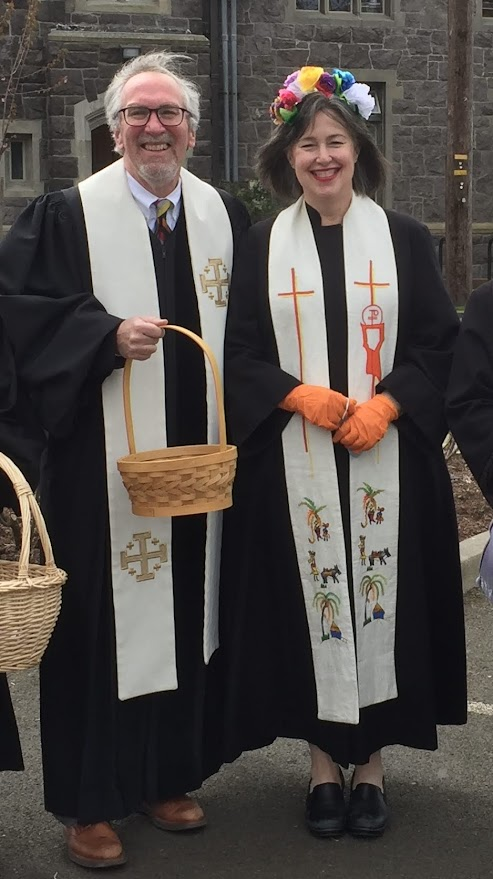
My husband and I on Easter Sunday, 2021, getting ready to celebrate drive-through communion in the church parking lot.

Love and Dust

Our daughter was born on Fat Tuesday, which meant I spent Ash Wednesday 2006 in a hospital room, recovering from a C-section and trying to figure out how to breastfeed. After experiencing the joy and fear of giving birth, I really did not need to remember that I was dust and to dust I would return. At the time, I felt more like I was made of blood and colostrum and placenta, which are very much things of birth.

That was the last time I was not marked with ashes on Ash Wednesday. This year I repeat that, for reasons that seem a bit inconsequential and maybe a little lazy. Last September I left the congregation I happily served for thirteen years, and I have not yet found a new worship home. To be honest, I haven’t looked for one yet. After serving congregations for thirty-one years, I need a break. I need to let go of all my expectations of how worship should happen, what fills me in worship. I need to empty myself of all of that, and then start fresh.

I imagine for many folks there is no need to be reminded that they are dust and to dust they will return. The world tells them that all the time. The White House tells them that in cruel tweets. Rude customers, impatient drivers, racists, misogynists – there is a message of death and hate that pervades so much of every day life. Why add ashes as another reminder?

I dare not speak for anyone , but I will say that there was something honorable and profound and horrific about making the sign of the cross on people’s foreheads. Honorable because they trusted me, their pastor, to say these true words with love. Profound, because death is so wrapped up in the mysteries of creation and incarnation and resurrection that mere words cannot begin to convey all that is meant by the ashy cross. And horrific, because the woman who has lost all her hair from her chemo treatments doesn’t need to be reminded that she will die, because the precious child, conceived by IVF after years of miscarriages, needs to live a full, long life, and not think about death for a long, long time.

Receiving the ashes is another thing. Sometimes a fellow pastor would mark me, and sometimes my fellow pastor/husband made the sign of the cross on my forehead. Sometimes a parishioner would make the sign. It didn’t matter who did it, though I always knew the person. Someone who loved me, or who worked to love me in that Christ-way, was telling me the truth that I would die some day, that all of us will die some day. On Ash Wednesday, that’s as far as we get in the story.

And so Lent has begun, and for me, without ashes. My daughter sent me a picture today of her and her friend who made it a point to go to chapel and get marked today. I’m a bit filled by that. A stranger told her that she is dust. While I clung to her in that hospital bed at the beginning of Lent nineteen years ago, now I let her go into the world, full of dust and life, to make her own way. For a long, long time, I hope.

So given the state of the world, perhaps this year I would offer these words:
“Remember you are made of love, and to Love you will return.”

Women, Ancient and Present

The Daughters of Zelophehad: Numbers 27
“Then the daughters of Zelophehad came forward. Zelophehad was son of Hepher son of Gilead son of Machir son of Manasseh, of the clans of Manasseh, son of Joseph. The names of his daughters were Mahlah, Noah, Hoglah, Milcah, and Tirzah. They stood before Moses, Eleazar the priest, the leaders, and all the congregation, at the entrance of the tent of meeting, saying, ‘Our father died in the wilderness; he was not among the congregation of those who gathered themselves together against the Lord in the congregation of Korah but died for his own sin, and he had no sons. Why should the name of our father be taken away from his clan because he had no son? Give to us a possession among our father’s brothers.’

Moses brought their case before the Lord. And the Lord spoke to Moses, saying, ‘The daughters of Zelophehad are right in what they are saying; you shall indeed let them possess an inheritance among their father’s brothers and pass the inheritance of their father on to them. You shall also speak to the Israelites, saying: If a man dies and has no son, then you shall pass his inheritance on to his daughter. If he has no daughter, then you shall give his inheritance to his brothers. 1 If he has no brothers, then you shall give his inheritance to his father’s brothers. And if his father has no brothers, then you shall give his inheritance to the nearest kinsman of his clan, and he shall possess it. It shall be for the Israelites a statute and ordinance, as the Lord commanded Moses.'”

Years ago, when I was in seminary, we were studying the Hebrew Scriptures. At some point in the semester the professors assigned us an article by Dr. Katharine Doob Sakenfeld, Professor of Old Testament Literature and Exegesis Emerita at Princeton Theological Seminary, having previously been William Albright Eisenberger Professor of Old Testament Literature and Exegesis. This story – unknown to me – took place during the Exodus, as the people who have been wandering the wilderness are about to enter the promised land. Well, the article opened my eyes, not only to this story of five sisters who plead their case before Moses and Eleazer, but also to the possibility of feminist biblical interpretation. Whether this story is historically true, which it is likely not, it is a curious thing that in all of the Torah, the story of these sisters – Malah, Noah, Hoglah, Milcah, and Tirzah – is included.


Is it a dangerous passage, this story of women challenging the patriarchal rule that only sons can inherit land? Does granting women access to things that historically belonged to men and men only open the floodgates to women doing all sorts of things that might give them power? What does this story tell us about the lives of women in ancient scripture? And how does this ancient story speak to the lives of women today?


I wish this story ended beautifully, all tied up with a neat bow, but it doesn’t. At first, Moses consults God who says yes, these women may inherit their father’s land. That’s Numbers 27. But jump ahead to Numbers 36 and we learn the inheritance comes with a condition: that the five sisters marry only within their own tribe, so that the land does not end up with someone outside the family. Of course.


A few years ago I discovered the work of Dr. Wilda C. Gafney, (The Right Rev. Sam B. Hulsey Professor of Hebrew Bible at Brite Divinity School of Texas Christian University), a biblical scholar who writes from the Womanist tradition. She, too, is interested in the stories of women in scripture, but from the perspective of Black women. Her writing has inspired me to consider even more women in the biblical stories, to look deeply at their lives, and to consider what they might say to us today. If you’re willing to face some Hebrew and academic terms that might be unfamiliar, I heartily recommend her book Womanist Midrash: A Reintroduction to the Women of the Torah and the Throne.


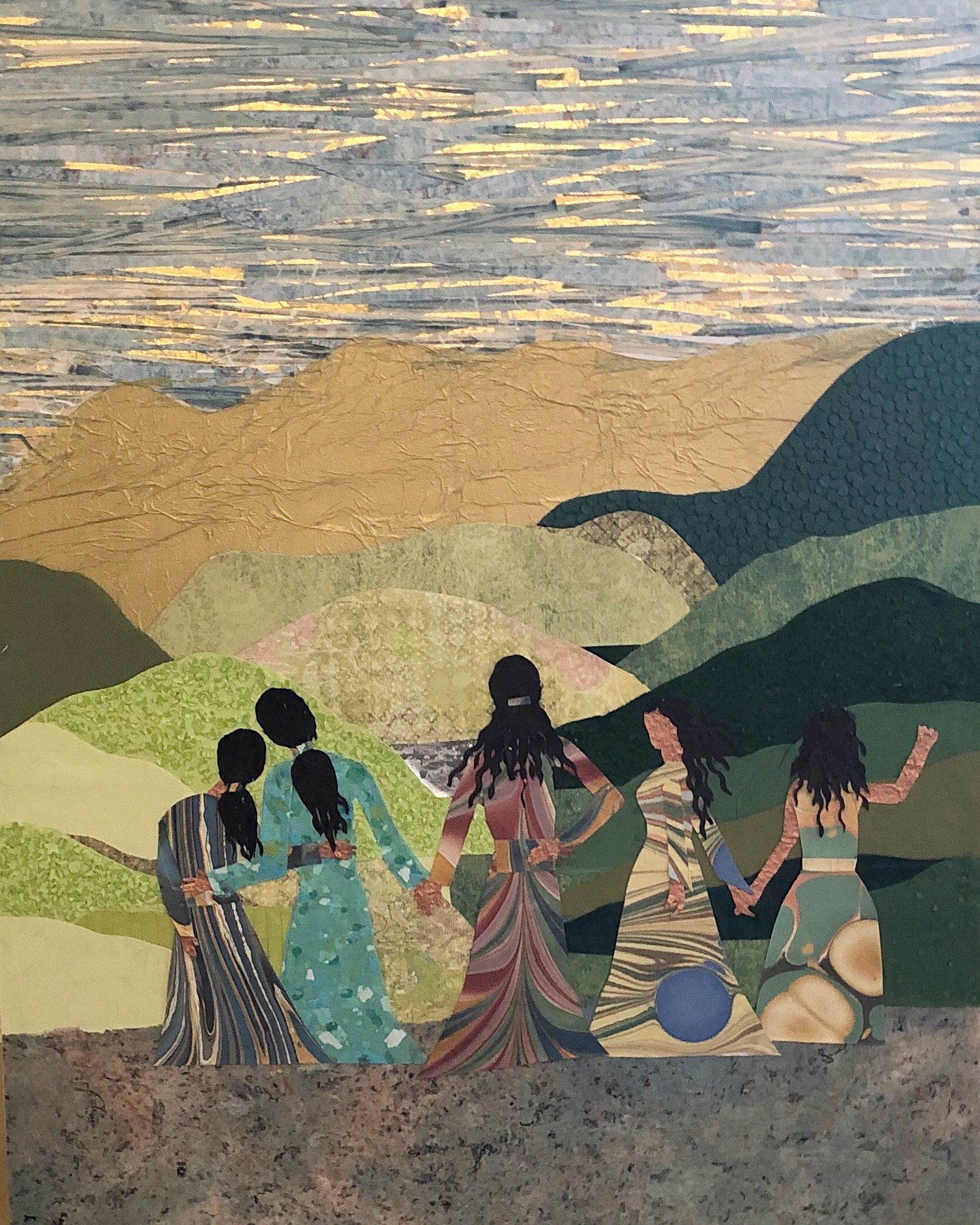
Anyway, I will get to the point. Since that Old Testament class in 1989, the daughters of Zelophehad have stuck with me. A few years ago I was working on an art series, “Unknown and Unnamed: Women of the Bible” and made this picture, “The Five Sisters Who Inherited Their Father’s Land.” It’s been a fan-favorite of my ten fans, and I have promised my own daughter I will not sell it.


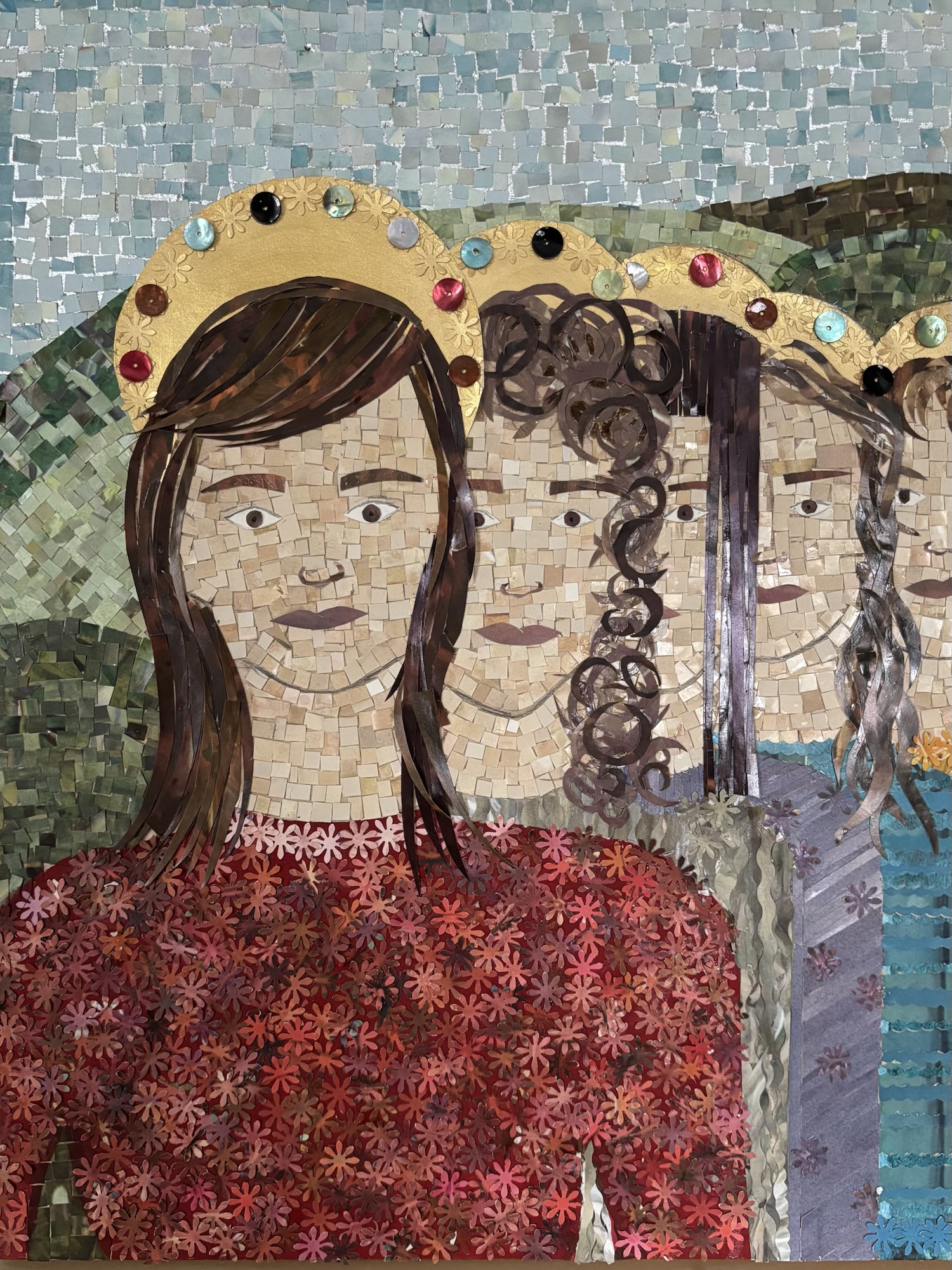
More recently I’ve been motivated to create some new Matron Saints, and the first of this new batch is “Malah, Noah, Hoglah, Milcah, and Tirzah (the daughters of Zelophehad), Matron Saints of Those Who Challenge the Patriarchy.”


Why has this story stuck with me? In part because I get so very frustrated and enraged by the power games of the patriarchy which still exists today. I am cautious about criticizing cultures that are not my own, so I’ll stick with the U.S. I see patriarchal power plays in the culture, in politics, and I see them far too often in the church, even in my own beloved denomination of the Presbyterian Church (U.S.A.)


So if there’s a chance that women might receive something previously withheld from them, or better, receive it without condition, I want to celebrate that. I want to celebrate women being acknowledged as being gifted, compassionate, strong, emotionally intelligent, intellectual, wise, brave, capable of making decisions about their own bodies, and willing to make good trouble. I want to hear the stories of women who have been denied, of women who’ve given up because that wall of patriarchy is twenty feet thick and make of diamonds and steel. I want to know men who are willing to step away, step down, so that a woman might have an opportunity otherwise denied them.


I want the descendants of Malah, Noah, Hoglah, Milcah, and Tirzah to be emboldened to speak up not only for themselves but for other women as well. I want us to make as happy an ending as possible for the story of women. I echo what Marie Shear once said: Feminism is the radical notion that women are people. May it be so.

My thanks to Drs. Robert Coote and Marvin Chaney, my Old Testament professors at San Francisco Theological Seminary, to Dr. Sakenfeld and Dr. Gafney for their rich and inspiring work, and to all the women out there who keep on going.
Praying for a miracle

candleOnce a month our congregation offers an evening service of healing and wholeness in the Taize style of worship.  I attended the service for the first time last night – for the first time, not because I don’t have those to pray for who are seeking healing and wholeness, but because, really, my colleague is beautifully suited to lead that service and usually at 5:30 on a Saturday night I don’t want to be in church.

But I went last night, in part so that I could experience it but also because a few of us were staying afterwards to decorate for the Pentecost service today.  It was a lovely service and I’m glad I was there as it feels that there is a lot to pray about right now .

So the choir is leading some of the Taize songs, and my mind wanders in a good way.  I start thinking about a friend of mine who has been diagnosed with cancer, and the prognosis is so-so.  I start thinking that I would like a miracle for this friend, which gets me thinking about miracles in general.

Once in my life I prayed for a miracle.  A very dear parishioner in the first congregation I served was in a coma.  It was a cardiac thing, an utter surprise for this healthy, relatively young, fabulous, beautiful, kind woman. She lay in a coma and I stood by her bedside and prayed for a miracle, that she would come out of the coma, that they would shrink her enlarged heart, that her husband and sons would enjoy decades more with her.  But the miracle didn’t happen, and eventually she died and it was awful.

I haven’t prayed for a miracle since, but last night as I was thinking about my cancer-diagnosed friend, I thought about miracles again. What if there was some rule that you could only get one miracle granted in the course of your lifetime?  Would I hoard it for myself or my child or my husband, save it for a rainy day? Or would I be burdened by the miracle and offer it up the first ripe opportunity, and not be weighed down by the decision of when to use it?  Would I not pray for the miracle and then regret it the rest of my life?

I know people who have experienced miracles.  I know people who have experienced answers to prayer that they would call miraculous.  I’ve only prayed for a miracle once, and it didn’t happen.  And I know that should not be proof that God doesn’t grant miracles (or perform them?  I’m not sure what verb to use.)  But it’s hard to ask for something and get a ‘no’ and then be willing to ask again; harder to do that again and again and again.  It leads to a world of disappointment and not a little bit of doubt about the good intentions of the Divine Creator.

Meanwhile the choir finished their Taize song and we had moved on to other prayers.  I didn’t pray for a miracle last night.  Instead, I went to light a candle, for my friend, and for a few others.    I added a little light in the darkness, and in that moment, that felt better than a miracle.

Word Nerd at Prayer

I am the first to admit that I am not great at prayer, which might not be a problem for you, except that I am the pastor of a congregation, and with that comes a certain expectation that I will also be a good pray-er, that I will be devoted to my inner spiritual well-being, that I have set aside time each day to bask in the presence of God.

I intend to, I do.  But….

So the other night I was in bed, lights were out, and I was trying to fall asleep but couldn’t, so I decided to pray (since, frankly, prayer often does put me to sleep.) I am still ruminating on the murders at Newtown, and as the mother of a six-year-old, I’m having trouble letting it all go. So I’m praying for my daughter, and I ask God to protect her and guide her and to help me keep her-

Then I derail. “No,” I’m thinking to myself, “Keep isn’t the right word. It’s not a good word to use before God. ‘Keep’ suggests control, and I don’t want to control her; what’s the right verb?” And off I go into my little cranial thesaurus, all thoughts of God swept to the wayside.

It’s a privilege to love words and the Word. I love that my calling lets me use words all the time – words for prayer and for sermons, words for classes, even knowing when no word is appropriate. Maybe that’s a gift from God, and maybe God understands if my prayer gets derailed by my verbal crisis. After all, as the poet of Genesis 1 says, God used words to make the world.

Or I could be completely wrong about all of this, have ticked God off by my inattentiveness, and await the word of condemnation from on high.

Word.

Um, Like, Wow

I’ve been thinking about the word ‘wow’ lately, for two reasons. Steve Jobs’ sister said that his dying words were “Oh wow, oh wow, oh wow.” And I just finished Anne Lamott’s little book Help, Thanks, Wow: Three Essential Prayers. All of which has got me to thinking – When was the last time I said ‘wow’? When was the last time something took my breath away, knocked me flat on my bum, made me realize (in that split second that it takes to say ‘wow’) that as much as I pretend to be Empress of All That Is, there are amazing things out there that are simply beyond my ken?

We say ‘wow’ when Bear has a particularly good round of Uno, but we don’t necessarily mean it the way a beach sunset is wow. What made Steve Jobs say what he did – was a look back or a look forward? What took his breath away as his breath ebbed away? Why the wow?

Maybe it’s not coincidence that WOW spelled upside down is MOM. My life is full of details and to-do lists and pragmatics. I am always planning something, carrying out the plan, or post-morteming the past plan. Something always has to get done – hair deloused, hutch dusted, a Sunday bulletin proofed, dinner made, toilet paper rolls recycled. But for me, the planning has edged out the wow. There is just no room for amazement in my well-planned life. Plans resist spontaneity. Wow takes too much mindfulness, too much time.

But what kind of mom am I if I don’t show my child the Wow? What if she never learns anything about amazement from me? What if fireworks never knock her on her bum, or a kiss, or a Bernini sculpture? What if all she wants to be when she grows up the next Empress of All That Is?

Wow. That would not be good.

P.S. A few days after I wrote this, I picked my daughter up from an after-school activities. The clouds were forming what would be a gorgeous sunset. She looked up and said, “Wow.” And so did I.

afternoon sky