The Multiplication of the Papers and Woo-Woo Presbyterians

papersOne of the benefits of being an Art History major is that I know all sorts of obscure titles for religious paintings.  The Assumption of the Virgin (in which Mary does NOT make an ass of you and me but rather flies up to Heaven); the Harrowing of Hell (in which Jesus, after the cross but before Easter, goes to Hell and rescues all the souls who died before he could save them, like Adam and Eve, etc.) and the Multiplication of Loaves and Fishes, in which Jesus feeds a mess of people with five loaves of bread and two fish.  If you don’t believe me, type one of those titles into Google images and see the multiplication of Roman Catholic Great Masters’ paintings.

Of late, our household has experienced the multiplication of the morning papers.  It all began when for four days we didn’t receive our daily Oregonian, and then after one complaint call, we started getting three a day.  For ten days.  In spite of two more phone calls.

But today was special.  This morning when I walked the puppy at 6:00, I noticed our usual three papers on the porch.  My husband called and spoke to someone at the paper.  When I came home at lunch, there was a new paper – today’s paper – a fourth paper –  by the front door.  Maybe the earlier papers had a little Periodical Fun, and Fourth Paper in the Yellow Bag is their offspring.

Let’s detour for a moment to Woo Woo Presbyterians.  They call themselves this – I did not make it up.  I call them our Buddhist Presbyterians.  Whatever you want to call them, they are folks committed to our Presbyterian congregation who nonetheless see things on a different spiritual plain.  One of them once saw a delightful aura of white bouncing balls over my head while I preached.  (How AWESOME is that?)  Another can quote Buddhist masters, and pronounce their names correctly, at the drop of a hat.  I love them, because they are so generous in spirit, and let me be my usual frozen chosen self, not seeing auras and mispronouncing all sorts of names.

But because these Woo Woo Presbyterians are in my life, I’ve started to wonder if The Universe is trying to tell me something by sending me three or four morning papers.  I confess that my husband is the paper reader.  If I get to the Sudoku, I’m good.  If I finish the Sudoku and read the obituaries, it’s a banner day.  But is The Universe, by multiplying my Oregonian, suggesting that I actually read the paper?  That I know what’s happening in my community and in the world?  And that number three – that is WAY significant in Christianity: the Trinity, on the third day he arose, John 3:16.  But then what about the number four?

I don’t know.  And if tomorrow morning there is only one paper on the porch, or no paper, does that mean I should stop doing the Sudoku?  What would my Woo Woo Presbyterians say?

Maybe they would tell me it’s just The Universe pranking me.  Ha ha.  Funny.

Not an epic fail, but maybe a holy one

this pictures captures what the story was about

this pictures captures what the story was about

Yesterday in my sermon I committed the cardinal sin of pastor-parents: I told a story about my child without getting her permission.  Rookie mistake for this pastor of 20 years, but there you are.  It just fit so well into the sermon, and we had talked about it but in my mind we had not settled the matter.  But as it says in Galatians 6:7 (part of the passage I preached on) “you reap what you sow.”

So I’m in the first third of the sermon; my husband is sitting on the chancel near me and our daughter is sitting by herself in the front pew, as she usually does.  She hears me telling the story and she begins to cry, prostrating herself on the lovely needle-pointed pew cushion, weeping for not all but many to see and hear.  Crap.  Just the word the preacher wants to hear in her head while she is delivering the beautiful word of God.

I can handle a lot in worship.  I can handle crying babies, coughing parishioners, people who live on the streets wandering up and looking at the offering plates, fainters, barfers, organ ciphers, mangled liturgy, and laryngitis, but what absolutely does me in is when I have to be pastor and mom at the same time.  It doesn’t happen very often but when it does I become completely unglued – maybe because I suspect I’m not particularly good at either one, or maybe because it feels like both demand so much of my being.

So in the first third of my sermon, while my daughter is crying, I break the fourth wall of sorts, interrupt myself, and ask my husband to sit with her, which he does.  I then resume preaching, talking about accountability when we do something wrong, and being in community in our suffering, and reconciling with brother or sister before coming to the communion table.  And did I mention we celebrated communion yesterday?

At the end of the sermon, I issued this invitation to the congregation:

“I don’t know if gathered here this morning are people who are at odds with each other; sheer numbers would suggest that there are. I’m not going to ask  that we now pause for a minute for reconciliation – that would be putting all of us on the spot. But perhaps in the silence after the sermon, we might think of those we are at odds with. We might think about them, and about bearing their burden, about carrying our own load, about forgiveness and grace. We might imagine, as we all say the Lord’s Prayer during communion, sitting next to that person, and saying the prayer with them.”

It was so nice of the Holy Spirit to provide me with an opportunity to practice what I preach, and during the silence after the sermon I thought about how I could check in with my daughter before going to the table.  My husband/co-pastor came back up and said she was fine, mostly because one of her friends sweetly came up and sat with her and got her out of her funk.  During communion, my daughter passed by all the other celebrants to come receive the bread from me, and gave me a hug, and I told her I was sorry and I love her so much.

I thought it was a mediocre sermon that was made worse for the wear by my embarrassing my daughter.  As it turns out, what the congregation heard and saw were opportunities for grace, and realness, and empathy, and kindness, and grace again.

But if I ever tell a story about her again, I will get her permission in writing.

Never did say good-bye

What happens when we don’t get a chance to say goodbye?  Do we live with a sense of unfinished-ness?  Or do we move on and squish the unresolved stuff into that deep well in the gut where it gurgles and festers but never sees the light of day?

There are so many unfinished goodbyes.  A beloved, a friend, an acquaintance dies suddenly and there is no way to ask him for his cobbler recipe or to thank her for bailing you out that time.  A couple divorces, and friends must choose a side, and in-laws are cut off.  I know of two  (and there are more) congregations where the pastor was summarily dismissed, there one Sunday and gone the next, and parishioners who were for and against that person never had the opportunity to say things like “I never liked you but you showed up when you needed to” or “that sermon you preached on the woman at the well turned me around.”

A hospital chaplain used to admonish pastors and interns and everybody to keep our goodbyes current.  What happens when we don’t, when we lose the opportunity to get in a last, good word?  Sometimes it’s a mess, when we don’t say goodbye.  Sometimes we cling like shrinkwrap to the next best person.  Sometimes we grieve everywhere but the place we most need to.  Sometimes we wander lost, the way my cat did when his littermate died suddenly; he roamed the house, mewing and looking around, so sad and confused.  Bereft too, I would say.

I once served a congregation whose previous pastor had been let go suddenly, with no going away party.  I served there part-time for seven months, but when I left, they threw me the biggest shindig you can imagine.  I was bowled over; my husband reminded me that really, the party was as much for the previous pastor as it was for me.  Interim pastors learn that sort of thing, but I wish my predecessor could have been there too, since 90% of the party was for him.  (I did keep and still treasure the quilt they made for me.)

Our word goodbye derives from a 14th century word meaning “God be with ye.”  There is hope in that – though I didn’t get to say goodbye, I choose to believe that I and the one I miss are with God.  But one last hug would have been nice.goodbye

Keystone Kommunion

For some, the sacrament of Holy Communion, the celebration of the Lord’s Supper, the Eucharist -whatever you call it – is a solemn and holy occasion. It is replete with mystery, with grace, with all that church should be. Delicious, inclusive, meditative, intimate, theological.

And it is all of those things, except when it’s not, which is just about every month for me.

Everybody does communion a little bit differently. In our congregation, and I would guess in the majority of Presbyterian congregations, we celebrate communion once a month, on the first Sunday. Usually, but not always, we “do” communion by intinction, which means that the people come forward and take a little pre-cubed bite of bread and dip it into the chalice of grape juice. We say “the body of Christ” or “the bread of life” or “the bread of Heaven” and “the blood of Christ” or “the cup of salvation” or “the cup of forgiveness.” And the people partake, and then return to their seats as guided by one of the deacon ushers with all efficiency of a flight attendant giving safety instructions. We also sometimes pass plates of bread and trays of little cups of juice out into the congregation, but that does not make for very many good stories.

So here are three common communion mishaps that make it not a solemn and holy occasion but a joyful, mirthful feast.

1. Floaters

It always happens, and usually at the beginning. Someone very understandably drops their tiny piece of pre-cubed bread into the chalice. We always tell them to take another piece, that it happens all the time, but the partaker usually feels deep mortification, which I think is a spiritual discipline among the Opus Dei folks that involves flaying oneself with a studded whip. But I could be wrong. But maybe dropping the Bread of Heaven into the Cup of Salvation is the emotional or spiritual equivalent of flaying oneself. I actually wouldn’t know, as I always go last when there are plenty of floaters in the cup and it’s no big deal if my bread goes skinny dipping with the other pieces.

2. Drink Ye, All of It

Occasionally we have people who are from a different tradition within Christianity who are used to coming forward and actually drinking the cup. They’re usually from a tradition in which only men in white regalia will serve them, and in which they stick out their tongues and someone puts a communion “wafer” (read: piece of cardboard treated to look edible) on their tongue so they don’t have to touch anything. These people get confused by us Presbyterians. First of all, there might be women up front, and people who aren’t clergy. But our guests are game and hungry and faithful, so they help themselves to our nice yeasty bread cubes. Then they want the cup. Sometimes they get. Sometimes there’s a wrestling match. Sometimes they drink the floaters. Then we all pretend we’re not throwing up just the tiniest bit in our mouths, and we move on.

3. “But all I wanted was a little blessing…”

We have guests with us who want to be a part of the party but they’re really not sure about the whole body/blood thing. That or they’re scared of the floaters, or the person in front of them just drank the cup. Anyway, all they want is a blessing, but sometimes they’re not sure how to get that. I once attended a Catholic wedding, and one of the bridesmaids was Jewish. She had been instructed, when the wedding party was served communion, just to cross her arms over her chest to indicate she would not be partaking. In the heat of the moment, she forgot the choreography and instead clamped both hands over her mouth as though coming into any contact with the Body of Christ would magically indoctrinate her into the Christian Club, or would so offend the priest that he wouldn’t finish the wedding ceremony. (The couple is no longer married, but the bridesmaid is still a faithful Jew, so there you are.) Sometimes our people who just want a blessing do that too, put their hands over their mouths or cross their arms over their chests and that would all be fine. Unless the pastor and her serving partner misread the cue, and we end up trying to force-feed them the dang bread and cup, already! Yes, that happens. To me. More than once.

My husband is best on his feet at the spur of the moment and I love it when he offers the invitation to the table, because he manages to weave in the theme of the sermon or the image from scripture or some phrase from a hymn along with the graciousness to be someone who creates a floater or otherwise does thing not so decently or in order. And I love that, because really it is all about grace, about being invited to a table regardless of whether we’re hungry or sated, perfect or really screwed up, faithful or doubt-full, good/bad, wise/foolish, ballerina or bumpkin or clown.

clown communion

When I did a google image search on “clown communion” none of the clergy were the clowns. Pity. I think that’s more accurate!

So now, would you be gracious enough to share your Mirthful Feast stories?

The Dinner Party

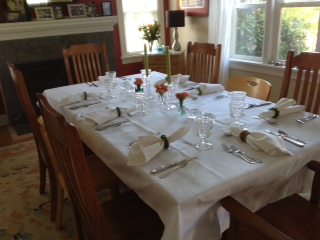
photo (1)We’re having six lovely people over for dinner tonight, which means that I have been frantic for about three weeks.  This is nothing new.  How do I clean the house, cook the food, look presentable; dust the floorboards, wash the front exterior windows, really clean the hardwood floors in the dining room, find a menu that is tasty and delicious and doable, with the right blend of flavors, textures, and colors, find the time to shower and do something with my mop of hair and remember to put on lipstick; vacuum thecobwebslivingontheceilingswipethehandprintsoffthedoorjambscleanthestainlesssteelappliances makesure iknowifanyguestsareglutenfreeorallergicorhaveastrongpreferenceagainst porkormushrooms orasparagusormakesurethedogstays outofthehouseandshouldiwear askirtorculottesoradressorpants andwhatearringsdoiwearand willanyonenoticei fimwearingmy tennishoes?

Frantic.  Yes.

I do love to have people over for dinner but we haven’t done that much lately.  Or house is smaller than our last one and it gets rather cozy when more than four show up.  Our seven year old tolerates a bunch of grown ups.  And then there’s the puppy, who simply has not understood this week why I do not allow what’s left of Giraffe’s innards to remain in bunches strewn through the house.

I love having people over and I love the fuss.  Because our guests tonight are slightly older than my husband and I, I’m using the good stuff, and it’s a thank-you dinner, so I’m using the good stuff.  I love using the good stuff, because the communion of saints is with me.  Whitney and John gave my the linen tablecloth as a wedding present.  My in-laws gave us their cut glass water glasses.  My parents downsized and gave me back the Waterford votives we gave them for their twenty-fifth wedding anniversary.  I’m using our wedding china and crystal for dinner, and my father-in-law’s mother’s china for dessert.

I love having people and I love the fuss – up to a point.  I find myself teetering on the edge of Crazy, and I don’t want to fall off that particular cliff because deep down I know this really is all about hospitality.  Our guest won’t care one whit if there’s a cobweb in the corner, or if one of the puppy’s chew toys is left in the bathroom.  They won’t care if the wine is so-so and food lukewarm. What they will remember is if they felt welcomed, and if there was good conversation, and if we were enjoying ourselves as well.

So during this day of cleaning and chopping and prepping, I’ve been thinking about communion this Sunday.  I think about the women who are so great about making sure the communion cloth is centered, if there is the right number of plates and chalices.  I think about them crowding into our little sacristy, laying out bread pieces and sharing their relief that it’s intinction this month and they don’t have to fill all the little juice glasses. I think about communion as hospitality, knowing that those who come for this particular holy meal probably wouldn’t notice if the tablecloth were off-center or a little stained.  They wouldn’t care if they had to wait a moment while the bread plate was replenished.  What they might remember was that a pastor called them by name, and offered them the bread of life and cup of blessing, and with two small tastes something inside them was sated.

Of course, bread and juice is a lot simpler than pork tenderloin, wild mushroom bread pudding, roasted asparagus, and panna cotta.

Praying for a miracle

candleOnce a month our congregation offers an evening service of healing and wholeness in the Taize style of worship.  I attended the service for the first time last night – for the first time, not because I don’t have those to pray for who are seeking healing and wholeness, but because, really, my colleague is beautifully suited to lead that service and usually at 5:30 on a Saturday night I don’t want to be in church.

But I went last night, in part so that I could experience it but also because a few of us were staying afterwards to decorate for the Pentecost service today.  It was a lovely service and I’m glad I was there as it feels that there is a lot to pray about right now .

So the choir is leading some of the Taize songs, and my mind wanders in a good way.  I start thinking about a friend of mine who has been diagnosed with cancer, and the prognosis is so-so.  I start thinking that I would like a miracle for this friend, which gets me thinking about miracles in general.

Once in my life I prayed for a miracle.  A very dear parishioner in the first congregation I served was in a coma.  It was a cardiac thing, an utter surprise for this healthy, relatively young, fabulous, beautiful, kind woman. She lay in a coma and I stood by her bedside and prayed for a miracle, that she would come out of the coma, that they would shrink her enlarged heart, that her husband and sons would enjoy decades more with her.  But the miracle didn’t happen, and eventually she died and it was awful.

I haven’t prayed for a miracle since, but last night as I was thinking about my cancer-diagnosed friend, I thought about miracles again. What if there was some rule that you could only get one miracle granted in the course of your lifetime?  Would I hoard it for myself or my child or my husband, save it for a rainy day? Or would I be burdened by the miracle and offer it up the first ripe opportunity, and not be weighed down by the decision of when to use it?  Would I not pray for the miracle and then regret it the rest of my life?

I know people who have experienced miracles.  I know people who have experienced answers to prayer that they would call miraculous.  I’ve only prayed for a miracle once, and it didn’t happen.  And I know that should not be proof that God doesn’t grant miracles (or perform them?  I’m not sure what verb to use.)  But it’s hard to ask for something and get a ‘no’ and then be willing to ask again; harder to do that again and again and again.  It leads to a world of disappointment and not a little bit of doubt about the good intentions of the Divine Creator.

Meanwhile the choir finished their Taize song and we had moved on to other prayers.  I didn’t pray for a miracle last night.  Instead, I went to light a candle, for my friend, and for a few others.    I added a little light in the darkness, and in that moment, that felt better than a miracle.

Wandering – but lost?

It’s just one of those ministry days.  A meeting here or there, a little pastoral care, some reading to prep for class, checking the calendar to make sure I’m not missing anything.  And two encounters with homelessness that have gotten me to thinking but not drawing any conclusions.

Our congregation participates in a Portland project allowing people experiencing homelessness to sleep in their cars overnight in our parking lot.  It’s not a great solution; it’s a pretty terrible one, but sometimes it’s the best choice some folks have.  We work with a shelter that provides a temporary “home” for families and helps them find more permanent homes, and today I met with a family that will be our parking lot guests until a space at the shelter opens.

If you met these people at McDonalds or Safeway, you wouldn’t think twice about where they lay their heads at night.  A mom, a dad, a rambunctious two-year-old boy, a sweet girl almost one and almost walking.  They were on their way to renting-to-own a house; turns out it was a swindle, and they lost all their money.  They’ve been sleeping in their car for six weeks.  They go camping when they can so they can stretch out in their tent and let the kids run around outside.  Mom and Dad are the biological parents of both kids.  He’s had the same swing-shift job for three years.  She is well-spoken and a very attentive and patient mother, taking classes. And they call their Xterra home, at least for now.  We’ll provide them with a porta-potty, a designated parking space, access to showers and laundry, and prayers.  And probably some diapers and gas cards and cookies, if I know my congregation.

This afternoon I was waiting outside the church entrance with the parents and some of the kids in our children’s choir.  They are on their way to the local university to be real-live subjects for college kids studying to be music teachers.  It’s become an annual outing, and the kids love it.  Riding light rail, going to college, performing for young adults, plus pizza and a movie at the end.  Woo hoo!  Good times.

So we’re outside waiting when a man who is obviously homeless starts coming down the sidewalk.  “Obviously homeless” – that’s telling.  And judgmental of me.  And descriptive.  He had scraggly facial hair, random layered clothes that were stained and too loose.  Shoes that have seen more than I have in my lifetime.  He had that look in his eyes that made me want to usher all the kids inside.  But I’m trying to be a role model here so we stayed and acted non-anxious.

He catches my eye and says something to me that I think is “what time is it?”  I don’t have a watch or phone, and tell him I don’t know.  He asks another mom there “what time is it?”  She tells him 3:30.  He says something else, and she is patient and kind and says, “I’m sorry, I don’t know.”  Then he sees my husband, the co-pastor with me.  He goes nose-to-nose with my husband, tricky because there is a cigarette (unlit) dangling out of his mouth.  He gets a bit belligerant, and the kids notice.  My husband very patiently, very calmly starts to move him along the sidewalk while the rest of us do usher the kids inside.  Now my daughter is beside herself, worried that this man will punch her dad.

My husband comes back; he’s fine.  He comforts my daughter.  The kids all want to know about his guy.  What’s wrong with him?  Why did he act that way? I am blessed to have great adults around.  We say things like “his brain works differently”  “we don’t know what he thought he was seeing” “he’s someone who needs help”.

I don’t even know how to draw a lesson out of these encounters, except to say that many people wander, but not all of them are lost.  But some of them are lost, and have been for a while, and it will take a lot more than cookies and kindness to help them find their way home.

The Pitfalls of Mother’s Day

As I lay in bed snuggling my daughter tonight, I started thinking about people I know for whom tomorrow is going to be difficult – the mother whose daughter was just diagnosed with cancer.  The husband and two daughters whose wife/mother died suddenly earlier this year.  The friend whose relationship with his mother is strained because of deep-held and widely different understandings of what sin is.  The mother of a preschooler and an infant who posted one of those things on Facebook this week about the utter frustration about not being able to get it all done.  The mother who was first to find her daughter’s body.  The woman whose daughter has made bad choice after bad choice, who was treated savagely this last month.

But then there’s the first-time mom, a woman I knew in her twenties, who glows in every picture she posts.

Flowers, chocolates, and sweet cards can’t make up for all the fraught-ness of Mother’s Day.  I dread Mother’s Day in church, knowing that for some it’s right up there with Easter and Christmas and for others it’s a day to avoid the worship and sweetness and light.  Before I met my husband, when my own hope to become a mother was slipping away, silently and ashamedly, I was leading prayers one Mother’s Day.  At the first service, a well-intentioned person asked prayers for all those women who had hoped to become mothers who never did.  I felt as though he had shined a klieg light on all that I was trying to suppress that day.  I made it through that service, and then collapsed. My good colleagues covered for me, but it was excruciating and humiliating.

Why all the fraughtness? Why is Mother’s Day the be-all-end-all for some and the nadir of existence for others?  Does Father’s Day carry the same peculiar heft?  Maybe it goes way back to a time when a woman’s worth was measured by her ability to bear children, especially those of the male variety.  Maybe it has to do with the different emotionality of women (which, I suspect, isn’t really all that different from the emotionality of men.)

But maybe in the end it’s because Mother’s Day is really about life, but pinpointed and concentrated.  Mother’s Day reminds us of how we’ve been loved in this life.  Mother’s Day reminds us of hopes fulfilled and crushed.  Mother’s Day magnifies the grief and the joy, the disappointment and the exhaustion.

This morning my daughter and I painted the door to our garage.  I really wanted to do it by myself, so I could get it right; she really wanted to do it with me, because she loves me and loves to be with me.  Seven years into this mother-thing, I have figured that part out.  It’s not about being perfect; it’s not about the flowers and chocolate and matching apron and oven mitts that I know are waiting for me tomorrow.

It is about the moments, the little moments of squirting paint, and getting out splinters, and shouting and making up.  The grief and the disappointment and the frustration lurk around the corner.  But we got our door painted today, on Saturday, and as far as I’m concerned, I’ve already had a great Mother’s Day.

So raise a glass or a mug tomorrow to someone you love – someone who’s here, or someone who’s gone; someone who is your mom or someone who is your hero; someone who’s load is unbearable, or someone who radiates joy in every fiber of his being.  Raise a glass to the good, however it comes, and whoever it looks like for you.photo

Blessed to be a blessing

So it’s Monday morning and I’m on my way to Starbucks.  In my defense, I usually don’t visit Starbucks on a Monday morning, but there was a lot of gardening and the ensuing sore muscles yesterday, and the child woke me up at 2:30, and biology woke me up at 4:30, and the puppy woke me up for good at 5:30, and this week’s liturgy just needed a boost of caffeine.

So I’m on my way to Starbucks, a two-minute walk from the church, and I pass a guy pushing a grocery cart with a big garbage bag in it, which I assume is filled with cans and bottles he’s planning to recycle for the 5 cent rebate.  I’m on a mission for coffee, but I do think to myself, “God, bless that man” as I walk by.  But in the seconds after I pass him, before I get to Starbucks, I think to myself, “Maybe God wants me to be a blessing to him.”  And I go in and order my tall latte.

I have brought $3.oo with me; the coffee is $2.65 and I put the change in the tip jar.  I’m chatting with the barrista who’s foaming the milk and I hear the guy come in.  “Have you seen my friend who was pushing the thing?  Has he come out yet?”  No, says the barrista.  But then his friend comes out of the loo – an older gentleman wearing an Oregon State cap, pushing one of those walkers that has a basket and a padded seat.  The gentlemen leave.

I get my coffee, go outside, and pass them by.  They nod to me, and I’m expecting them to ask me for a dollar or two and I regret having only brought was was necessary for the coffee.  But they don’t ask me for anything; I’m pretty sure they don’t even notice me.  We end up  next to each other at the light and cross the street together.  The guys are chatting away, oblivious to my theological musings.  And on my way back to the office, I think to myself, “Who’s to say that man isn’t meant to be a blessing to me?”

May there be caffeine and the blessing of strangers for you today.

shoppingcartguy

At Least It Wasn’t a Bake Sale

auction paddleMy husband and I recently attended the annual auction at our local school.  It was a good event.  The parent volunteers  who planned it did a great job.  It had a groovy theme.  Many teachers and staff were in attendance, as were many parents, grandparents, aunts, uncles and friends of the students.  The food was good, the wine was fine.  And a lot of money was raised.

But two things about the auction have not sat well with me.  One, I hate the fact that here in Portland (and likely in other places) we have auctions to raise money to pay for things like a music teacher, or this year, for I-pads for the students.  (Not one per student, but about two dozen; this is a public school after all.) I won’t spend this post talking about funding public education, although I could.

The thing that really did not sit well with me was the class divide at the auction, and the bigger problem it points out.  It’s not cheap (at least by my standards) to go this thing.  It’s $50 per ticket, and for some families in our school, that is simply too much.  And then once you get there, there are lovely items to bid on at the silent auction (another $25 minimum), free wine but beer and cocktails to pay for, and then the live auction, which was great, but the $4,800 (not including air fare) Canyon Ranch weekend for two was beyond our means.

I hate the fact that not all the families at the school could afford to participate even if they wanted to.  But it points to a larger issue about gentrification in our neighborhood, captured by the Fifth Grade Art Project.

Most classes at the school made an art object for the auction; some were part of the silent auction, some were part of the live auction.  Three of the kindergarten classes had items in the live auction.  They were darling, each of them.  The kids and their teachers did a great job with them. One of them was hot – it was quite the bidding war and it went for an astounding $3,800.  And that is great, great for the student artists, great for the school.

Then the fifth grade art project went up for bid.  I thought it was just as great as the kindergarteners’.  Starting bid: $500.  No takers.  Not a one.  None.  Nobody.  Nadie.  Pas de personne.  So the auctioneer lowered the opening bid: $200.  I was crushed.  I felt so awful for those fifth graders and their parents.  A few paddles raised, and it went for $250.

And here’s what my husband said: it’s all about the changing demographics in our neighborhood.  Two years ago we bought a home in a nice neighborhood that’s on the upswing; we could not afford to buy it now.  Younger families with more money are moving in, and moving out are families that are a little older who can no longer afford the upkeep or the property taxes.  They move out, out east, out north, where the prices are still manageable and the taxes not exorbitant.  They move out, and maybe don’t even bother to buy but just rent.

There’s a developer at work in our up-and-coming neighborhood, a guy who takes modest, 1,200 square-foot bungalows, tears down all but one wall (so that it can be considered a “remodel”) then builds up a 4,000 square foot house on a lot smaller than a quarter acre.  One of those went up down the street from us, and has sold for twice what our house is worth.

I love our neighborhood and I love our school.  I love the cherry trees in bloom, and the vegetable gardens people plant in their front yards.  I love the friendliness of the place.  I love our school.  I love the kids and the teachers and I love the fact that in a not-very-diverse Portland, there is diversity of race and class.  But I don’t like the changes that are happening, maybe because they all feel out of control.  And maybe because we are part of the pogo-31problem.  We bought our house from a flipper, who bought it out of a foreclosure, prettied it up, and sold it for a nice profit.  We have met the enemy….

Back to the auction.

Every year at this event during the live auction there is a special appeal.  This year the appeal was for I-pads.  The staff made a fantastic video showing 1) how outdated the current computers were (oooo!  a 1990’s Mac!) and 2) the ways that I-pads could help the educational process especially among the youngest learners.  And the auction began.  First category: those willing to make a gift of $1,000.

And the paddles went up – about ten of them.  I had tears in my eyes, despite all my misgivings about the event.  I had tears in my eyes because I thought, “Oh thank God, these kids are going to have a chance.”  Next category: $500.  Another $3,000.  Next category: $100.  I looked at my husband, and up went our paddle.  All in all, about $30,000 was raised in this special appeal for I-pads.  I still get teary thinking about it.  These kids – all of them – are going to have a chance.

But will they be able to stay in the neighborhood?