Dancin’ in September

Another musician of my adolescence has died.  The first concert I ever went to was Earth, Wind & Fire, and so it was with a heavy heart, and an awareness that none of us is getting any younger, that I took in the news of Maurice White’s death.

I cranked up “September” and went back to September of 1979.  That fall I got a new dress, an plum-colored wrap in that wonder fabric, Qiana.  I loved that dress; I felt pretty in it, or at least as pretty as any fifteen-year-old girl can feel.

My memory, as best I recall it, is of me wearing that dress to church one fine September day in Houston, and standing in the courtyard of the church after the service, a little blissed out because my crush du jour went to my church and I got to hang out with him that morning.  He had no idea, to the best of my knowledge.  I liked to keep my crushes secret – easier on the heart and ego, I’d found.

My best girlfriends were at church too, and someone had a tape player and the grown ups were all still inside, but there we were, gangly and dressed up in things we thought were so sophisticated,  with too much blusher and mascara, giggling and spinning and singing “September” and hoping the boys would notice us.

I wonder sometimes how much my youth church experience affected my decision to go into ministry.  I went to a church with a booming youth program, and I was able to do a lot of things there, and was invited to take on different leadership roles.  I was valued and loved and respected.  Not long after dancing in September, a passer-through asked if I’d thought about going into ministry.  That question took a while to ferment.  But here I am.

That church also allowed me to be an awkward, blushing fifteen-year-old who responded to the glories of worship by cranking up Earth, Wind & Fire and dancing with her friends in the courtyard.

“Our hearts were ringing,
In the keys that our souls were singing.”

But dancing with joy, with friends, with hope: maybe that’s the best response to worship, and not a bad way to receive a call.

Girls dancing with hoops, ca. 1920s

Wrestling with my angel

the-vision-after-the-sermon-jacob-wrestling-with-the-angel-1888A year or so ago the story of Jacob wrestling the angel came up in the lectionary.  My husband preached that day, and as he read the scripture I sat up at the last line: “And he was limping because of his hip.”
I limp because of my hip, and a limp is a hard thing to hide when you process up and down long aisles in a church and you go up to the table and the pulpit and the like.  I smiled when he read that line, and the congregation did too.

Since then the image of Jacob wrestling that angel has stayed with me, and I often go to an earlier line of the story: “I will not let go until you have blessed me.”  I’ve found that a helpful image as I wrestle with something, picturing myself continuing in the struggle, and not giving up, and not giving in, until a blessing has come out of it.

Today I asked someone what he would say to God or ask God when he died and presumably went to heaven.  I heard him talk about something he struggles as he tries to live out his faith.  It brings him some anguish, this issue, and part of that anguish is the uncertainty of it and the fact that he would even dare to question God.  So I encouraged him to continue to wrestle with it until he had received a blessing.

I have no idea if my great wisdom made any sense to him, because that’s the thing about wisdom: what seems deep and powerful to us ends up as a poster with the picture of a kitten for someone else.

So maybe the wrestling is just for me.  I’m still waiting to receive this blessing, and most days I wake up feeling like some devious angel has punched me right in the hip joint.  But I will not let go – not yet.  There’s a blessing just around the corner.

Or at least a kitten poster.

Hang-in-There-Kitten


In search of courageous leaders

One of the things I appreciate about the Presbyterian church is our form of government.  It’s representative – the congregation elects elders to make decisions about the ministry and mission of the church, and the congregation as a whole is empowered to make only a few types of decisions.  We trust our elected leaders to lead.

The form of the U.S. government is based upon the Presbyterian’s; we elect officials to lead us.  We don’t elect them so that they will vote the way we want them to vote.  We elect them because we think (we hope) that they are wise and that they will make the best decisions they can for our whole nation.  It’s representative; not every American citizen gets a say in every thing.

But lately, I’ve been worried that our elected officials are way more worried about currying favor that will lead to re-election than they are about governing wisely or justly.  The latest vote of the Senate regarding gun control laws makes the point.  Why on earth would a senator not vote to restrict access to guns by someone on the terrorist watch list, if not because a) they won’t get funding from a lobby, or b) they won’t get re-elected?

We are nearing the third anniversary of the massacre at Sandy Hook Elementary School, and I will not get through this week without tears.  I don’t know how that community is doing it, except by sheer grace and will and determination to redeem those deaths somehow, by truthful living, by calling out the powers.  Last night I wrote my congressman and senators and the President.  I know those emails will only be read by an aide, that my words won’t matter or make a difference, but I felt as though I was doing something.

So I’m going to read the names.  I am going to read the names of the victims in San Bernardino, and Colorado Springs, and Roseburg, and Charleston, and Sandy Hook.  That’s the least I can do – remember those people who went about their everyday lives, who left the house or the dorm room one morning, who never returned.  I will read their names, and then I might write my congressman and senators and the president again.

I grew up in a family of hunters.  It’s what my people did, my dad and brothers and uncles and grandfather.  We always had guns in the house, rifles and shotguns.  They were always locked up, and they were never loaded in the house.  That’s what common sense people do – keep their guns, which are for recreation, locked up.

When I was sixteen, my family was held up at gunpoint in our home.  I’ll skip to the end: no one was physically hurt.  But for a few hours we were numb with terror.  At one point, the intruder was standing behind me and cocked the gun and I thought that was it.  Writing that, thirty five years later, still quickens my heart.  We were held captive by a man with a gun, but at any point did it occur to any of us to go get one of our guns?  No.  In the moment, it doesn’t work that way.

As I said, no one was physically hurt, but it was an ordeal to recover from, and anxiety has been my long-time companion ever since.  I cannot imagine the courage it will take the employees of the Inland Regional Center to go back to work, or women using the services of Planned Parenthood in Colorado Springs, or students and staff at Umpqua Community College, or the congregation at Mother Emanuel.  By they do go back and they will go back, the survivors, the grief-laden.  They will have courage to do that.

I only wish our elected officials showed that same kind of courage.

Prince of Pieces

If I let myself, I could be sad all the time.  Not depressed, mind you, but sad, because there is so much to be sad about.  I am sad about ignorance, equating ISIS with Syrian refugees and governors who not only don’t know the difference but also don’t know the Constitution.  I am sad about all those people who died from violence, in Paris and Beirut, in Kenya, transgender women of color killed just because, victims of domestic abuse, black boys.  I’m sad about how many people I know are fighting cancer.  I could be sad all the time.  So much is falling apart and in tatters

I can’t imagine being part of a church that ignored the sadness of the world but I wonder sometimes how much I ignore the joy of the world.  “God is good/all the time/all the time/God is good” chafes me a little, because I think of how it might sound to someone who just received a terrible diagnosis or who lost a beloved. In an ultimate sense, God is good.  It’s what we hang our hats on, that something Good awaits us after all the bad. But we don’t live in the then, we live in the now, and the now can be pretty bleak.  Off the top of my head, I can instantly name five people whose lives are in shambles for one reason or another.  I could be sad all the time.

For many years I have loved Walter Wangerin’s story Ragman,  in which Jesus takes what is broken in others and replaces it with what is whole in him. Near the end of the story,  he is all broken, and then he dies, and then he comes back, with only a scar to show for his suffering.  It is such a story.

These days I picture Jesus picking up the pieces of our lives, the shreds that are still left, with care and tenderness and with the skill of an artist, putting them back together; sort of.  I imagine if he tried to put us back together as we had been we would all look like Frankenstein’s monster, everything where it should be but wrong.  So instead I imagine he takes us in our brokenness and makes a mosaic out of the shattered parts of our lives.

Or I think about this world of ours that is torn to shreds by so much, by hunger and war, by famine, by drought and tsunamis, by greed, by fear, by apathy, ignorance.  They are wood chippers, electric carvers gone mad, these forces.  It’s like the map of the world has been put through the paper shredder, and Jesus stands there with the strips of what’s left and we hand him some old, yellowing Scotch tape, and beg him to fix it.

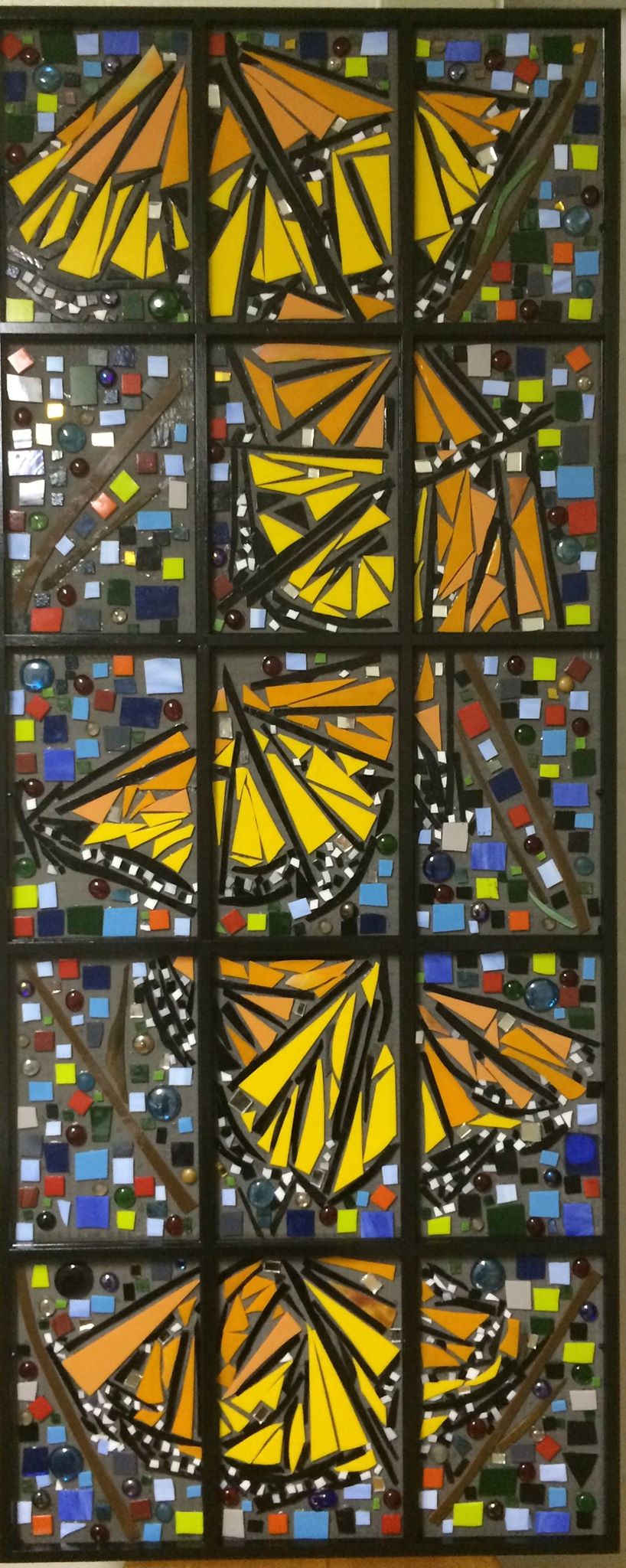
“Las Monarcas” My friend Jill Ross created this mosaic of monach butterflies, and I am grateful to her for the many ways she brings beauty to the world. This image is copyrighted and used by permission of the artist.

Then I think what would happen if he, being Jesus, didn’t take us up on our old tape but instead took all those strands of the shredded paper, the refuse of the world map, and wove them into something new, so that the boundaries went away, and age old enemies were woven next to each other, and what we had was no longer a map but something different, and new, and because it is woven, something stronger than what existed before.

Maybe the Prince of Peace will be the Prince of Pieces, our pieces, the flotsam and jetsam of our tragedy and sin, picked up and not discarded but reused, remade, into something different but still beautiful.

There is sadness in that, too; but maybe a little beauty or at least a little hope.


Jolted

  Sundays in September at church are a glorious thing. About a third of the congregation I serve takes the summer off. They travel, to the beach or the mountains or to other countries. They visit relatives. They go camping. They sleep in and go to brunch and enjoy leisurely coffee with the ever-shrinking Sunday paper. And then, like magic or clockwork, come the Sunday after Labor Day, they’re back in their usual pew, tanned and relaxed and joyous to be with the people again. 

By the second Sunday after Labor Day they have remembered the routine and dress rehearsal is over. They know to come early so they can find a parking place. The pastors robe.  The acolytes light the candles.  The choir processes. The prelude begins and the anticipation of what is to come is palpable. 

Last Sunday I sat up front looking out on the congregation. It’s one of my favorite things to do. There’s so-and-so; those kids grew a foot over the summer; she’s sitting by herself now. We get to baptize that baby this fall. A young couple!  Maybe they’ll come back. 

And as I looked out over the congregation I saw a family I know enter. Grandma, Grandpa, other Grandma, mom, little girl, other little girl who’s lost her hair because she’s going through chemo because she has a tumor in her brain. 

Nothing makes you question the point of worshipping God like seeing a bald five-year-old come into church. 

It’s the hard part of being a pastor and of being a person who believes in God. Terrible things happen all the time, everywhere. Children get cancer. And God lets it happen. 

Tragedy will continue to strike. People will ask why. People will blame God. People will worship God. None of it makes any sense. 

What I know is that on Sunday this family was greeted with love and joy. And we still sang the songs and said the prayers and passed the peace. 

Maybe that child’s presence in the congregation grounded all of us on Sunday, a physical reminder that the world is not perfect. Maybe we all had to dig a little deeper about this God we worship. Maybe we peered into the abyss and saw paradox, joy and sorrow, community and loneliness. 

And maybe I realized why some people take the summer off from worshipping God. 

Clang, clang, clang…

trolley song“Went the trolley.”  You knew that.

I think my favorite role of Judy Garland’s was as Esther Smith in “Meet Me in St. Louis.”  The Gibson-Girl look suited her well, and she was so young and vibrant and in such good voice. There is nothing quite like the joy of “The Trolley Song”.  Ah, love.

I recently had dinner with two of my friends who have fallen in love, and hearing their story of getting to know each other and realizing, pretty early on, that there was something very good there made my heart go zing.  At one point during the conversation, one of them turned to me and said, “Could your smile get any bigger?”

No, it couldn’t, because I love these two people and they suit each other so well, and finding that Someone is one of life’s grandest joys.  Hearing their story took me back to my own story of falling in love with the man who would eventually become my husband – pretty much once that train left the station, it was never going back.  We thought we had been quite clever keeping our relationship secret, but once we started telling people, they all had a “No duh” kind of reaction, which was a little anti-climactic, but I was in love so I didn’t care.

“Meet in St. Louis” ends with the family and love interests gazing at the lagoon at the World’s Fair.  All is well, all crises averted or resolved, all unrequited loves requited.

Life isn’t like that.  People don’t spontaneously burst into song and dance, and happy endings are never perfect.  Some love goes unrequited; some relationships don’t last.  Judy Garland lost that voice and that vivacity, but she never really lost her presence.

My friends who have fallen in love know that, because they’ve endured their fair share of disappointment and sorrow.  That does not erase the elation they now know.  And if this relationship moves to something deeper, that elation will get burnished and shine differently.  I hope that for them.

When I was growing up, my parent had this funny whiskey decanter set that was a trolley car.  The center held two different cut glass decanters, and at each end of the car, roped off with a little chain, were two shot glasses.  When you lifted one of the decanters, a music box started playing “I Left My Heart in San Francisco.”

I supposed we all leave our hearts somewhere.  Perhaps it’s best to leave our hearts with someone.

Clang, clang, clang.


heart

Verklempt at the airport

Departures-and-Arrivals-BoardLast week I was meeting my mom at the airport, and I was sitting in this nice little waiting area just outside security.  I was a tad early, but I’d forgotten my readers, so since I couldn’t check up on my email and Facebook while waiting, I people-watched instead.  It didn’t take long to be mesmerized by a dad holding his young baby boy.  The child was maybe two months old, dressed in a darling little outfit that only a two-month-old can really pull off.  The dad was very sweet, and stood at the front of the waiting space, tender and eager.

I imagined who it was that he waited for.  Had mom gone away on a business trip, her first time away from her baby?  Did Dad know how anxious she would be to see her sweet child?  Or maybe Grandma and Grandpa were coming for Thanksgiving, and were meeting their grandson for the first time.  I did hope that the child’s awaited beloved would show up before my mom did, because I really wanted to see how the vignette would end.  (Although I could have easily convinced my infant-loving mother to stay and watch with me.)

And then the infant’s beloved showed up – a guy about the same age as the dad, bald in the cool-white-dude sort of way.  I don’t think he was the baby’s other dad, because it was clearly the first time the infant and adult had met.  I didn’t notice a resemblance between the two men, so I don’t think he was the uncle. The bald dude said hi to the dad and then went straight to the baby.  He held him and cradled him and rubbed his twin bald head and was so very, very delighted to meet this new little creature.  I could have stood there and watched them all day, the pure joy of the scene.

Fortunately – I guess  – I noticed that my mom was walking by looking for me, so I left my sweet scene and had my own little reunion.  It was not our first meeting, the first time a fifty-something and a seventy-something gazed into each others eyes.  A quick hug and kiss on the cheek was our version of the cradling and the rubbing of the head.

If airport walls could talk….  If a physical structure can hold the emotions of millions, imagine the feelings ingrained in the drywall.  All those goodbyes, some forever.  All those trips to go to a bedside, or a funeral, or a wedding, or a birth, or a courtroom, or a commencement.  All those reunions of lovers, of families, of old friends, of college roommates, of BFFs.  Fear, too, in those walls, and excitement.  It’s a wonder rebar and steel beams can bear the weight.

The holiday season will add to the airport walls, travelers heading out or coming home or getting away.  If I were among them this year (though I am not) I might leave my readers at home so I have nothing to do but watch the people, and get choked up, and be grateful.

Traveling mercies.

Morning Coffee

photo (5)I’m at our family place with most of my FOO (family of origin).  The house is big enough to hold all of us, though the septic tank gets a little cranky if we flush too often or shower too long.  It’s great to see everyone, to come back to this place where we have gathered most summers of my life, to raise glasses and share reader glasses and tell our stories to the younger generations.  It’s all good and harmonious – until we get to the  morning coffee.

We have four different ways of making morning coffee here, because none of us can agree on our Morning Foglifter (which is actually a Stumptown label that none of us has brought.)  My sister has her wee french press for her “stick-a-spoon-in-it-and-it-will-stand-on-its-own” coffee.  My parents have their own french press with special grinder for their strong-ish (emphasis on the “ish”) brew.  My brother and niece grind their own in the morning and brew it, half-decaf.  Me?  Well, last month I bought a Cuisinart 4-cup drip like the one I have at home, along with ground Peet’s French Roast, because the last thing I want to do before I’ve had my morning coffee is listen to a coffee grinder.  Least Favorite Sound. Ever.  It’s like the Fran Drescher of kitchen machines.

I try not to read too much into the whole coffee thing.  I try not to overanalyze the situation, not think that this is endemic of our familial inability to come together, to let go of our preferences and share in the common good, or the common ground, or the common grounds.  At dinner we all manage to share the same bottles of wine; why not morning coffee?

Truth be told, although most of us in my family are morning people there’s a limit to our morning-ness. We are up with the sun, but we don’t really want to engage with each other until we’ve been a little dosed with caffeine.  Maybe there’s grace in allowing each other our individual brews.  After all, my husband foregoes the coffee and reaches for the Diet Coke, and my sister-in-law is a confirmed tea drinker, and we love them.

When we would come to this place when I was little, at the old house where we stayed before my parents built their own place, there was one percolater.  Grandpa was usually up first, and the percolator was going, bubbling up in the glass lid-thing at the top.  If you were a coffee drinker, that’s what you drank in the morning – no french presses, no coffee grinders, just a good waking up to Folgers.  My grandfather, who had a magnificent, wry sense of humor, would laugh to see us these mornings.  But he would be glad we’re all up here, whatever we might be drinking.

So I raise my mug to him this morning, with gratitude for the gift of this place, and for my morning cuppa joe.

photo (4)


Deus Ex Machina

shrugSometimes things go wrong that are completely out of one’s control.  Sometimes things go right that are completely out of one’s control, and often we churchy types attribute the latter to God and the former to the human  condition – or Satan, depending on your theological outlook.

Currently I am attending our biennial national meeting of Presbyterians, the General Assembly of the Presbyterian Church (U.S.A.) (not to be confused with any other kind of Presbyterian, of which there are many.)  I’m here in my role as a Future Volunteer when I will be part of the leadership team providing hospitality to the General Assembly when they meet in Portland in 2016.  This is what I’ve learned so far:

Sometimes things go wrong that are completely out of one’s control.  That may be a God-thing; that may be a Satan-thing; that may be a human condition-thing; or it may just be because the wifi isn’t working.

Here’s something else I’ve learned so far: when something goes wrong that is completely beyond one’s control, how one responds to that is of the utmost importance.  Freaking out is usually not helpful. Calm leadership is helpful.  Sometimes singing is good, and sometimes quiet snarkis good.  And most of the time, having someone who will offer a sympathetic ear, apologize, agree that the situation is messed up, and take a note and see if anything can be done is really the  most helpful thing of all.

Several years ago when on a theater tour in college, one person in the troupe was the designated scapegoat for the tour.  That meant that whenever something went wrong (and something went wrong at least once every day) it was that person’s fault.  Everyone had someone to yell at, to point the finger at, to blame.  And because that person knew that he or she was the scapegoat, he was able to take it.  She apologized for the error, mishap, failure.  He agreed that he should do a better job next time.  She was terribly, terribly sorry.  And then life went on until something else got messed up in some way.

I doubt anyone at this General Assembly wants to volunteer to be GA Scapegoat; in Judeo-Christian circles, being scapegoat usually gets you killed.  So for now, for the the few GA attendees who read this blog, I’ll volunteer.  Yesterday’s wifi overload?  Totally  my fault, and I do apologize.  The need to use paper ballots for the  moderator’s election?  That one’s on me, too.  I am sorry, and if you come by my booth in the Exhibition Hall and mention this blog, I will give you chocolate.  That will fix things – for now.


Waves of Plumeria

This week marks the one year anniversary of the death of my friend Martha. It’s still so hard to believe that someone whose cup ranneth over with life is gone. The photos of her that have popped up on Facebook and our alumni magazine exude vitality and joy and hilarity that taunt death, in a way. But she’s still gone and we still grieve.

This Christmas my parents graced our whole family with a trip to Hawaii, which was wonderful and restorative, and the sprinkles of (let’s call it) family dynamics were few and far between.

On New Years Eve day, my sister-in-law, my nephew, my daughter and I went to a plumeria farm to pick flowers to make leis for the family as part of our New Years Eve festivities.
The kids loved it, and the flowers were beautiful, and our eco-hippie guide showed us his paintings (which we did not buy) and the coconut cups his son made ( which we did buy), and offered us poi and bananas. We made eight leis and went home. We rang in the new year in various time zones, and discovered that one can bear the weight and fragrance of a lei only so long before the sinuses clog up and the neck starts sweating.

New Year’s Day came and the leis began to wilt. We weren’t sure we could bring them back stateside but it seemed to me that to put them in the trash was a bit of a disservice. So I made a plan. Those who wanted would take the plumeria, freed from their strings, to the beach and toss them onto the waters, and remember those we lost.

In the end, only my husband and daughter joined me, mostly because they are good sports. My sister commented that I love ritual, but that comment was as close as she came to making it to the beach laden with flowers.

So in the surf we stood, my husband and daughter and I, and we began flinging flowers and shouting names over the roar of the waves.

Mike and Bud. Ann and Glen. Ruth and Owen. Beulah and Paul- the grandparents. Uncle George and Aunt Mimi and Uncle Jerry and Uncle Harry. Martha. My dear Martha. Gregg’s dear Carolyn. Marie and Dick, my friend’s parents, because if she had been there she would have been the first one on the beach. And the church people. “Mary!” My daughter shouted, and I added Hank. Janet and Wayne and Anne and John and Betsy and so many. It was great.

And then the plumeria all washed up on shore. Not the ritual I was going for.

You see, the flowers were supposed to go out to sea, in a Bobby Darrin sort of way – a reminder that our loves wait for us beyond the waves. But no. These loves washed up on the shore bedraggled and worse for the ritual.

Then I began to worry that in Hawaii it is illegal to throw anything into the pristine Pacific. “If anyone asks, we have no idea where these flowers came from,” I instructed my people.

I was disappointed, let down by my own petard. They looked so awful now, these pretty plumeria. Beat up, drowned. Dead.

But maybe that’s the point. Those who leave us are dead, and that is not pretty and they are not coming back. What’s left of them does sometimes wash up onto our lives, painful memories of the beauty or kindness or hilarity that are no more.

The next day I went down to the beach, and the flowers were gone, somewhere beyond the sea. Perhaps they have been gathered up, leis again, adorning our beloved a who are indeed waiting for us.

20140220-200751.jpg