The Earthly Cloud of Witnesses

A friend of mine is in the middle of a tragedy right now.  It’s a tragedy of circumstance, of being in the wrong place at the wrong time.  There was no evil, no harmful intent.  But she is in the midst of a tragedy, and it is wrenching.

My friend is one of the most faithful servants of the church that we have nowadays.  She has committed her life to serving this funny, flawed, and hope-filled institution.  I consider her a mentor, friend, and yente, as she worked years to get me and my husband together.  I owe her more than I can ever say, and she would never say that I owe her anything.  She’s that kind of person.

Because she has been this faithful servant of the church she knows a lot of people, and I mean, a LOT of people. So when news of this tragedy hit Facebook, our modern and immediate Pony Express, the message boards lit up with prayers that you would not believe.  At the end of the day I read all the comments on all the posts, and I am overwhelmed.  I am overwhelmed by the love and the faith and the hope and the presence that these silly, powerful Facebook comments convey.  And last night, after a long session meeting, as I sat on the couch in my pajamas with the dog in my lap, the husband by my side, and Castle playing on the DVR, I realized that as much as we talk about the great cloud of witnesses in the sky, there is the earthly cloud of witnesses, too.

All these people posting on Facebook – and all those posting on the Caring Bridge site, and emailing and calling and showing up: they are witnesses to love, to the power of love and gratitude.  They are witnesses to the power of friendship, and the church, and belief that you tell people you love them and hold them in your heart.

Love cannot undo this tragedy, and my heart breaks at that.  Love cannot fix what is broken in this situation.  But love might be able to make it a little less worse than it is.  As the tragedy is cauterized, love might distract in that good way.  Love might take away an ounce of the pain.  Love will persist, because I know some of these people in this earthly cloud of witnesses, and like me, they have been mentored and loved by my friend.  They will show up; they will pray; and whether they know or care that they are doing this, they will witness to the Good.

“The light shines in the darkness, and the darkness did not overwhelm it.”

Candlelight vigil cups color

Haunted

Door-AjarToday, after lunch after worship, I went to one of our senior living communities to preside over our monthly communion there.  I love doing that – extending the morning’s table to a group of our saints who can’t make it to the church in the morning.  For some, it’s too hard to physically get into the van that brings them to church, and then too hard to climb even a few stairs.  For others, one hour-ish is just too long to sit in a less than comfortable pew with restrooms too far away.

So we take church to them, gladly.  Two retired clergy who live in this place, and who worship with us regularly, organize the whole thing and I appreciate that.  These two guys could easily play Statler and Waldorf – the old Muppets commentating in the balcony. They love to make cranky observations about church, but I’ve learned as I watch them minister to the saints at communion that you only have to dust off that fine powder of curmudgeon to discover some sweet and compassionate men.

When I arrived at our communion place, which is also where people gather to watch movies and assemble jigsaw puzzles, one of the deacons told me that a regular wasn’t feeling well enough to join the group; could we take communion to her?  Of course.  As we went to her room, we passed one room where a church member recently died.  Farther down the hall, we passed the room where that woman’s husband died a year or so earlier.  Other people now live in those rooms.

It was odd passing those rooms where I spent a few very intense hours as they lay dying.  It’s odd that other people live there now.  It’s odd that those place which were so holy during those dying days are now rooms for another purpose.  Is the holinesss still there?  Or did it leave with the soul of the departed?

After communion I stopped by the hospital to visit another member who has been unconscious in the intensive care unit for ten days now.  She’s another saint of the church.  At 93, she’s been taking French lesson.  As I entered the ICU, I passed by the room where a member was recovering from a stroke.  She has since passed, but I remember the conversations she and I had in that room, and the prayers shared there with family and friends.

So I’m feeling a bit haunted today; haunted by the memory of people who have died, haunted in spaces they inhabited, haunted not so much by their death but by their absence.  It’s odd to feel haunted on the first day of Advent.  Of all the things this season is about, mourning loss or even just remembering it doesn’t quite fit the bill.  It’s a season of light and dark, of portents and hope, of God breaking into the world.  It’s not about our breaking out of the world, or about emptiness.

But maybe it is.  Maybe Advent is about loss, in a way – the loss of the old way of doing things, the loss of the old understanding of how God does things. And maybe it’s a little okay to be haunted by that.

The gathering

angel weepingHaving just led my third memorial service in three weeks, and with All Saints still fresh in my mind, and with one of our members in her last few days, I’ve been thinking a lot about death and grief and community.  I’ve also had a lot of stiffness in my “angel wing spots” – that place just inside the shoulder blades that get tense and knotty.  I’m thinking it’s accumulated grief, having witnessed a lot of tears and soggy tissues lately.

I’m one of those who often says, “I don’t know what people who don’t have a church do when someone they love dies,” except now I do, because I’ve been a witness to that, too.  The first of the recent memorials was for a woman whose husband described her as “a very lapsed Catholic.”  Church is not his thing, and was not hers, but they needed a place to have a memorial for this woman who was an extraordinary advocate for justice in many ways.  The church, full of faithed and non-faithed people, was packed, like Christmas Eve packed. People wept, and sang, and gave testimony to her life.  I offered a prayer and a blessing.

The second memorial was for a woman who was a person of faith, but who had so many different communities of which she was a part – 12 Step, running, partying, engineers.  Again the people gathered, some have nothing to do with God, some relying on their Higher Power, at least one who follows the path of Buddhism.  God didn’t matter to so many of them, but gathering in community mattered very, very much.

So to my own question of “what do people who don’t have a church do when someone they  love dies?” I now answer: they gather.

And sometimes they gather in a church, because (at least for me) churches still offer the witness of hospitality, opening our doors to those who grieve. We don’t ask for proof of baptism at the door; we don’t preach that those who don’t believe in Jesus will go to hell when they die.  We open our doors. Because they – whatever they believe – need to gather, we do what we can – offer pews and organs and pianos and chairs, and tea and coffee and cookies.  We have projectors and screens for their slide shows, and tables for photographs and flowers. We have deacons who pass out programs and hosts and hostesses who refresh the bowls of nuts.

I think people are surprised that churches do this sort of thing, at least in this neck of the woods.  “You would let us have your service there?  But my loved one wasn’t a member/ didn’t go to church/ maybe didn’t believe in God.”  Yes, we would.  That’s what we do.  We witness to the hospitality of God by offering hospitality to the community.

In my All Saints sermon, I said “I imagine sometimes that the walls of the sanctuary have a patina, invisible layers of our songs and our prayers and the tears shed in this space.”  And here’s the thing: some of those songs and tears have come from people who don’t believe in God, who are shocked to find themselves inside a church, amazed that they are even welcome in a church.  But their tears and songs and silences are part of the patina too. They don’t have to believe in God in order to grieve the death of this person they loved.

There is a holiness in grief, and a privilege in witnessing it.  But I would like a little less of it, please.

Alas.

My Favorite Sunday

ray of lightThe celebration of All Saints is, hands down, my favorite Sunday of the year.  Not the Sunday before Christmas, not Easter, not Epiphany or any other, but All Saints.  As the preacher of the day, I always want to capture this elusive feeling/image/sense I have of the day – something glowing, radiant; Ralph Vaughan Williams, gold and white, a packed house with nary a dry eye.  Rarely does it come together that way, but we can have our aspirations.

The church I grew up in didn’t celebrate All Saints; few Protestant churches did in the ’70s and ’80s.  My first experience of the holy day was at seminary, when in the chapel service a list of the dead was read and in the Latin American tradition, after each name was pronounced we all shouted, “Presente!”  They are present.  The saints have left, and haven’t.

This year, it’s a ten-day celebration of saints for me.  It began last Saturday with a memorial service-ish for someone I’d never met, a woman who was not particularly Christian any more, whose friends filled just about every nook and cranny in our sanctuary (which seats around 500.)  Last night, I led our evening worship service, borrowing elements from the Day of the Dead tradition.  People were invited to bring photos of their beloveds who had died, or to write their names on a card, and to take the photos and cards to the communion table and decorate them with flowers and candles and chocolate and other things.  Last night was no glowing, white and gold majestic thing.  It was colorful, vivid, as down-to-earth as you can be while singing accompanied by guitar and accordion.

This coming Saturday I’ll preside over another memorial service, for a young woman who was a member of our congregation whom I knew a little.  She was murdered a few weeks ago, having fallen in with the wrong sort.  Shot in the head after a night at a strip club, she died alone in the middle of the night.  I want to throw up, and scream, and go back in time to save her.  But I can’t.  What I can do is offer a place for her varied group of friends to come and remember her, to testify to the good and to the mess of her life, to build a community so that, at least for a few hours, some light will shine in the darkness that surrounds her death.

And then there’s this Sunday, my favorite, golden and gleaming (maybe).  Good hymns, good liturgy, the roll of the deceased read and the opportunity to name loved ones who are gone.  Communion, too.  I love it, and hope to do it justice but know that really, that’s not up to me but the Spirit who usually does show up when She’s invited, and often shows up when She’s not.

Why do I love it, this day that can be so sad?  I can’t get through “For All the Saints” when we sing that line, “through gates of pearl stream in the countless host.”  Why do I love it? I think because it’s a thin place, All Saints Day.  Earth and heaven breathe on each other like a mother and child snuggling at bedtime.  It’s a thin line between the living and the dying, because all of us who are alive still face the mystery of death, and because those who have died linger among us in their gifts and legacies, and their eerie presence that we still feel at unexpected times.

All Saints Sunday is coming, and I am glad for that.  In the meantime, there is a memorial service to plan and, I just learned, another one after that.  There are committee meetings to prep for, and a poetry class that starts this Sunday.  There’s a newsletter article to write, and one last pumpkin to carve at home.  I might even put up a few cobwebs for Halloween, and I still need to buy candy.

In the meantime, life happens as it happened for all the saints.  We feebly struggle, they in glory shine.  That’s what I’m counting on, when my meantime ends and that thin line is crossed.

Pride and Humility, with maybe a bit of prejudice thrown in

But maybe it's humble pie...

But maybe it’s humble pie…

So I was pretty sure I was about to get my gluteus maximus handed to me on a platter.  Instead, I received a more gracious lesson in humilty than I could ever have imagined.

Someone else handed that part to me on a platter in a different matter, but that’s another story.

A friend of mine just posted “I’ve been learning a lot about humility lately” and I replied “me too.”  I have a new-found respect for the beatitude about the meek, because if they’re anything like the few meek people I knew, I do believe they deserve the inheritance of this beautiful earth.

Maybe like a lot of people, I have a lumpy ego – strong in some areas, wilted in others.  In my role as pastor, and particularly as female pastor, I’ve assumed a strong stance.  Just because I’m a lady minister does not mean that I am a pushover, so I will assert myself in meetings and sermons  and emails and all sorts of places.  And sometimes I really am working from a strong place; sometimes I’m just pretending and praying that no one will pull the curtain and discover that, in fact, I am not Great and Powerful but just pretending to be.

I want to be strong, smart, articulate, assertive, on top of things.  But I learned today that sometimes being those things is off-putting or discouraging to someone else.  There I was, talking to someone whom the world might disregard, overlook, or write off, for reasons of prejudice I won’t go into.  I was pretty sure this person was mad at me and was going to let me have it.  So I had girded my loins and prayed my version of the Sinner’s Prayer: “Dear sweet Jesus, please help me to keep my mouth shut and help me to channel just a little bit of your grace.  Amen.”

Well, Jesus didn’t need to help me keep my mouth shut because my Meek of the Earth person did.  In an elegant, direct, kind way, this person helped me understand that when I put forth my Miss Smartypants self, I can be intimitidating.  The wilted part of my ego finds it hilarious that I could intimidate anyone, but the reality check I had today confirmed it.  At some point during our conversation I had the big a-ha.  Oh, this is what Jesus means by the least of these.  These are the ones we are to care about and to care for.  I have gotten it wrong, wrong, wrong.  It really is so not about me.

Anyway, I’m humbled today, and that comes from a strong place, if you know what I mean.

The Great Hall Curtains

These aren't our curtains, but they could be.

These aren’t our curtains, but they could be.

Last weekend I was at church for a dinner which was held in our Great Hall, a space that’s known as the fellowship hall in other churches.  It’s a big room with a stage at one end and a kitchen at the other.  Pretty much everything happens there – coffee hour after worship, Christmas pageants, chorus rehearsals, Qi Gong, youth fellowship, congregational meetings, congregational dinners.  The whole schmear.

So I’m in the Great Hall, a place I’ve been hundreds of times, and once again I notice the curtains.  Dear Lord in Heaven, they are in terrible shape.  On some of them the rod is detaching from the wall, so they hang at a nice slant.  On others, the curtain pull mechanism is broken and they look a bit like wilted lettuce (if lettuce were beige, in which case I wouldn’t eat it.)  Most of them are stained, and a few have some holes in the lining.  So I’m sitting at this dinner and make some sort of remark of exasperation about the curtains.

Not five seconds later, I regret the remark.  I’m sitting next to a visiting Presbyterian minister who is one of our denomination’s missionaries working in Mexico along the Arizona border.  He has come to speak at the dinner, to teach a class about his ministry and about our relationship with Mexico, and to preach on World Communion Sunday.  I bet the last thing he noticed were the curtains.  And I wonder if he heard my comment and thought, “with all the need in the world, with all the need I see on a daily basis, with all the need even in your own backyard of Portland, you’re worried about the curtains?”

He didn’t say that, mind you.  He made a general comment about taking care of spaces and I, chagrined, quickly changed the subject.  I wrestle with it – how do we spend our resources?  On the one hand, I want to take pride in our facility, because it is used not only by the congregation but by a variety of groups in the community as well.  A few weeks ago we held a memorial service there because there was a wedding in the sanctuary.  Did the mourners notice the dilapidated state of things?  On the other hand, there are people going hungry; isn’t it better that they are fed than that the curtains look nice?

I suppose it’s good to struggle, but today, I wish for an easier answer.

For the rain it raineth every day

Heavy DownpourLong ago, while studying the Hebrew scriptures in seminary, I was more than a little bored while we were in the middle of 1 & 2 Chronicles and their fully detailed description of building the temple in Jerusalem.  Feel free to read 2 Chronicles 3-6 if you want to get a sense of this.  Anyway, dear Marv Chaney noted our rolling eyes and yawns, and said something like this:

“Surely these details are abundant, but I tell you, some day when you’re the pastor of a church and you’re building a new sanctuary, you will want to fill me in on all the details of the plans.”  Yeah, right, I thought, little knowing that in my first call, we would remodel the sanctuary; in my second call, we would build an entirely new sanctuary/office/fellowship hall; in my third call, we would remodel the kitchen and fellowship hall; in my present call, we are figuring out what to do with this building which of late has sprung a few leaks.

When I went into ministry, I did not realize I was signing up for building management.  I wasn’t, of course, but….  We have really, really competent lay folk – architects and engineers and interior designers and contractors – who are able to make informed decisions, and building and custodial staff who deal with the nuts and bolts of our physical plant.  But still, hundred-year-old buildings, like hundred-year-old people, require a lot of care.  So while over the past few months we’ve talked about accessibility and deferred maintenance and improvements, and while in the last week we’ve dealt with significant water damage caused by rain during a re-roofing project, I’ve been a bit convicted by something Frederick Buechner once said in an interview with The Christian Century.

“I say the best thing that could happen to your church is for it to burn down and for all your fax and email machines to be burned up, and for the minister to be run over by a truck so that you have nothing left except each other and God.”  (9/18/02)

There are days.  There are those days when I wish we didn’t have a building to care about.  But then I remember the holiness of a church building and of our church building.  WIthin these walls people have seriously mourned, and riotously praised.  Within these walls the Spirit has led people to join the family of God.  We’ve broken bread and shared the prayers of broken hearts.  We have sung, and those songs still linger like incense among the rafters.  The church building is a holy place, not because of the cross or pulpit or stained glass, but because in the building God and humans have run into each other and laughed with amazement at it all.

So I guess I’m both resigned and grateful to have this building to take care of.  And there will always be something to take care of, because as Feste sang in Twelfth Night, “the rain it raineth every day,” or the boiler will be on the fritz, or a toilet will overflow.  But I would appreciate it if God would stop sending the rain our way so that we can mop things up and get on with the work of ministry.

In Praise of Pastors’ Spouses

lizzy bennettTonight I am going to a rehearsal dinner in the role of pastor’s spouse.  I’m not in that role very often, since my spousal unit and I are co-pastors.  But once in a while someone outside the congregation asks just one of us to do something, and the other tags along in the spouse role.  When I go to this sort of thing, I always imagine myself as Elizabeth Bennet, a tactful and witty observer of the human condition.  I look forward to tonight, plus I get to get dressed up a little.

The first time I was in the role of pastor’s spouse was pretty horrifying for me.  We’d not yet been married for a year, and for various reasons too complicated to explain here, I wasn’t working.  My husband was serving as an interim synod co-executive (I kid you not.) We drove five hours for him to be the Honored Guest at the tenth anniversary of a new congregation formed when three congregations merged.  (As a side note, it’s pretty good for a merger of three churches to have lasted ten years.)  Anyway, when we arrived, we were greeted warmly and I was given a nametag that read “Beth Neel, Visiting Pastor’s Wife.”

I almost cried.

I had been a pastor – a real bona fide pastor of a congregation – for ten years.  My husband had never served a congregation, and there I was, thrust into the role of Sunday-school-teaching, jello-recipe-exchanging, cookie-baking wife.  We laughed about it – later.  Much later.

Here’s the thing about pastors’ spouses that I know: they put up with a whole lot of stuff.  They have more expectations put on them than pastors do.  Like pastors, they are punished if they really speak their mind at church and so are relegated to commenting on whether the bark mulch needs some freshening up or if the punch was too fizzy last week.  If they choose to have firm boundaries about what they will or won’t do at church, they’re criticized.  On top of all that, they get to listen to their spouse complain, and rant, and cry, and wonder if it’s time to go sell insurance.

I think – or maybe it’s just a hope – that it’s gotten better for pastors’ spouses with an increase in the number of clergywomen.  There are different role expectations for men than for women.  And most pastor families I know need for both spouses to work, so there simply isn’t time to be Number One Volunteer at the church.  As our society moves more toward gender equality, it’s understood that anyone can bake cookies, spread mulch, teach Sunday School, or direct the children’s choir.  They don’t even have to be married to someone on the staff.

Still, it must be hard at times for those husbands and wives.  So this week, if you’re at church, don’t just shake the pastor’s hand.  If your pastor is married, find her or his spouse and tell that person how glad you are that she or he is here. You really don’t have to say anything else.  And if the pastor’s spouse isn’t there, for heaven’s sake don’t ask why he or she is playing hooky.

So, to the pastor’s spouses I’ve known, especially those whose spouses I’ve worked with – Betty, Kay, Kerri, Tracey, John, Anna, Sue, Missy, Julie, Dave, Sarah, Fi, Carol, Barb, Nancy – my hat is off to you.  Thanks for being you.

A Perfect Moment

asteriskThis morning I was sitting in the sanctuary about half an hour before the service started.  I came down from the office because the choir was rehearsing one of my favorite anthems – John Rutter’s For the Beauty of the Earth –  and hearing just once in the service wasn’t going to cut if for me.  I sat down in one of the transept pews, next to a dear, long-time member of the church who comes early, I think, so she can hear the choir rehearse.

As the choir was making their way through the song, one of my other pastor colleagues came in with a family whose infant son was to be baptized.  The parents joined the church at Easter, when the dad was baptized, so there was something lovely about he and his wife bringing their baby to be baptized.  The child was as bald as a peeled peach, with a sweet sweet round face.  Just enough drool to make him adorable hung on his chin, and he smiled at me while I made silly faces at him.

My colleague was showing the parents the baptism choreography, and as he took the baby, so tenderly, and kissed his little forehead, the choir was singing, “For the joy of human love/Brother, sister, parent child,” I thought: that’s perfect.  Everyone is up there practicing for the real thing, and the community isn’t gathered yet to witness it, but I was able to witness this moment when song and delight and love came together just right.

That would have been enough for me, that experience of the holy, twenty minutes before the service started.  But the choir finished and need to trot downstairs to put their robes on, and the family need to do one last diaper change before the service.  I had gone to the trouble to write a sermon, so I figured I might as well preach.

Those perfect moments are rare, especially when you’re in the business of church and you have a fair amount of responsibility for all the details that go into that one hour a week.  Rarely do we conduct perfect worship, nor does God want perfection.  I think God would much rather have something flawed and authentic than perfect and over-rehearsed.  But those rare perfect moments are like little asterisks at the end of the sentence of a hard week, a reminder that the crap gets meliorated by a gracious, patient God who isn’t too high and mighty to show up for rehearsals.

It was good worship today – not perfect, but good – and as one parishioner noted, it thundered during the baptism, which was cool of the Holy Spirit.  It’s so good in the fall to have everyone back together, the fullness of worship and hymns and prayers and rambunctious kids in the children’s moment and all that.

But truth be told, when the service started, I had already done my worship for the day.

Hard Work Does Not a Good Suit of Armor Make

suit of armorOften I am surprised that at the ripe old age of 49, I am still learning things about myself. As a younger version of myself might have said, “No duh.”

This week’s insight: I work hard so as to avoid criticism. Sometimes I enjoy working hard because I love whatever project I’m doing. Back in my single days, when I had more free time, I painted furniture. I could spend an entire Saturday painting squiggles and checkerboards on chairs and love every minute of it. Sometimes I enjoy working hard because of the intellectual challenge – writing a sermon or some liturgy, or preparing for a class I’ve never taught and have to create from scratch.

But the ugly truth is that much of the time I work hard so that others won’t criticize me. I look at my to-do list and sometimes prioritize based on how much flack I will get from a person or a committee if I don’t do that particular thing. I anticipate all the critiques that could come my way if I don’t do something, or don’t do something well, and I bust my proverbial butt to create something excellent – not because the thing deserves to be excellent, but because I don’t want people to complain if/when it isn’t excellent.

Here are the flaws in this plan:

1. Some people criticize no matter what.

2. Sometimes my best is not what someone else considers good.

3. If I keep this up, I will become cranky, feel put upon, and likely burn out.

I once worked with a pastor who was adamant about not being a people-pleaser, and let me tell you, he wasn’t. There was a big downside to that, because he wore his “I’m not a people pleaser” t-shirt with pride, to every worship service, to every session meeting, to every staff meeting. But there was an upside, too. He was not overwhelmed when he was criticized. He had really decent boundaries around work. And he made decisions and prioritized not to stave off the critics in the church, but because it was the right thing to do.

Of course I imagine more criticism than would actually come my way. I work in a place where people are rather kind, and thoughtful, and gentle with their criticism, which is usually valid. But my imagination has been working overtime lately, with a few big hard decisions that have been made, and with the start of the program year and a long to-do list. With my overactive imagination has come some edginess, and anxiousness, and definite thoughts of being put upon. And I have put them upon myself.

Last week, just before the benediction, I quoted a line from our closing hymn: “My grace, all sufficient, shall be thy supply.” I really don’t believe God is in the criticism business, that God is in the grace business. So I’m working off taking off that suit of armor, and putting on my dance shoes, to work with grace.

“I know nothing, except what everyone knows –

if there when Grace dances, I should dance.”

W. H. Auden

20130913-100332.jpg

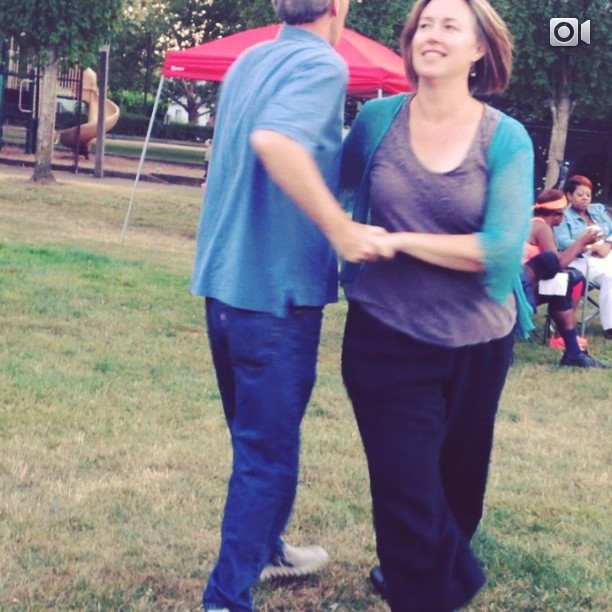
My husband and I dancing (sorry the video won’t play) at a concert in a park