Easter Thoughts, A Little Early

This year, I will be leading the Vespers service at a local retirement community on Easter Sunday, and as is my wont, I started looking through old Easter sermons that could be brushed up a little for this upcoming occasion. As I went through them, I kept tearing up. Why? Happily, not because they were terrible, but because they offered a word of hope, and I hadn’t realized how much I needed to hear about hope, even from myself a few years back. It was hard to read the ones I offered during the pandemic, from my home or from an empty sanctuary, remembering the uncertainty of that time and the losses upon losses.

And though Easter is still shy of two weeks away, I offer the conclusion to one of them, if you’re a preacher in need of some hope or joy. I don’t claim that any of my words would even win a preaching prize (which is really a silly thing, after all) but sometimes you need a little bump to get you going.

In the meantime, Lent is still with us, and given all that’s happening, it may feel as though Lent is still with us after April 21. Even so, God always gets the last word, and Love always wins. Here you go.

Joy is the jitterbug meeting the waltz, and Rembrandt and Dr. Seuss comparing notes, and hope disguised as a gardener. And you? And I? What is our joy?

Joy is when the rains cease
Joy is when the baby squeals
Joy is the march
Joy is the old friend who shows up
Joy is the peace accord
Joy is the casserole
Joy is the grave cloths neatly folded away
Joy is the mountain decked in so much snow
Joy is the full table with everyone there
Joy is the story told again and again
Joy is the joke with life as the punchline
Joy is the fern unfurling
Joy is the empty tomb
Joy is the daphne and lilac and lavender
Joy is the gift that will not be taken back
Joy is life, and more life, and life after that.

My husband and I on Easter Sunday, 2021, getting ready to celebrate drive-through communion in the church parking lot.

Love and Dust

Our daughter was born on Fat Tuesday, which meant I spent Ash Wednesday 2006 in a hospital room, recovering from a C-section and trying to figure out how to breastfeed. After experiencing the joy and fear of giving birth, I really did not need to remember that I was dust and to dust I would return. At the time, I felt more like I was made of blood and colostrum and placenta, which are very much things of birth.

That was the last time I was not marked with ashes on Ash Wednesday. This year I repeat that, for reasons that seem a bit inconsequential and maybe a little lazy. Last September I left the congregation I happily served for thirteen years, and I have not yet found a new worship home. To be honest, I haven’t looked for one yet. After serving congregations for thirty-one years, I need a break. I need to let go of all my expectations of how worship should happen, what fills me in worship. I need to empty myself of all of that, and then start fresh.

I imagine for many folks there is no need to be reminded that they are dust and to dust they will return. The world tells them that all the time. The White House tells them that in cruel tweets. Rude customers, impatient drivers, racists, misogynists – there is a message of death and hate that pervades so much of every day life. Why add ashes as another reminder?

I dare not speak for anyone , but I will say that there was something honorable and profound and horrific about making the sign of the cross on people’s foreheads. Honorable because they trusted me, their pastor, to say these true words with love. Profound, because death is so wrapped up in the mysteries of creation and incarnation and resurrection that mere words cannot begin to convey all that is meant by the ashy cross. And horrific, because the woman who has lost all her hair from her chemo treatments doesn’t need to be reminded that she will die, because the precious child, conceived by IVF after years of miscarriages, needs to live a full, long life, and not think about death for a long, long time.

Receiving the ashes is another thing. Sometimes a fellow pastor would mark me, and sometimes my fellow pastor/husband made the sign of the cross on my forehead. Sometimes a parishioner would make the sign. It didn’t matter who did it, though I always knew the person. Someone who loved me, or who worked to love me in that Christ-way, was telling me the truth that I would die some day, that all of us will die some day. On Ash Wednesday, that’s as far as we get in the story.

And so Lent has begun, and for me, without ashes. My daughter sent me a picture today of her and her friend who made it a point to go to chapel and get marked today. I’m a bit filled by that. A stranger told her that she is dust. While I clung to her in that hospital bed at the beginning of Lent nineteen years ago, now I let her go into the world, full of dust and life, to make her own way. For a long, long time, I hope.

So given the state of the world, perhaps this year I would offer these words:
“Remember you are made of love, and to Love you will return.”

Women, Ancient and Present

The Daughters of Zelophehad: Numbers 27
“Then the daughters of Zelophehad came forward. Zelophehad was son of Hepher son of Gilead son of Machir son of Manasseh, of the clans of Manasseh, son of Joseph. The names of his daughters were Mahlah, Noah, Hoglah, Milcah, and Tirzah. They stood before Moses, Eleazar the priest, the leaders, and all the congregation, at the entrance of the tent of meeting, saying, ‘Our father died in the wilderness; he was not among the congregation of those who gathered themselves together against the Lord in the congregation of Korah but died for his own sin, and he had no sons. Why should the name of our father be taken away from his clan because he had no son? Give to us a possession among our father’s brothers.’

Moses brought their case before the Lord. And the Lord spoke to Moses, saying, ‘The daughters of Zelophehad are right in what they are saying; you shall indeed let them possess an inheritance among their father’s brothers and pass the inheritance of their father on to them. You shall also speak to the Israelites, saying: If a man dies and has no son, then you shall pass his inheritance on to his daughter. If he has no daughter, then you shall give his inheritance to his brothers. 1 If he has no brothers, then you shall give his inheritance to his father’s brothers. And if his father has no brothers, then you shall give his inheritance to the nearest kinsman of his clan, and he shall possess it. It shall be for the Israelites a statute and ordinance, as the Lord commanded Moses.'”

Years ago, when I was in seminary, we were studying the Hebrew Scriptures. At some point in the semester the professors assigned us an article by Dr. Katharine Doob Sakenfeld, Professor of Old Testament Literature and Exegesis Emerita at Princeton Theological Seminary, having previously been William Albright Eisenberger Professor of Old Testament Literature and Exegesis. This story – unknown to me – took place during the Exodus, as the people who have been wandering the wilderness are about to enter the promised land. Well, the article opened my eyes, not only to this story of five sisters who plead their case before Moses and Eleazer, but also to the possibility of feminist biblical interpretation. Whether this story is historically true, which it is likely not, it is a curious thing that in all of the Torah, the story of these sisters – Malah, Noah, Hoglah, Milcah, and Tirzah – is included.


Is it a dangerous passage, this story of women challenging the patriarchal rule that only sons can inherit land? Does granting women access to things that historically belonged to men and men only open the floodgates to women doing all sorts of things that might give them power? What does this story tell us about the lives of women in ancient scripture? And how does this ancient story speak to the lives of women today?


I wish this story ended beautifully, all tied up with a neat bow, but it doesn’t. At first, Moses consults God who says yes, these women may inherit their father’s land. That’s Numbers 27. But jump ahead to Numbers 36 and we learn the inheritance comes with a condition: that the five sisters marry only within their own tribe, so that the land does not end up with someone outside the family. Of course.


A few years ago I discovered the work of Dr. Wilda C. Gafney, (The Right Rev. Sam B. Hulsey Professor of Hebrew Bible at Brite Divinity School of Texas Christian University), a biblical scholar who writes from the Womanist tradition. She, too, is interested in the stories of women in scripture, but from the perspective of Black women. Her writing has inspired me to consider even more women in the biblical stories, to look deeply at their lives, and to consider what they might say to us today. If you’re willing to face some Hebrew and academic terms that might be unfamiliar, I heartily recommend her book Womanist Midrash: A Reintroduction to the Women of the Torah and the Throne.


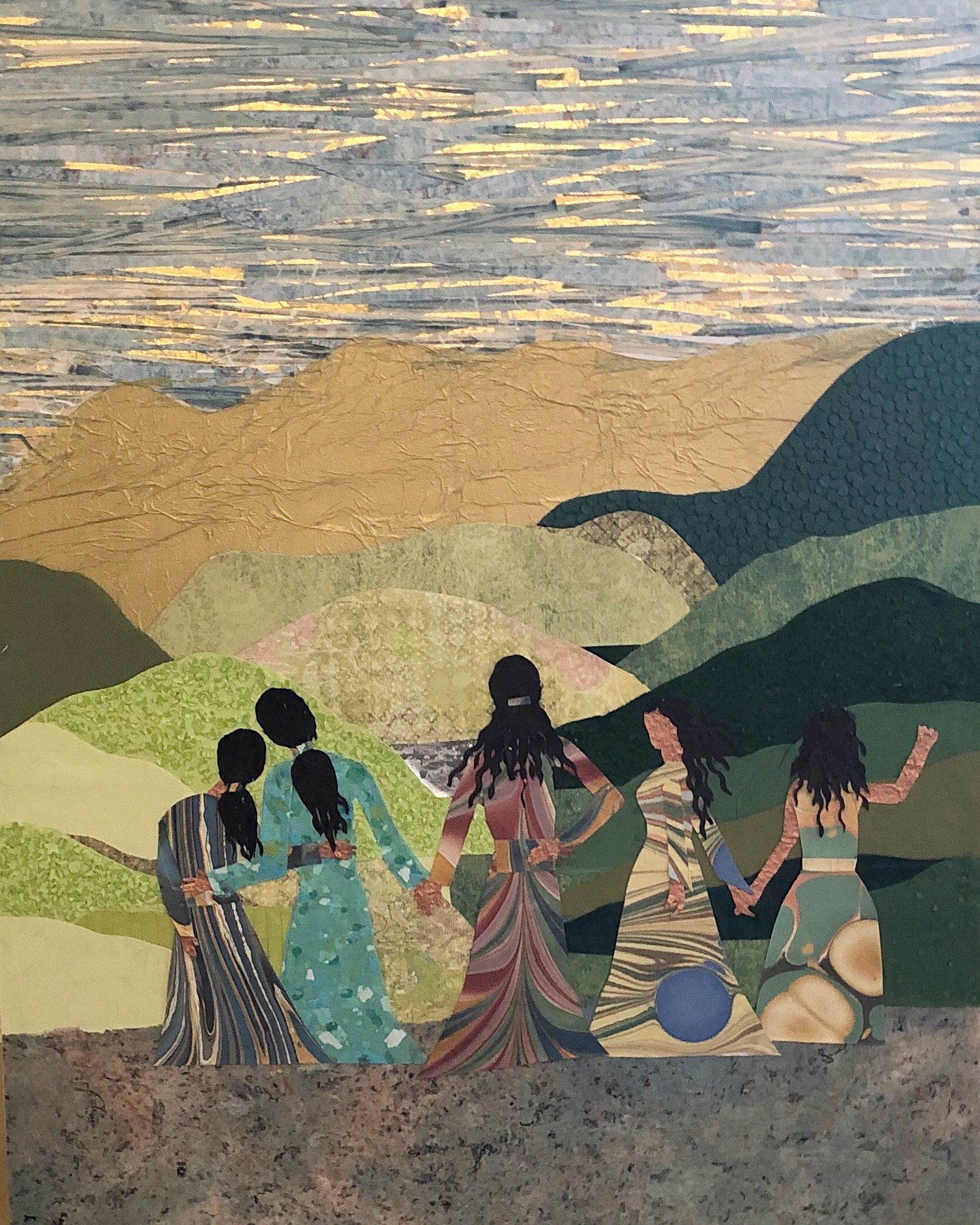
Anyway, I will get to the point. Since that Old Testament class in 1989, the daughters of Zelophehad have stuck with me. A few years ago I was working on an art series, “Unknown and Unnamed: Women of the Bible” and made this picture, “The Five Sisters Who Inherited Their Father’s Land.” It’s been a fan-favorite of my ten fans, and I have promised my own daughter I will not sell it.


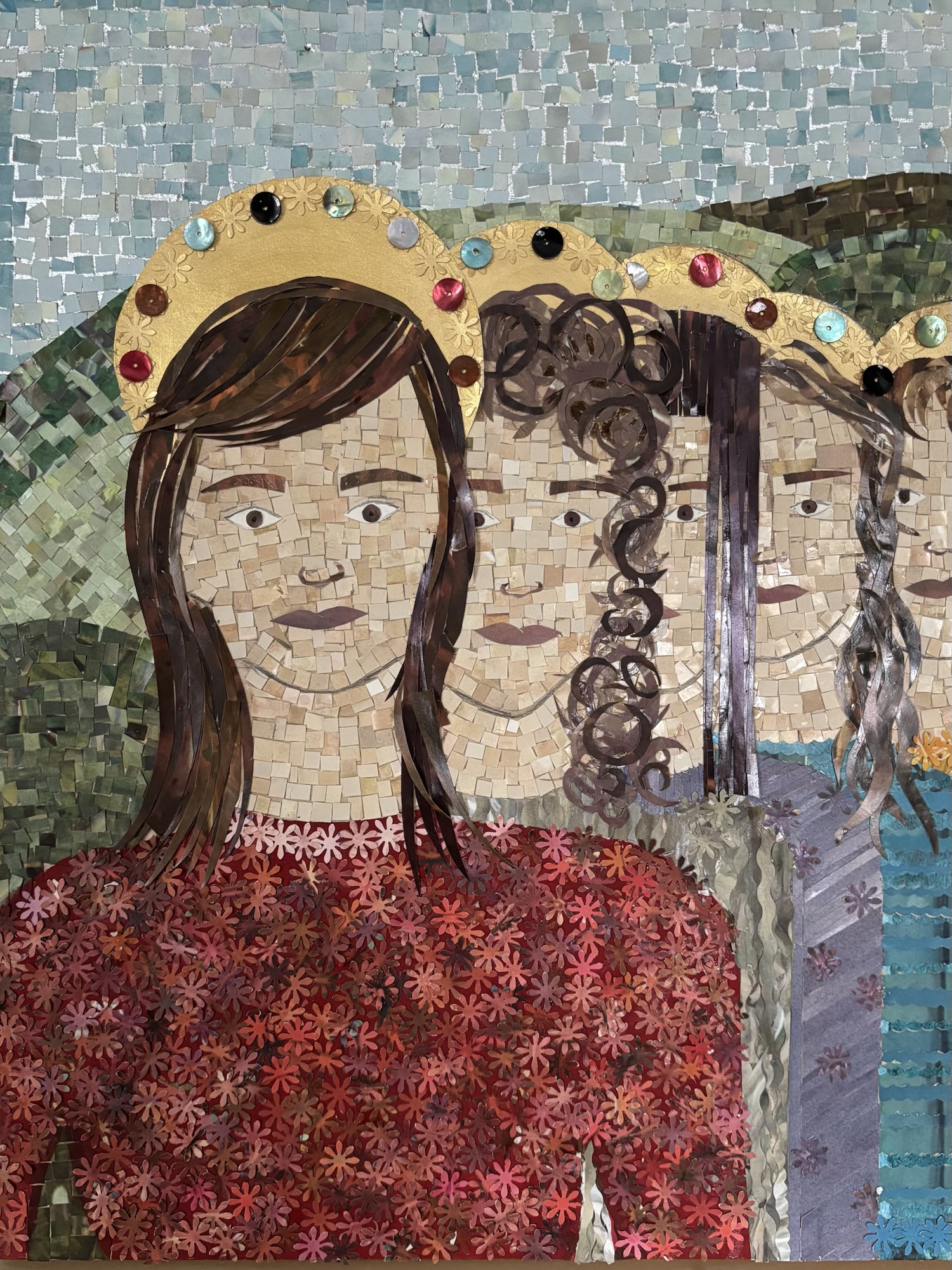
More recently I’ve been motivated to create some new Matron Saints, and the first of this new batch is “Malah, Noah, Hoglah, Milcah, and Tirzah (the daughters of Zelophehad), Matron Saints of Those Who Challenge the Patriarchy.”


Why has this story stuck with me? In part because I get so very frustrated and enraged by the power games of the patriarchy which still exists today. I am cautious about criticizing cultures that are not my own, so I’ll stick with the U.S. I see patriarchal power plays in the culture, in politics, and I see them far too often in the church, even in my own beloved denomination of the Presbyterian Church (U.S.A.)


So if there’s a chance that women might receive something previously withheld from them, or better, receive it without condition, I want to celebrate that. I want to celebrate women being acknowledged as being gifted, compassionate, strong, emotionally intelligent, intellectual, wise, brave, capable of making decisions about their own bodies, and willing to make good trouble. I want to hear the stories of women who have been denied, of women who’ve given up because that wall of patriarchy is twenty feet thick and make of diamonds and steel. I want to know men who are willing to step away, step down, so that a woman might have an opportunity otherwise denied them.


I want the descendants of Malah, Noah, Hoglah, Milcah, and Tirzah to be emboldened to speak up not only for themselves but for other women as well. I want us to make as happy an ending as possible for the story of women. I echo what Marie Shear once said: Feminism is the radical notion that women are people. May it be so.

My thanks to Drs. Robert Coote and Marvin Chaney, my Old Testament professors at San Francisco Theological Seminary, to Dr. Sakenfeld and Dr. Gafney for their rich and inspiring work, and to all the women out there who keep on going.

Revisiting the Matron Saints

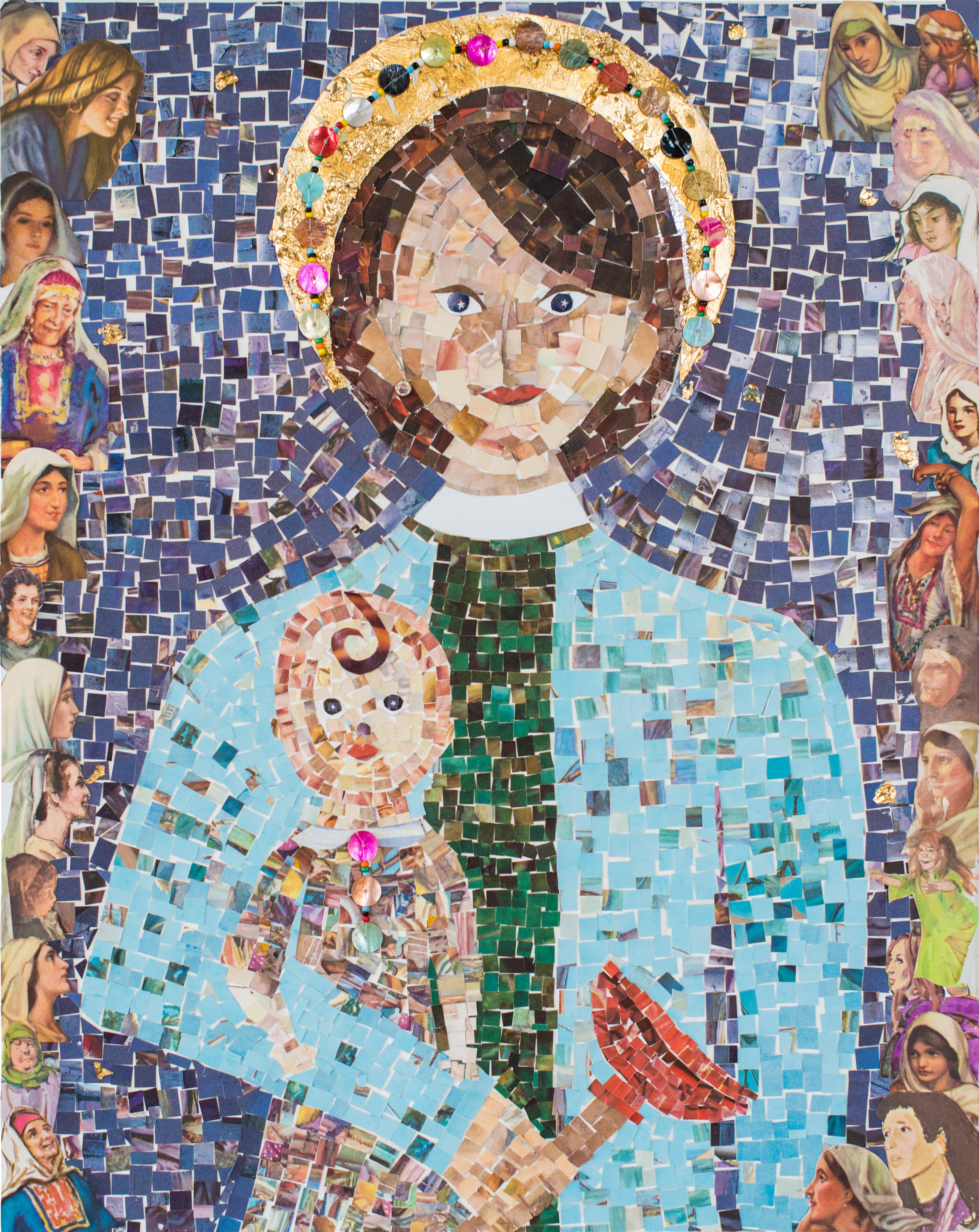
Eight years ago I made a paper collage icon of the biblical Martha, using cut-up pieces of old Sunday School lithographs. I modernized her, imagined her as a clergywoman (or my experience as a clergywoman) and so, in addition to wearing her very proper clerical collar, she was also holding a baby in one hand and a toilet plunger in the other. She was surrounded by all the women who encouraged her over the years – and one who was very grumpy about the whole thing and really thought that only men should be pastors. Ask any clergywoman you know, and she will concur with the experience.

And so the Matron Saints (h/t to my friend Michelle Bartel, who came up with the title) were born. I made twelve, and each was a woman in a Bible story whom I admired or thought a lot about and who represented an issue in the world, the nation, or my life. Creating them helped me get through the first Trump administration.

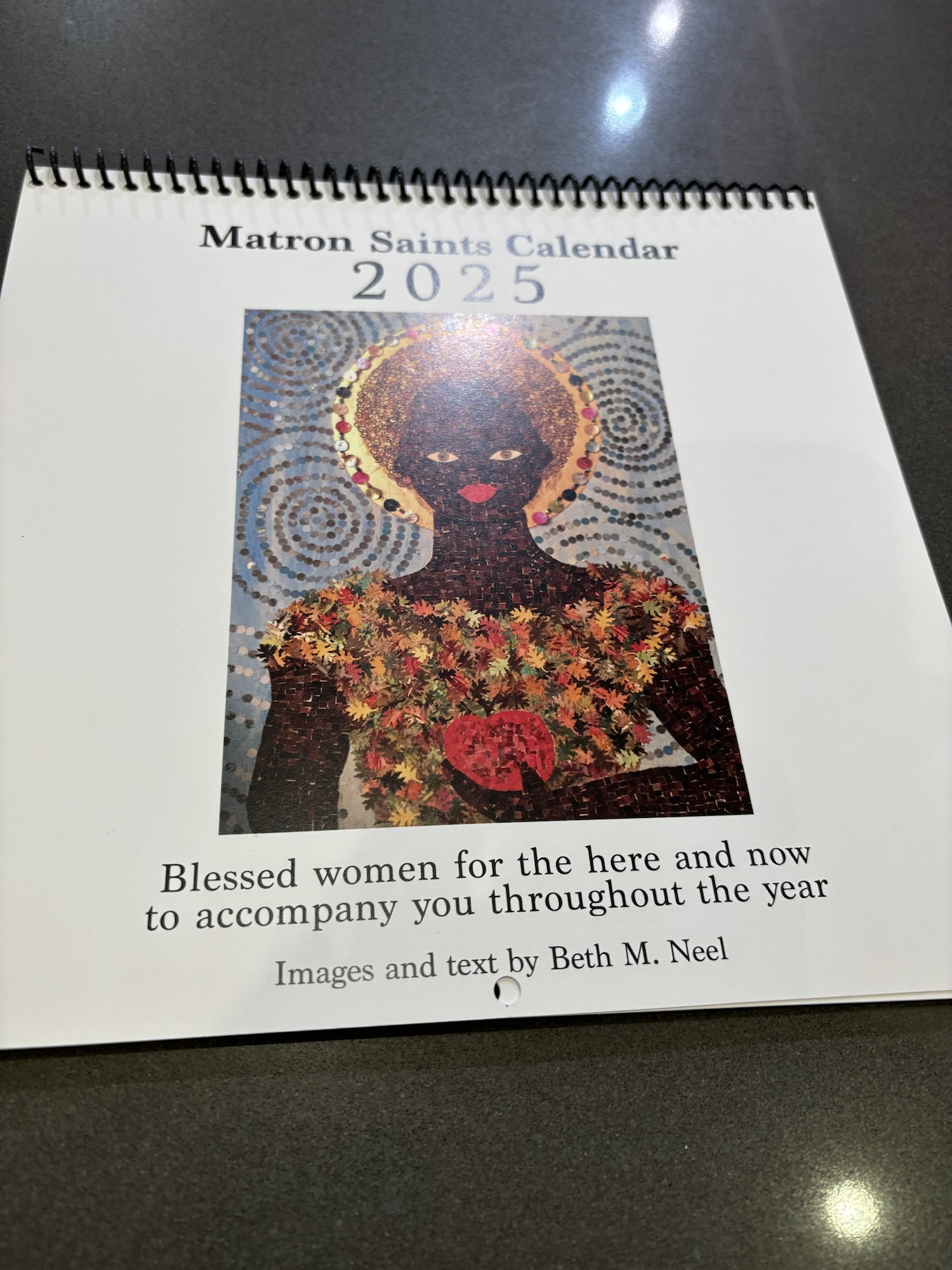
I made notecards and sold some and then let them be. But the time has come for them to be dusted off. So this post is really a bit of a shameless plug, because not only am I selling cards again ($30 for a pack of 12 Matron Saints, or $3 per card, plus shipping if you’re not local) but I also made calendars and they are, much to my surprise, selling like hotcakes ($25, plus shipping.)

If you want to know more about this project, click on the “matron saints” tab above, and on its drop-down menu. If you’d like to order some, reply to this and then I’ll follow up.

In the meantime, be well, and be blessed, and don’t give up hope.

The Waterford Cookie Jar

When my husband and I got married nineteen years ago, one of the people on both of our invitee lists was a woman named Georgia, whom we’d both known before we knew each other. Georgia was the quintessential church lady. She would be 101 now if she was still with us, and was of that generation of women who (mostly) stayed home to raise the kids, volunteered out the wazoo, and never wore pants. That’s a tremendous generalization, of course, but you get the picture.

She was on the search committee for the first church I served. The first time I came to interview, because I was moving from the beautiful produce aisles of California to the iffy ones of the midwest, I asked if I could visit a grocery store. She looked at me for all of three seconds like I had two heads, but then said yes, and arranged a visit to the local Jewel Osco.

She was also the person who made the communion bread every month, except it was more like sweet pie crust than it was bread. I asked her once how she got to do that, and she said, “Well, when Chick C. was chair of the deacons he wasn’t married yet, and the wife of the deacons chair always made the communion bread, so I said I’d make and I never stopped.” At that point Chick C. and his wife had been married about fifty years. I didn’t question Georgia any more.

Anyway, when we got married she gave us a Waterford cookie jar which had not been on our gift registry but which delighted me. I never would have thought to register for such an elegant, impractical thing, but I loved it and love it still, though it now holds coffee pods and not cookies.

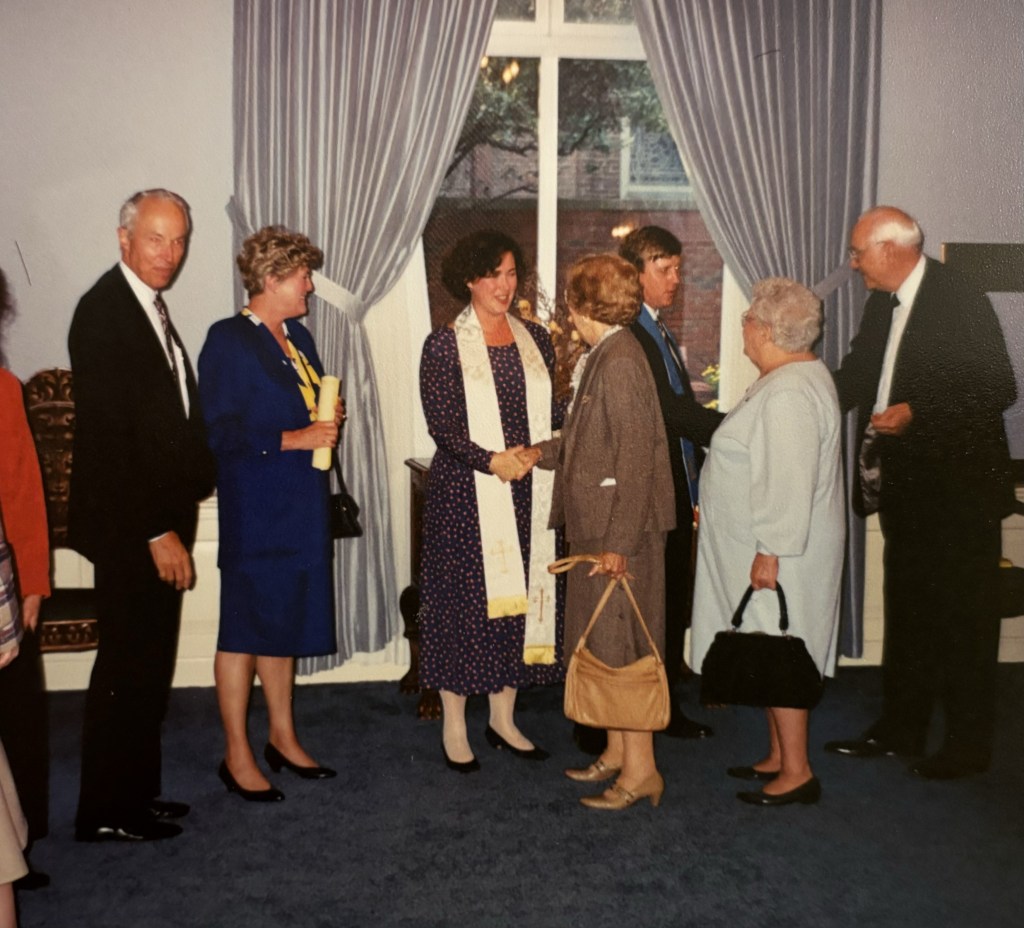
Reception after my ordination with my mom and dad in the receiving line.

October 3 is the thirtieth anniversary of my ordination to the Ministry of Word and Sacrament in the Presbyterian Church (U.S.A.) I’ve been reflecting on that a bit, because thirty years of anything seems like a long time, but here I am much to my amazement. So I’ve been thinking about people like Georgia, and all the other saints who got me to this day.

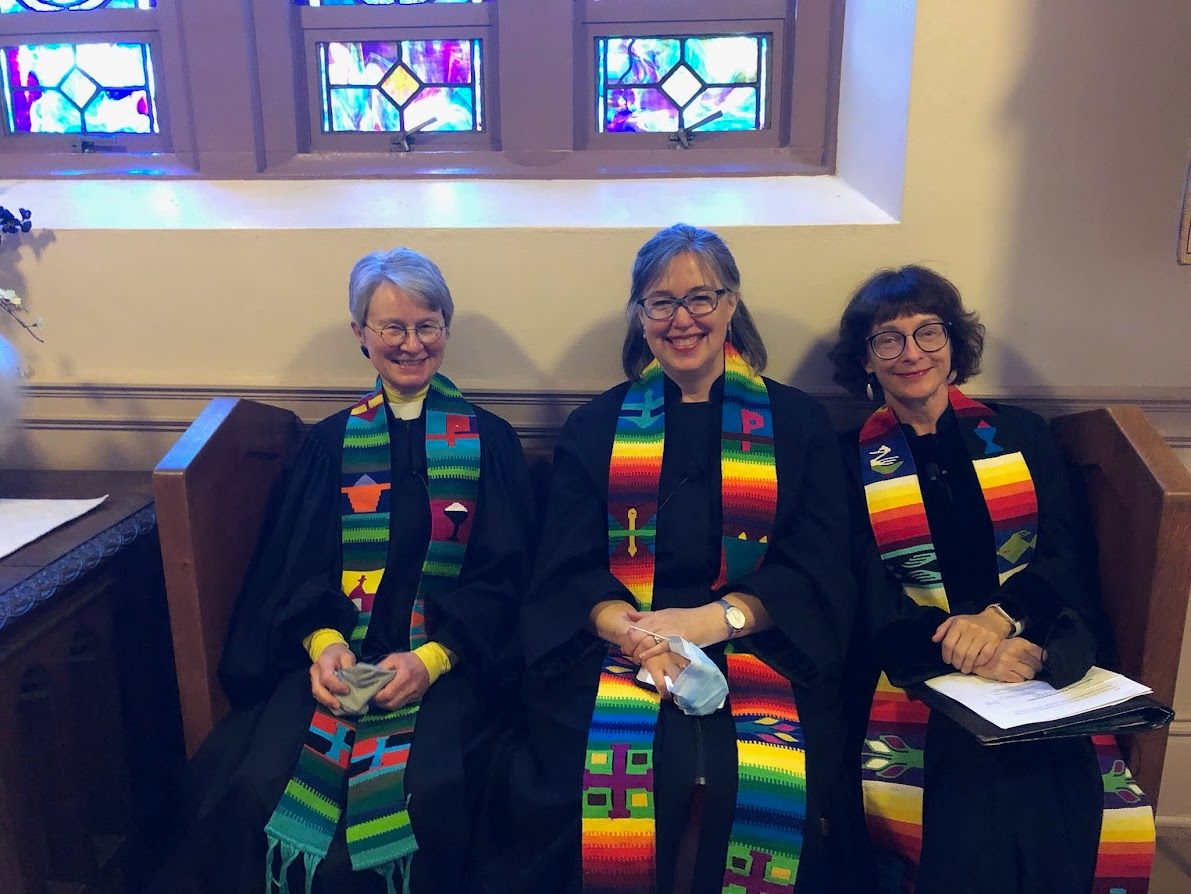
With the Revs. Eileen Parfrey and Laurie Newman, two of the clergy women I’ve been privileged to serve with

I dare not name them because I will undoubtedly forget someone, but I am filled with the faces and stories of people who encouraged me, challenged me, thanked and congratulated me; those who pissed me off or disregarded me, those who treated me like the hired help, those thought no woman should be in a pulpit and all those women who went before me so that I could take my place there. Thank you all.

On my thirtieth ordiversary, allow me to confess a few things.

Every year of these last thirty I have thought about leaving the ministry. Being a pastor can be glorious and can be utterly disheartening. I could make more money. I could have weekends off. I could tell people what I do for a living and not have them make immediate assumptions about me. A three day weekend could really be a three day weekend without having to take a vacation day. Every year I’ve thought about doing something else. But I haven’t.

Sometimes I admit that the real reason I went into ministry is so that I would be a good person. I wasn’t sure I could be good if I weren’t tied to God and the church. I worried I would give into greed, and consumerism, and selfishness, and meanness and, maybe most importantly, not hold myself accountable for those actions. I am far, far, far from perfect, but because I am a pastor, I work harder to be good than I would if I weren’t one.

The last confession is a good one: God and Jesus placed this call in my heart and my head and God and Jesus have not left me or taken that call away. That’s as good a reason as any why I’m still here. The love of God is as strong a tether as I know, and I am grateful, because there are seasons in pastoring when it all feels like free falling and without that tether, I would be a pile of broken bones and hearts and dreams.

So I thank my family and remember when Dad and Jack and I all got baptized on the same day and the day I told Mom I was going to seminary and she said she always knew I would.
I thank my first church family at Memorial Drive Presbyterian Church in Houston.
I thank the family that took me under care at First Presbyterian Church, New Vernon, NJ.
I thank my family at San Francisco Theological Seminary.
I thank my family at Simpson United Methodist Church in Minneapolis where I interned for a year.
I thank the congregations that welcomed me and taught me and then sent me off: First Presbyterian Church, Springfield, Illinois; First Presbyterian Church, Crown Point, Indiana; Community Presbyterian Church, Clarendon Hills, Illinois; The Kettle Moraine Parish, Waukesha County, Wisconsin; Southminster Presbyterian Church, Waukesha, Wisconsin; Crossroads Presbyterian Church, Mequon, Wisconsin. And the place where I am now, for twelve years, Westminster Presbyterian Church, Portland, Oregon.

Maybe a Waterford cookie jar isn’t a bad image for ministry. It is glass, which means if it breaks it shatters and you can get hurt, but it’s leaded glass, which means it’s also durable. You can see what’s inside, not only like the fishbowl that pastors live in but also the glimpse into the intimate moments of people’s lives. And it holds good things: children of God who gather for a million different reasons, who seek the love of their Creator, who seek forgiveness, who seek wisdom and community and cookies after worship and trust and faith and hope and love.

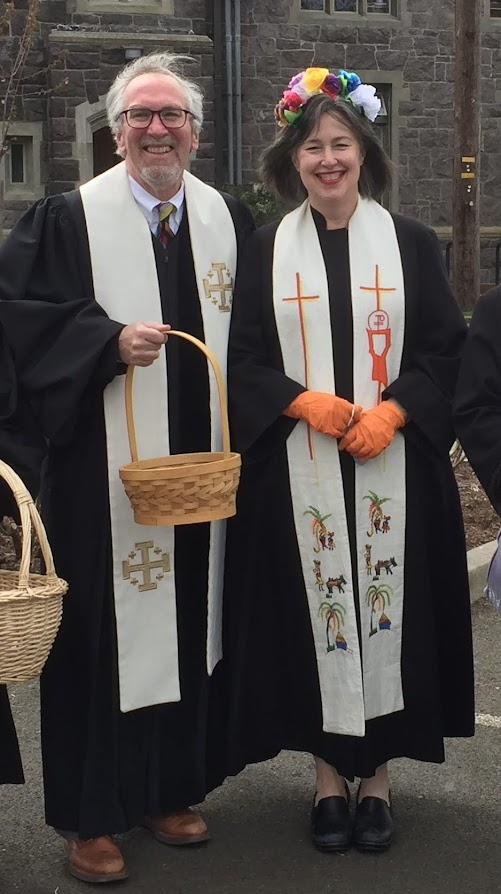
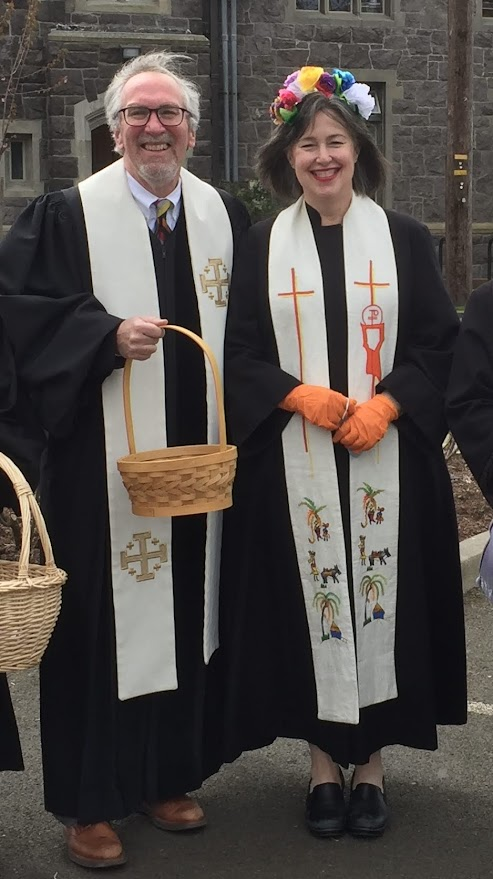
With co-pastor/husband, parking lot communion on Easter Sunday 2021. I added flowers to my face shield, as you do.

Thank you, all. Thank you.

PS: Statistics:
135 memorials/funerals
107 baptisms
48 weddings
652 sermons
6 calls

Associate Pastor (6 Years and 3 years)

Interim Pastor (22 months)

Half-time Interim Pastor of a Four Point Parish (6 months)

Temporary Supply Pastor (7 months)

Interim Associate Pastor (16 months)

Co-Pastor (12 years and counting)

The Superpower of Presence

I’d like to share a lovely (in the end) story from yesterday.

I was in my office at the church, and one of our staff members called. She was a block away, and a young man was having a medical emergency, and was that the sort of thing that a pastor might want to know or help out with. I said yes, and my co-pastor/husband and I went out.

Indeed, a young man had collapsed next to his car after stopping at the local bakery. Our colleague and another bystander had called 911, and had determined that the man spoke Spanish. I remember a decent amount of my high school Spanish, enough to reassure him that help was on the way. In the meantime, a woman who lived in the condo in front of where the young man collapsed came out to see if she could help, as did someone from the bakery.

Eventually a police officer arrived, and I think his heart was lightened that it was not a fentanyl overdose, which he has experienced a lot of lately. He made sure the paramedics were on their way, and soon enough, the EMT/firefighters arrived. I don’t know how to ask, “Are you dizzy?” in Spanish, but I was able to tell the EMTs that he had a horrible headache. I think I told the man I was a pastor and would pray for him, but I might have said that I was a shepherdess with gold. The police officer was able to use the emergency contact on the young man’s phone and reached his spouse. The ambulance came, started an IV, and took him to the hospital.

I went to the hospital, mostly because I wanted the man’s spouse to have someone to talk to about what happened. The fellow at the ED check-in desk could not have been any nicer. He took my card and heard the story which he said he would pass on to the man. I then found a chaplain, who was equally kind. I do wonder what they thought of me and my boundaries – but I figured I wasn’t violating any HIPAA things and I left the ball in their court to contact me.

This morning when I got to the office, the man’s spouse had left me a voicemail, thanking me and all those who helped. And then just as I sat down to write this post, the young man called. He was relieved I spoke Spanish. (I told him he needed to speak slowly.) He was better, and home, and he really just want to say thank you. But we agreed to get together for coffee next week.

So thank you to the strangers who noticed a young man in pain and stopped to help. Thank you to the neighbor and the bakery worker. Thank you to the first responders and EMTs and the hospital staff.

Remember, friends: kindness is never wasted. Being present to others really is a superpower.

And now I’m going to go brush up on my Spanish!

When chronos and kairos collide

“Chronos time is how we measure our days and our lives quantitatively. Kairos is the qualitative time of life.” (Josep F. Maria, SJ)

I’m thinking about Holy Week, and worship services for Palm Sunday, Good Friday, and Easter. I’m thinking about palms and azaleas and stripping the church. I’m thinking about despair and hope, short-term and long-term wins, and whether or not to invite folks up to the sing the “Hallelujah” chorus this year. In other words, I’m a pastor three weeks out from Holy Week.

On Holy Saturday, our group of dedicated volunteers will decorate the sanctuary for Easter: butterfly banners, white paraments, real azaleas and fake lilies, as the organist and this pastor are allergic to the real ones. The problem is that the flowers get delivered on Good Friday, and must be hidden away lest one preparing for the solemnity and sadness of Good Friday be confronted with the hope and life of Easter.

It’s like chronos time – the delivery of Easter flowers on Good Friday – collides with kairos time – the holiness and presence of God in despair and in joy. Maybe that’s just what life is: flowers in the midst of mourning.

It’s like all the images of sunflowers in social media, signs of support for the people of Ukraine enduring the horrors of war. It’s like wee flowering weeds pushing up between cracks in the concrete. It’s like that grain of wheat which must fall and die in order to bear much fruit.

To be honest, it’s what coming out of this pandemic (please, God; fingers crossed) feels like. There’s the chronos of fewer and fewer requirements to wear masks, and the declining numbers of hospitalizations and death. There’s the wonder of seeing people’s smiles in real life, and sitting in a restaurant and catching up with a favorite waiter.

And there’s the kairos of our emotional and psychological landscape having been forever altered by the experiences of these past two years. We cannot get back the things that we missed. We cannot say goodbye to the people who died when hospital visits were prohibited and memorial services had to be livestreamed. I can count five people who were dying whom I said goodbye to on the phone. It was awful. The sadness, despair, and anger that hung over us and inside us during the pandemic is not something that can be measured, put on a calendar, given an end date. Those things exist in the kairos time.

Some years when Easter morning dawns, I am still in Good Friday. Sure, I’ve written a homily for the day but it feels as real to me as the fake lilies that don’t make me sneeze. And there have been Good Fridays when I’m just pretending to be sad and solemn but my heart and soul are already at the empty tomb. As much as I like things to be in order, I have finally accepted that I cannot plan out my feelings or schedule my soul. And that is good.

So maybe this year, as I walk by the Easter azaleas on my way to conduct the Good Friday service, I will let all of that be, knowing that while God’s time is not my time, nor our time, God is still present with us all the time.

Why Churches Should Continue Their Online Services

Yesterday morning, as I was drinking my coffee and going over my sermon, which would be delivered to an online-only congregation, I read a headline and immediately had some thoughts. As of Monday morning, only two parishioners have sent me a link to yesterday’s New York Times editorial by Tish Harrison Warren, “Why Churches Should Drop Their Online Services“.

In case there is a paywall and you can’t access the editorial, in a nutshell Ms. Warren makes the case for dropping online services (which would include livestreamed and prerecorded) and going back to in-person services only. Her theological point is valid: Christians are an incarnational people, and worship is best in person, when it is visceral, physical, when we get to experience the best and worst of being with other people. We can hear their voices and the cry of babies; we can smell our favorite person’s perfume or shampoo; we hear the whine of hearing aids being adjusted, and truly share from a common loaf and common cup. Some of those thoughts are my extrapolation of hers.

But. But but but but but. I fear that Ms. Warren has not taken in the fullness of the Body of Christ into her argument.

Last night, my favorite group of pastors weighed in on the article in a text chain. I trust these people with my faith and with my life, with laughter and with preferences in bourbon. They agreed with me (which is always nice) and here is what we would say in response to Ms. Warren and maybe anyone who believes that online worship should go the way of tokens for communion, male-only clergy, and a publication of what each family pledges to the church.

First: not everyone can manage the physicality of our worship spaces. The congregation I serve has worked hard to make our sanctuary accessible, and it is, but it’s a long walk or wheelchair ride from the accessible entrance (which is right next to the garbage bin enclosure) to the sanctuary. And frankly, for anyone with back problems, our pews are uncomfortable if not excruciating. Some have a hard time wearing a mask for an hour or so. And some can see and hear better online.

Second: some people cannot come to worship. Some live far away. Some are sick. Some are unable to leave their home. Some live with chronic anxiety and public gatherings are terrifying. Some have a napping baby. There might be a winter storm with icy streets. Offering online worship provides a way to get that weekly dose of Jesus that might not otherwise be possible.

Third: computers are not going away. Online events are not going away. Using technology is not going away. We wonder how many of our committees will choose to continue to meet on Zoom, rather than drive to church on a dark and rainy night, going straight from work to a meeting without getting any dinner. Rather than shun the opportunity that online worship offers, we should embrace it.

There are probably more reasons but three seems a good number. Let me add that last night we made the decision to go back to in-person worship and I could not be happier about that.

And as for me and my house, we will continue to offer both in-person and online worship, to the glory of God.

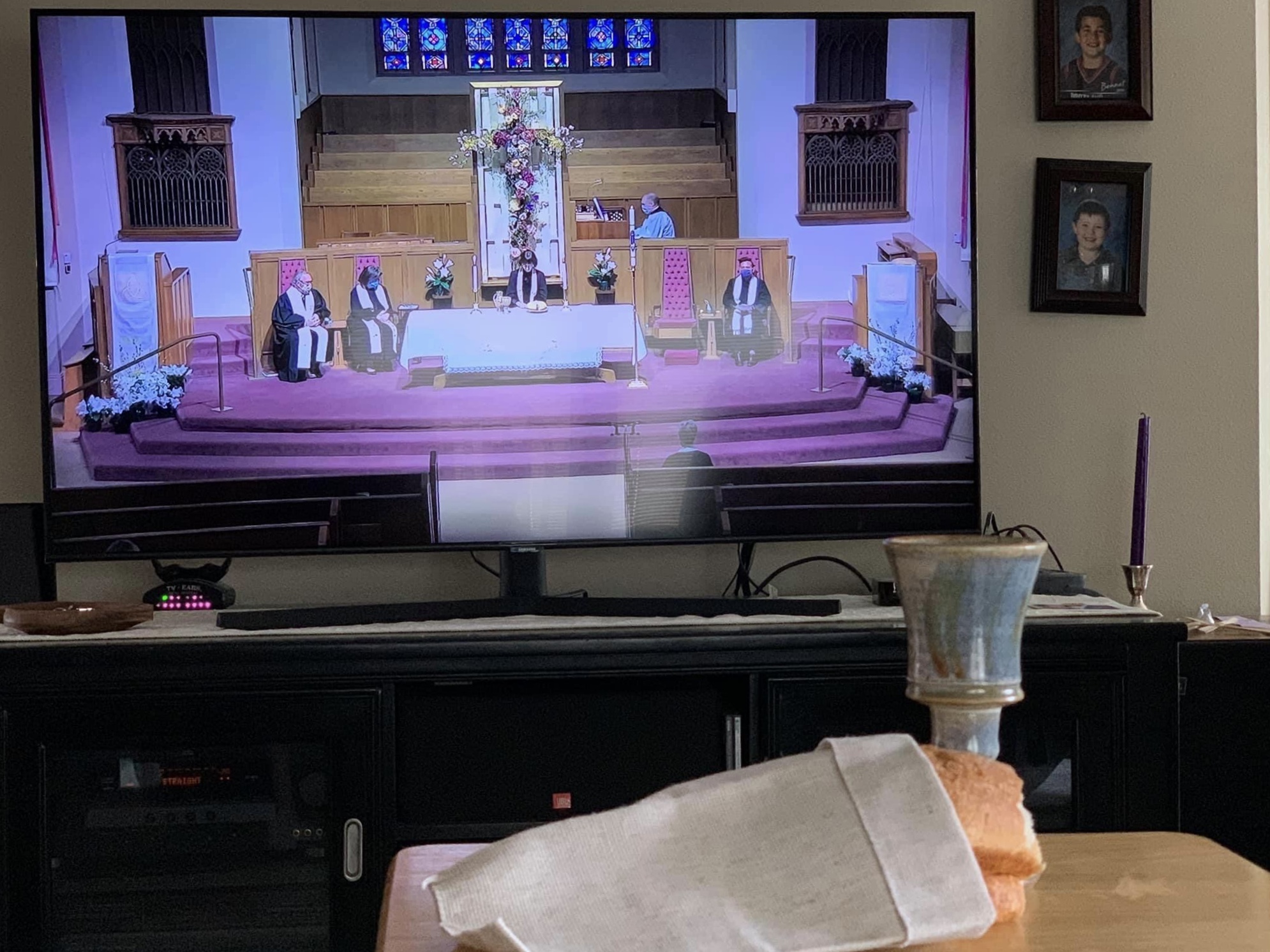
Photo taken by a parishioner worshipping only. She and her husband are unable to attend in person because of health concerns.

One Miracle

Clouds Miracle Beautiful - Free photo on Pixabay

What if, in our lifetimes, we had the ability to perform one miracle?

That thought came to mind as I was walking the dog the other morning, when I often get my best thoughts. We were walking by my neighbors’ house, and I was wishing I could make his cancer disappear. That would be a miracle, because it’s the kind of cancer that cannot be cured.

What if we all got one miracle?

Years ago, a parishioner who was very dear to me experienced a cataclysmic medical event, went into a coma on life support for two weeks, and then, after the family decision to remove the life support, died. She was fifty years old, good, kind, funny, healthy, and beloved. When I went to see her in the hospital, unresponsive, machines helping her breathe, feeding her, helping her eliminate – that sound of those machines has never left me. I prayed so hard for a miracle. “Save her,” I prayed, again and again, knowing in my soul that only God could save her, that her recovering would be a miracle.

But it didn’t happen.

As I walked the dog, I entertained the idea. If I had one miracle, would I use it at the first opportunity and then be done? And if I did that, would I regret it later on? Or would I save it, thinking that if my child ever needed it, it would be there for her? And if she never needed it and I never used it, would it become a wasted miracle? Or would I save it for myself? Or would I use it for peace in places of war, or water in places of drought, or a contraption that would prevent catalytic converter theft?

By the time I was home and taking the dog’s leash off, I decided I would not want the responsibility and burden of having a miracle at my disposal. Too hard to make that decision, too much of a temptation to be selfish or selfless, to have that sort of power.

We don’t get miracles, but we do get other things, like patience and prayer, like hope and grace. We get doctors and scientists and pharmacists. We get casseroles and Postmates gift cards. We get friends who drop everything at moment’s notice. We get hospital chaplains and Kleenex and gallows humor. In the end, maybe all those are better than a miracle.

But if I did have a miracle….

Lent Prayers

As part of my Lenten discipline, I’m writing prayers every day and posting them to the church’s Instagram and Facebook accounts. But I thought I’d add them here, too. After this post, you can find them here, under the Liturgy tab, under Lent. But here’s the first week’s worth. Enjoy – ? -!

Prayer for the Seventh Day of Lent
Well, Lord, could we talk about disappointment today? Because to be very honest, it’s been a disappointing year. And You haven’t fixed things for us. Can we say we’re disappointed in You? Can we say that You have let us down? Is that allowed? Or would You respond and tell us that You are disappointed in us, too? It feels like there’s no room for grace in disappointment. So help us today to acknowledge our unmet expectations, our hurt feelings, our sadnesses, and our disappointment. And then shower us with grace, because we really need it. Thank You. Amen.

Prayer for the Sixth Day of Lent
“Pray for your enemies,” Jesus taught. “Love your enemies,” he said. Okay, so first I must admit I have enemies. And that means admitting that there are people I hate or fear. And than means admitting there is hate and fear in my heart. And that means admitting I’m falling a bit short of the mark. Before I pray for my enemies, I must ask forgiveness for letting hate and fear settle in my heart, for letting hate and fear clothe a person or a people. I must confess to reducing one of your children to a symbol or a cartoon. I confess my sin. And now, Holy One, on to my enemies. I call them many things – evil, selfish, murderous, wrong, stupid. And I close the door to any inkling of hope for reconciliation. Help me to see their humanity. Help me to understand their hearts. Help me to work on forgiving them, just as I have been forgiven. Amen.

Prayer for the First Sunday in Lent
Creator God, thank you for the daphne pontica, the sweestest of flowers that remind us spring is not too far away. Perhaps this is the scent of costly nard, the expensive oil used to anoint Jesus before his death. Perhaps this is the scent of devotion and love. Help us to remember that acts of devotion are priceless: the act of showing love, the act of serving another, the act of taking risks, the act of being present. And so help us to be devoted to You and one another. Amen.

Prayer for the Fourth Day of Lent
Most Blessed, Most Glorious, Ancient of Days, God: I just spend half an hour scrolling through my phone, when there are more holy and faithful things I might have done. I might have been on my knees as I confessed my sin. I might have been lifting my hands in praise. I might have studied scripture, or prayed a psalm. But no. I sat in my chair and looked down at a tiny screen for thirty minutes of this day. Still, I must admit that sometimes I see You there, on my tiny screen – in the headlines, in a friend’s comment, in a Facebook post, in the beauty of a photograph, in pain I read between the lines, in hope I read between the lines. So I think today I ask for Your blessing as I scroll through my phone, that I will recognize what is holy even there. Amen.

Prayer for the Third Day of Lent
God of justice and mercy, we know that to fast is to be able to fast, that we get to choose to give up food, or screens, or the daily latte. We also know that right now, so many of our neighbors and so many of Your children in the world fast without choice. Your children, our neighbors, are without food. Your children, our neighbors, are without access to clean water. Your children, our neighbors, are without power. Your children, our neighbors, are without hope. We want to ask You to fix it, all the while knowing that Your response would ask us how we plan to partner with You in that. We know that You call us to bring compassion, justice, kindness, compassion, justice, wisdom, imagination, and love to that. So we pray for them and we pray to You and we pray for ourselves in all of this. Amen.

Prayer for the Second Day of Lent
Well, God of the journey, there’s no going back to ordinary time; the trek has begun. There’s no going back to “normal”, whatever normal was: we have been forever changed by all that has happened in the past twelve months – a racial reckoning that we ignore to the peril of both black bodies and white bodies; a pandemic that has brought the world to its knees in fear and desperation; the mass consumption of lies that are way more convenient to believe than truth. There’s no going back to ordinary liturgical time either. We have the trek to the cross and empty tomb, a season where death precedes life, a season where grief must come before any inkling of joy. As You were with Moses in the desert, as You were with Jesus in the wilderness, be with us on the journey. When we cannot take one more step, give us rest. When our neighbor has fallen, let us give them a hand. When it all gets to be too much – be with us. Amen.

Prayer for Ash Wednesday
Creator of all that is, for us mortals it is a wonderment that death ended up being part of Your design. True, it might have been of our own making, but then again, maybe You knew something we didn’t or couldn’t. But here we are, on that day when we say to each other, “Remember you are dust, and to dust you will return.” We dare to say to each other, “Remember, you will die some day.” To tell our beloveds that, to tell our children that: it is awful. On this day, help us to remember that in life and in death, all of us belong to You. Help us remember that death is not an end, but a beginning. Help us to live well and in faith, knowing that we will die some day. Amen.