Christmas Eve at the cemetery

Arlington-without-Christmas-wreathsIt was such a brief scene as I drove by: a man pulled over on the side of the road, standing on a hillside that was dotted with in-ground gravestones, standing in front of one that was decorated with some red and white flowers – carnations, maybe.  I saw him for only a few seconds, and I wondered why he was there, standing on the muddy ground in the rain.

Was that his mother, his wife, his best friend, his brother?  Why that moment?

The chiaroscuro of the season always gets to me: life’s way of creating shadows so that the candlelight seems all the more bright; life’s way of creating drama about everyday things, like visiting a cemetery, or pulling over on the side of the road in the rain.

In my first six years of ministry, I conducted a funeral or memorial service every year on December 23rd, or 24th, or 26th.  Ruth, age 84.  Jean, age 81.  Gene, age 78.  Faith, age 85. Maybelle, age 79.  Bob, age 89.  I would often use the texts about Simeon and Anna for those service, old people who died knowing the full consolation of Israel and the promised savior.

But still.  Standing at the cemetery on Christmas Eve – it makes your heart break a little, when you get back into your car and “Grandma Got Run Over by a Reindeer” is the first thing that comes on the radio, and then some idiot passes you by with a loud blare of his horn because you’ve slowed down, because you can’t really drive very well with the tears flooding your eyes.

A friend of mine let me know I won’t see her on Christmas Eve; it’s a hard time right now, and she didn’t think everyone around her would appreciate her tears.  It is bleak, this midwinter, and for us in Portland is has been gray and sodden.  There are other  people I won’t see at church on Christmas Eve.  Some leave town to be with whatever family is still left.  Some will be full with a feast and wine, sleeping through our carols and candlelight.  And some will just stay home, because all the songs and all the twinkling trees cannot fill the well of sadness that’s taken squatter’s rights in the heart these days.  But there are many I will see, there because they have joy to share, or questions they seek answers for, or because they love to sing in the candlelight, or because their Mom made them come, or because this is their community, and of course they’ll be there on Christmas Eve.

A church I used to be a part of has Easter sunrise services at the cemetery every year.  I wonder what it would be like to have a Christmas Eve service at the cemetery – too Dickensian, waiting for the ghosts of Christmas past, present, and future to show up?  Too morbid, like the Zombie Nativity that’s made a few headlines?  Or too real – the presence of death even as we celebrate birth?

The mind goes to T.S. Eliot, who often gets the last word with me.  From “The Journey of the Magi”

All this was a long time ago, I remember,
And I would do it again, but set down
This set down
This: were we led all that way for
Birth or Death? There was a Birth, certainly
We had evidence and no doubt. I had seen birth and death,
But had thought they were different; this Birth was
Hard and bitter agony for us, like Death, our death.
We returned to our places, these Kingdoms,
But no longer at ease here, in the old dispensation,
With an alien people clutching their gods.
I should be glad of another death.

And still:  a warm Christmas to you, whatever that may mean.easter-candle

Sighing at the Angel Tree

IMG_7147So our congregation has, for many years, had a Christmastime Angel Tree, in which members purchase requested gifts for families in our local Head Start program.  Do not get me wrong: this is great.  It’s a way to make the holiday a little merrier for families who (I assume) don’t have a lot of extra disposable income.

And every year, our family waits until the later weeks of the Angel Tree to pick up our cards, because while there are many who want to buy clothes for adorable baby boys and five-year-old girls, other gift recipients are simply not as much fun to shop for.  This year we picked up cards for a family with four boys, ages 7 to 18. And off to Fred Meyer I went.

True confession: I do not enjoy shopping of any sort – grocery shopping, clothes shopping, Christmas gift shopping.  I just don’t. I like the idea of giving people presents, in theory.  I like the idea of the recipient knowing that I care about them or was thinking about them.  But going out to the store, at night, in the rain, in the cold: meh.  A recent trip to the mall confirmed for me what I’ve suspected for a while now: Hell is Macy’s.

So Monday night, while my kid was at church choir practice and my spouse was at church checking his email, I headed out, Angel Tree cards transcribed into a nice little list.  Boy’s undershirts, size medium.  Boy’s undershirts, size large.  Medium boy’s dress shirt.  Large boy’s pajamas.  Tennis shoes, size 3.5.  It just about broke my heart, knowing that some mom or dad desperately needs basic items for their sons, knowing that the last things those boys probably want Santa to bring them is dumb old clothes.

There were a few fun things on the list – a twin bed set (way out of our price range.)  Boat Legos.  Boat Legos?  I called my husband from the toy aisle.  “It says Boat Legos.  Would Pirate Legos count?”  I spent twenty minutes in the children’s shoe section.  There were no size 3.5 boys tennis shoes.  There were 4’s, and 5’s.  Nike, and Adidas.  $50 a pair.  $50 a pair?  For the youngest kid, so they can’t be passed down?  That’s a lot of money for shoes the kid will grow out of.  But maybe there is nothing worse than wearing hand-me-down boy’s tennis shoes.  And $50 – that’s just a couple of lunches out for our family.  The size 4 Nikes went into the basket.

I will be the first to admit I overthink things, including the Angel Tree gifts.  I spent more on the gifts for these four boys than I spent on my husband and child, and that feels about right.  I worry that I misread the size requests, that Pirate Legos are not the same thing as Boat Legos, that these kids will open presents they did not want and realize, once again, on Christmas morning, that they do not have as many choices as other kids.  They won’t get the brand new Play Station 17, or whatever number it’s up to.  They’ll get undershirts and pajamas, which may or may not fit.  But maybe it will bring Mom a smile.

What I wish I could do for my Angel Tree family is know them, and find out how Head Start was for them, and see what I can do to help them have more choices at Christmas  and all year.  But like the Santa who fills the Christmas stockings, the angels of the tree are anonymous.  Maybe it’s better that way.

But still… I wish them a Merry Christmas.  And I wish they could have a merrier one.

In search of courageous leaders

One of the things I appreciate about the Presbyterian church is our form of government.  It’s representative – the congregation elects elders to make decisions about the ministry and mission of the church, and the congregation as a whole is empowered to make only a few types of decisions.  We trust our elected leaders to lead.

The form of the U.S. government is based upon the Presbyterian’s; we elect officials to lead us.  We don’t elect them so that they will vote the way we want them to vote.  We elect them because we think (we hope) that they are wise and that they will make the best decisions they can for our whole nation.  It’s representative; not every American citizen gets a say in every thing.

But lately, I’ve been worried that our elected officials are way more worried about currying favor that will lead to re-election than they are about governing wisely or justly.  The latest vote of the Senate regarding gun control laws makes the point.  Why on earth would a senator not vote to restrict access to guns by someone on the terrorist watch list, if not because a) they won’t get funding from a lobby, or b) they won’t get re-elected?

We are nearing the third anniversary of the massacre at Sandy Hook Elementary School, and I will not get through this week without tears.  I don’t know how that community is doing it, except by sheer grace and will and determination to redeem those deaths somehow, by truthful living, by calling out the powers.  Last night I wrote my congressman and senators and the President.  I know those emails will only be read by an aide, that my words won’t matter or make a difference, but I felt as though I was doing something.

So I’m going to read the names.  I am going to read the names of the victims in San Bernardino, and Colorado Springs, and Roseburg, and Charleston, and Sandy Hook.  That’s the least I can do – remember those people who went about their everyday lives, who left the house or the dorm room one morning, who never returned.  I will read their names, and then I might write my congressman and senators and the president again.

I grew up in a family of hunters.  It’s what my people did, my dad and brothers and uncles and grandfather.  We always had guns in the house, rifles and shotguns.  They were always locked up, and they were never loaded in the house.  That’s what common sense people do – keep their guns, which are for recreation, locked up.

When I was sixteen, my family was held up at gunpoint in our home.  I’ll skip to the end: no one was physically hurt.  But for a few hours we were numb with terror.  At one point, the intruder was standing behind me and cocked the gun and I thought that was it.  Writing that, thirty five years later, still quickens my heart.  We were held captive by a man with a gun, but at any point did it occur to any of us to go get one of our guns?  No.  In the moment, it doesn’t work that way.

As I said, no one was physically hurt, but it was an ordeal to recover from, and anxiety has been my long-time companion ever since.  I cannot imagine the courage it will take the employees of the Inland Regional Center to go back to work, or women using the services of Planned Parenthood in Colorado Springs, or students and staff at Umpqua Community College, or the congregation at Mother Emanuel.  By they do go back and they will go back, the survivors, the grief-laden.  They will have courage to do that.

I only wish our elected officials showed that same kind of courage.

Human

12308588_996580600414507_3667030615107966682_n (1)What would it mean if we saw every person as human?

Centuries ago, St. Benedict proposed that his monks see all visitors as Christ:

Let all guests who arrive be received like Christ, for He is going to say, “I came as a guest, and you received Me” (Matt. 25:35). And to all let due honor be shown, especially to the domestics of the faith and to pilgrims.

It’s a tall order, to see Christ in everyone.  These days I wonder if we might start with a simpler step, to see everyone as human.  If so, I would have to start with Donald Trump, who was the muse of this particular post.

Let me explain.

My brilliant and brilliantly talented artist friend made these “human” badges, and posted a selfie wearing the badge.  I thought that was a fantastic and subversive response to Mr. Trump’s proposal that all Muslims in the U.S. wear badges identifying them by their religion. Except that he didn’t actually say that.  He has proposed other fear-inducing and xenophobic things, but he did not say he thought Muslims should wear badges.

I was a little disappointed because I rejoice just a little bit every time Mr. Trump reveals his cards, because, in part, I don’t think of Mr. Trump as a real-live human being, but as more of a caricature of some would-be Gordon Gekko Maverick guy with bad hair and a few ex-wives.  It doesn’t help that Mr. Trump claims to be one of ours, a Presbyterian.  That does not help one bit.

What would it mean for me to see him as human?  What would it mean for him to see a Muslim-American as human?

There are the basics:  inhabitant of planet Earth; homo sapiens; bi-ped mammal.  But beyond the flesh and blood, inside those brain chemicals and our hearts and the experiences that form us, what does it mean to share the identity of human?

Perhaps compassion is part of it – at least I hope it is.  Maybe the urge to protect the young and vulnerable is a part, too.  To be human is to engage in something – in a person, in beauty, in the natural world, in the life of the mind.  I wish that being human meant being someone who dances or someone who sings, or someone who stacks rocks into beautiful piles just to see if they will balance.  In the best of all possible worlds, being human would mean risking one’s own well-being for the well-being of a stranger.

Which makes it hard for me to see Mr. Trump as human.  I get how difficult this can be.  But if I can’t start with someone of my own tribe – white, Presbyterian, American – is there hope for us to see the stranger as human?  Or maybe that’s easier, because we don’t know or assume as much about that person who lives on the other side of this planet.

I was talking with a friend who loved someone who had schizophrenia, who had a life of suffering, who was often treated as less than human.  My friend said that someday we would have to talk about God and suffering, and I think that’s tied to being human, too.  Is to be human to suffer?  And to rejoice?  Can one human have all of that in life?

We love to assign labels and when we get carried away, we make labels for people to wear. Scarlet letters, stars of David, pink triangles.  That’s how we know who the other is, who the enemy is, who the criminal is.  That’s how we know we’re losing touch with our own humanity, when we segregate.  Homeless. Addict. Whore. Lunatic. Thief.  Liar.  Idiot. Waste.

Funny how no one took Jesus up on the offer to cast the first stone.

Maybe the reason Benedict encouraged his monks to see Christ in all they met was because Christ first saw humans in everyone he met –  people who danced and sang, who protected, who risked, who stacked rocks.  And so we start where He started, seeing the humanity in all.

Even Mr. Trump.  Bless his heart.12308588_996580600414507_3667030615107966682_n

Prince of Pieces

If I let myself, I could be sad all the time.  Not depressed, mind you, but sad, because there is so much to be sad about.  I am sad about ignorance, equating ISIS with Syrian refugees and governors who not only don’t know the difference but also don’t know the Constitution.  I am sad about all those people who died from violence, in Paris and Beirut, in Kenya, transgender women of color killed just because, victims of domestic abuse, black boys.  I’m sad about how many people I know are fighting cancer.  I could be sad all the time.  So much is falling apart and in tatters

I can’t imagine being part of a church that ignored the sadness of the world but I wonder sometimes how much I ignore the joy of the world.  “God is good/all the time/all the time/God is good” chafes me a little, because I think of how it might sound to someone who just received a terrible diagnosis or who lost a beloved. In an ultimate sense, God is good.  It’s what we hang our hats on, that something Good awaits us after all the bad. But we don’t live in the then, we live in the now, and the now can be pretty bleak.  Off the top of my head, I can instantly name five people whose lives are in shambles for one reason or another.  I could be sad all the time.

For many years I have loved Walter Wangerin’s story Ragman,  in which Jesus takes what is broken in others and replaces it with what is whole in him. Near the end of the story,  he is all broken, and then he dies, and then he comes back, with only a scar to show for his suffering.  It is such a story.

These days I picture Jesus picking up the pieces of our lives, the shreds that are still left, with care and tenderness and with the skill of an artist, putting them back together; sort of.  I imagine if he tried to put us back together as we had been we would all look like Frankenstein’s monster, everything where it should be but wrong.  So instead I imagine he takes us in our brokenness and makes a mosaic out of the shattered parts of our lives.

Or I think about this world of ours that is torn to shreds by so much, by hunger and war, by famine, by drought and tsunamis, by greed, by fear, by apathy, ignorance.  They are wood chippers, electric carvers gone mad, these forces.  It’s like the map of the world has been put through the paper shredder, and Jesus stands there with the strips of what’s left and we hand him some old, yellowing Scotch tape, and beg him to fix it.

“Las Monarcas” My friend Jill Ross created this mosaic of monach butterflies, and I am grateful to her for the many ways she brings beauty to the world. This image is copyrighted and used by permission of the artist.

Then I think what would happen if he, being Jesus, didn’t take us up on our old tape but instead took all those strands of the shredded paper, the refuse of the world map, and wove them into something new, so that the boundaries went away, and age old enemies were woven next to each other, and what we had was no longer a map but something different, and new, and because it is woven, something stronger than what existed before.

Maybe the Prince of Peace will be the Prince of Pieces, our pieces, the flotsam and jetsam of our tragedy and sin, picked up and not discarded but reused, remade, into something different but still beautiful.

There is sadness in that, too; but maybe a little beauty or at least a little hope.


The Terrible Beauty

Halloween is done, thank God.  I am so over that holiday.  This year we carved exactly one pumpkin, and I let the real spiders decorate inside and out.

Actually, Halloween was over for me after fifth grade.  That year, near Houston where I grew up, a father was found guilty of killing his son by lacing his Pixie Stix with cyanide.  The next year I broke my foot, and that was that.

Maybe part of the reason I’m glad Halloween is over is because I really, really, really love All Saints Day.  It’s right up there with Christmas and Easter for me, only better, because there are fewer expectations.

But this year, in the middle of the service – after I had preached but before we began to celebrate the Lord’s Supper, after we had sung “For All the Saints” and named our beloved dead – in the middle of the service as the choir sang an extraordinary anthem, I thought to myself

This is a terrible thing to do to people.

The choir was singing “Entreat Me Not to Leave You” by Dan Forrest.  (You can listen to a different choir sing it here.)  I was thinking about all the people I have loved who have left me in death, and I did not have the literal opportunity to tell them not to go, not to die, not to succumb to the cancer or the internal injuries or old age.  I got so sad, and had to do that pastor thing of disengaging emotionally so I could stand up and do the next thing.

Celebrating All Saints is a terrible beauty.  Terrible in that all that pain and grief and rage is unleashed again.  Terrible that it’s done publicly.  Terrible that we don’t all stand up and stomp around and insist that God stop all the tragic deaths.

But then it’s so God-damned beautiful too. The golden shining of those souls.  The memories.  Naming the names.  Affirming the hope that they are not gone forever.  Not being alone in our grief.  Really beautiful music.  Holy communion.

The best analogy I can find is wiggling a loose tooth.  It hurts, but it’s a good hurt. Today I think All Saints is that way, the worship service at any rate.  It hurts, remembering those people who have gone from us.  But it’s a good hurt, because we had them for a while, and now we have each other, and that will do.


IMG_0129

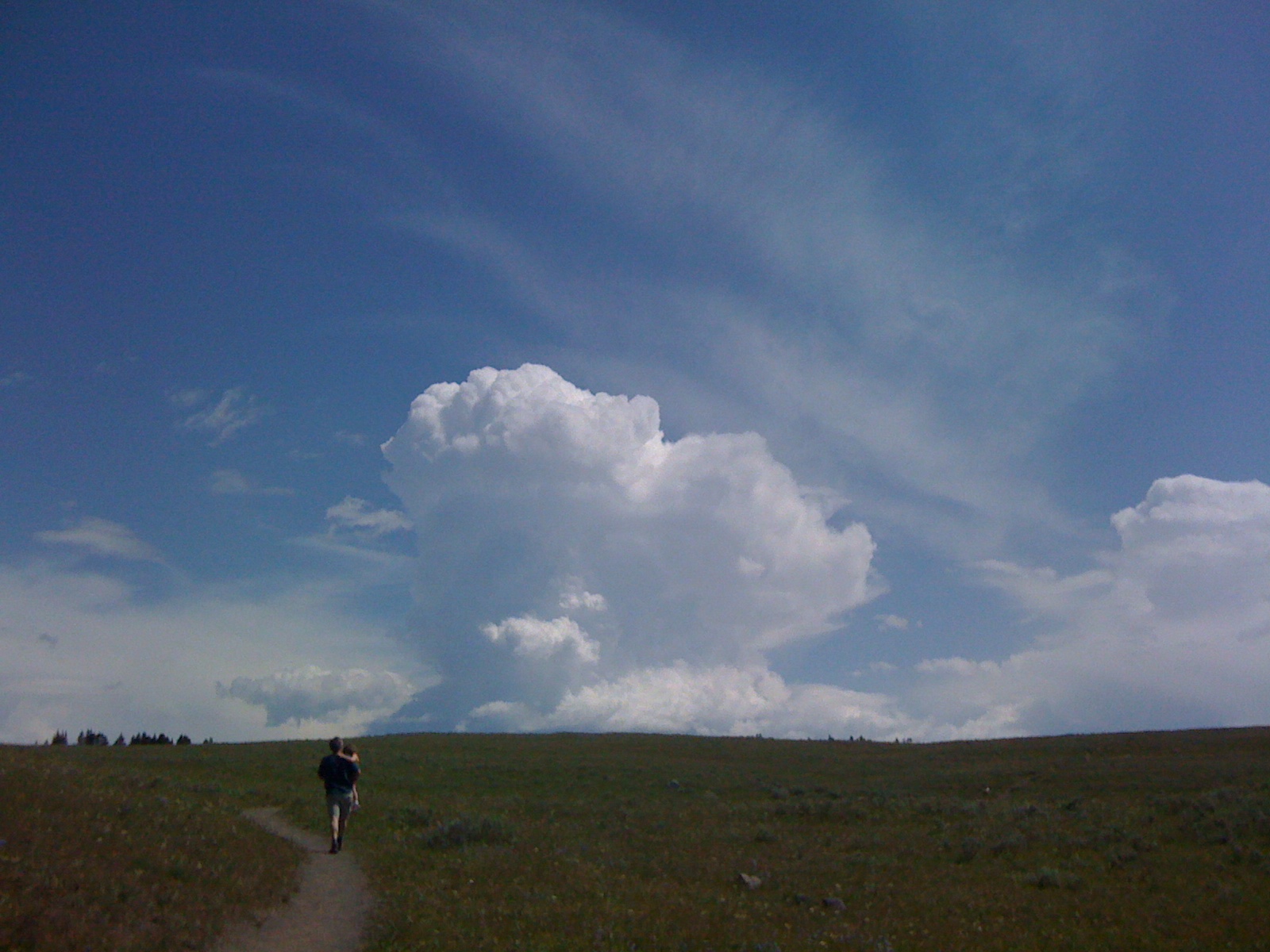
My husband and daughter, years ago, at Yellowstone, walking toward a wide sky.

Jury Duty: A Tale of Stupidity and Greed

IMG_6564

Quotation on the exterior of the Mark O. Hatfield Federal Building in Portland

I thought – when asked if I should be called “Reverend” were I to be selected to serve as a juror and I responded, “‘Ms.’ is fine.  ‘Reverend’ is an honorific, not a title” – I thought that neither the prosecution nor the defense would want the likes of me on a jury.  I was wrong.

I spent eleven-ish days as a juror on a trial, and another day as a juror in deliberations. It was a criminal trial in the federal court, and if you’d like to read more, please click here.  It was my first time to serve as a juror, and while the testimony was at times so tedious I wanted to stab my eyes out with an ice pick, or in Anne Lamott’s famous words, drink gin out of the cat dish, there were also many things that were interesting.  Until we began deliberations we jurors could not talk about the case with anyone, even each other, so we spent a lot of time talking about what the lawyers wore.  I haven’t seen so many pearls, pumps, pantyhose, and suits since I worked at PaineWebber in New York in the late ’80’s.

I could not talk  to anyone about the case, but almost every night I would think to myself, “Another day of greed and stupidity.”  The experience did much to affirm John Calvin’s notion of the depravity of human beings.

It was a fraud case, and investors in a bio-diesel project in Ghana and Chile lost over $1 million.  A group of the investors were men who went to church together, a church in the Portland suburbs about which I know very little.  Since the trial ended I googled it, and it’s one of those churches that has a lot of male pastors and a lot of female administrative assistants and child-care providers.  You know what I mean.  They would not invite me to preach there.

But if I were ever invited to preach there, I might preach about the love of mammon.  Or I might preach about how the followers of Jesus must be as wise as serpents and as innocent as doves.  Or I might just preach on Matthew 25:31-46 which catches me short every time I read it and maybe catches other Christians short as well.

For the first two weeks of the trial, I parked about six blocks away from the courthouse so I could get a little walk in every day.  And in downtown Portland, at 8:15 in the morning, on Third Avenue, there are a lot of people sleeping on the sidewalks and in the doorways. Some of them are just waking up, dazed, hungover, glazed-over.  They would wrap their blankets around them or bring out their cardboard signs asking for help, and I would turn a blind eye to them on my way to Starbucks.

Then I would go into the courtroom, and listen to witnesses testify about how much money they invested and lost.  Most of them invested more than once, despite the appalling lack of returns and appalling lack of evidence that bio-diesel was actually being produced. Some lost as little as $25,000.  One lost $500,000.

The group of church guys had talked about how fun this investment would be, that they were impressed that the Scam Artist was a professed Christian who had been both a pastor and a missionary.  If they invested, they would not only see a fabulous (one might even say unbelievable) return on their investment, they would also be helping the planet (bio-diesel!) and the people of Ghana and Chile. With my 20+ years experience as a pastor, with my A.B. and M.Div., I was not as impressed by his claim of being a pastor.  But he was a guy, a white guy, and he opened his staff meetings with prayer, and he opened his investor meetings with prayer, so he must be on the up-and-up, right?

Wrong.

I suppose it is okay to want to make money.  I suppose it is okay to want to help people.  I’m not sure it’s okay to want to make money while helping people on the side.  I have to think about that, because you could say I get paid/make money to help people.

But every morning, as I drove past the Union Gospel Mission, as I walked by the people sleeping on the streets, I thought about how far that $25,000 could have gone right here in Portland.  And I thought about how far that $500,000 could have gone in Ghana or Chile.  And I shook my head at the investors.  Why did they continue to give this guy money?  Why did they trust him?  Why?  Were they hoping that if they pumped another 100K into the thing they would finally see the return?  Were they desperate and scared?  Stupid?  One of the witnesses used that word.  Were they greedy?  Another witness described himself that way.

In the end…

In the end, I had little sympathy for those who lost hundreds of thousands of dollars.  It appeared they had the money to lose.  I judged them because I thought of all the ways that money might have been used, to help people in Ghana or Portland or who knows where else.

In the end, I had a little sympathy for the defendant.  None of us knows where the all the money he took in ended up.  We can follow the trail of some of it, but not all of it. In the end, the defendant could not afford an attorney but relied on the excellent services of the federal public defender.

In the end, I felt bad for the defendant’s daughter.  She cried when the judge read the verdict, and that is hard to witness.

In the end, I felt bad for the people in Chile who never received months of pay owed to them.

In the end, I felt bad for the people of Ghana who are still hoping against hope that Obrunie Jack will return and get the jatropha plantations going and the refineries producing bio-diesel.

What did I learn?  That we are blessed with a legal system that presumes innocence until proven guilty.  That public defenders are unsung heroes.  That jurors take their responsibility seriously.  That judges oversee the process fairly and intensely.  That people are kind, and stupid, and fair, and greedy, and ambitious, and humble.  That church folks go to their jobs all day long and then show up at night for church meetings – I had to do that a couple of times; it’s not easy.  I learned that it is a huge responsibility to decide if someone is guilty of breaking the law, knowing that my decision can send someone to prison.  I learned that Matthew 25:31-46 catches me short again, and I wonder if I will visit this man in prison.

I am grateful to the Honorable Anna Brown and her staff, and federal public defender Lisa Hay and her colleagues, and U. S. Attorneys Claire Fay and Donna Maddux and their staff.  I am grateful to my fellow jurors and wish them well.

And I am grateful this is over.

unnamed

Quotation at the Federal Courthouse, in the elevator lobby

Heart’s Desire

A-hand-drawn-heartFor months, at the urging of my spiritual director, I have been praying to find my heart’s desire, to find that thing (not a person – I have those) that inspires me, energizes me; my flow.  But you pray for something long enough, and the prayer goes unanswered, and eventually you stop praying for the thing.

The last few months have found me in the doldrums. (Excellent word, by the way, with possible origin in the words dull and tantrum.)  Yes, you could say I’ve been having a dull tantrum for a season, the result of an unusually warm summer, a not-fun spring at church, and continued physical pain as my hip heals more slowly than I would like. Plus sometimes I’m just a big baby.

And then I got an idea.  I would write a book, a novel, about a church, because I am the First Pastor Ever to think about writing a novel about a church.  I thought about it all spring, and I thought about during our first week of vacation, and I thought about it some more the week our kid was at sleep away camp.  And then I went away for a week, to the lovely shores of Lake Tahoe with a plum assignment of leading worship once a day.

In my free time, I powered up the ol’ laptop and started writing.

I am having a ball.

Today when I met with my spiritual director I told her I had started writing my book and she commented that light was bouncing all around me.  She noted my energy and joy.  And then she said, “I think you found your heart’s desire.”  I will note that God took God’s sweet time answering my prayer, but a thousand years are but a day, etc. etc.

Here’s the thing: writing this puppy is cathartic, and in twenty years of ministry I have met amazing people who have done strange and wonderful things that inspire the characters.  There’s swearing and liturgy.  Twists and turns.  Recipes.  Lists.  Thwarted romance.  A Yorkie Poo.  It is so me.

Back in high school, I aspired to be a writer, but college and theatre and then seminary and ministry got in the way.  To be truthful, my daughter’s own love of writing has inspired me, and maybe some day we will write a book together.  (I can just hear her saying, in about eight years, “As if.”)

This book will never see binding or a spine or a listing on Amazon.   I’m pretty clear about that.  It might show up on this blog.  It might be a Christmas present to my friends and family. But maybe one’s heart’s desire doesn’t have to have a purpose or action plan.  Maybe one’s heart’s desire doesn’t have to lead to success, fame, or fortune.  Maybe one’s heart’s desire is simply the thing that leads out of dull tantrums to joy.

That’s all for now – chapter nineteen awaits.writing

Skipping church

It’s Sunday morning and I am home and we’re not going to church today.  We are on vacation, enjoying one of our six Sundays a year not in church, but I’m feeling a little naughty and a little guilty about the whole thing.  The truth is, we could go to church – if not the church we serve, then another church.  A church of another denomination, in our neighborhood, whose pastor we admire.  A church served by one of our Presbyterian colleagues whom we never get to hear preach.  The hipster church down the road which brings in millenials in droves, for reasons we simply cannot fathom.

But no, we’re staying home this morning.  We might go to brunch – isn’t that what people who don’t go to church do on Sunday mornings? We could drink coffee and read the Sunday paper, but I’m the only one who drinks coffee and we cancelled the paper until tomorrow, thinking our vacation would last one more day than it actually did.  Instead, I was up at six (why?????) and the others are sleeping in.

Here’s the thing: pastors (and other church professionals) need a break from church and from Sunday morning worship.  If I were to go to my own congregation this morning, and sit somewhere in the sanctuary, it would be hard for me to let go and just worship.  If there were a mistake in the bulletin, I would see it.  If the sound system was wonky, I would notice it.  I would have to work hard to worship and not to critique, and that’s not fair to those who are leading worship today, or to myself.

And for me, it is hard to do a one-off at another congregation.  It’s hard to go to a brand new church whose traditions are not your own.  Did I sit in “someone’s” pew?  Do we kneel, come forward, stand up, sit down, fight fight fight?  If I sing the alto line to the hymn, will I get funny looks?  Will my child be bored to tears, or invited to leave to go God knows where for a Bible lesson, juice, and animal crackers?  Will the sermon move me or annoy me, or worse, bore me?  Will I be welcomed or ignored?

In the twenty-two years since I’ve been ordained, the most I have not gone to church is three weeks in a row, and that was when my daughter was first born.  Did I miss it?  I was so overwhelmed by my newborn, and breast feeding, and exhaustion, and healing from a C-section, that worship was the last thing on my mind.  But that fourth week, I couldn’t wait to take our daughter to church for the first time.  She was cooed over and held and I was loved and cared for.  We were home.

This morning we are home at our home.  The spouse and the kid are still asleep, and the dog just woke up and is sitting on my lap.  The morning coffee has been consumed.  I might make scones.  I might read.  I might do laundry.  I won’t go outside, because the smoke from the fires east of us is looming over all the city and it’s nothing short of gross outside.

I won’t go to church today; I’ll take the rare sabbath a pastor gets.  I’ll remember that I am not in charge of worship, nor solely responsible for it, nor the only one who does it right.  I will say a prayer – for my colleague who is on her own this morning; for the firefighters who are so brave and tireless; for those whose health and homes are affected by this fire.  I’ll say a prayer of thanks for this morning off, for vacation, for my family and my dog.

And then I’ll go make scones.morning-coffee

“I don’t want to grow up”

My child has no interest in being an adult, which makes me wonder what she hears her dad and me saying. Then it makes perfect sense.

Debt. Black mold. Mortgage. Death. Weight. Loans. Responsibility. Health. Dentists. Voting. Jobs. Work. The economy. Guns. Colonoscopy.

So, yes, if that’s all I ever heard, I probably wouldn’t want to grow up either.

When I was in junior high my older brother and sister were in high school and were being pretty typical teenagers. I said to my mother one day, ” I will never be like them.”  And I wasn’t.  I was much much worse.

Because what my daughter doesn’t  know, and what my junior high self did not know, was that there are these things called hormones which kick in and for a little while take over your life. You learn to manage them – eventually – and by the mid-twenties the frontal lobe finally develops and things begin to calm down. Then before you know it you’re 51 and tired and there’s black mold in the basement and your kid doesn’t want to be an adult.

But in just a few years she’ll start to think boys are kind of interesting (or maybe girls, just to be fair.) She will want to drive the car and have more independence than her bicycle currently affords. She will want to go away to college as far away from us as possible, in South Africa maybe, or the Arctic Circle.

For some (but not all) there is this little golden time when you get your first taste of independence before responsibility sets in. For me, it was at the end of high school and the beginning of college, when my biggest worries were exams and which Icelandic sweater pattern I should start next.

Job interviews were a wake-up call, as was getting fired from my third job. Going to everyone else’s wedding without having one of my own introduced me to the loneliness sneaks up in adulthood. Also, buying my first vacuum cleaner: a sure sign that I was truly on my own.

I pray my daughter will grow up and live every moment between now and then, the good, the bad, and the pimply.  Because as an adult I have learned that life is to be lived, not rehearsed or perfected.