Maundy Thursdy

Maybe not the last supper, but certainly a good one.

Maybe not the last supper, but certainly a good one.

There’s no chocolate on Maundy Thursday, but there is bread and there is red wine, and those are part of the four main food groups (along with chocolate and melted cheese.  Take that, food pyramid!)

Maybe things would have turned out better for Jesus had there been a little chocolate that night, but there wasn’t.  Evidently chocolate is a Meso-American thing that the Mayans cultivated in the 6th century, so even if Jesus had wanted chocolate that last supper, he could not have had it.  Bitter herbs and haroset it was.  But that, and the unleavened bread, and the wine, were probably better prep food for what was about to come than chocolate would have been.  Chocolate is celebratory, sumptuous, a little risque, even.  Wine and bread are different.

For several Saturdays in the past few months, I have found myself at 5pm throwing in the towel and declaring that we are going out to dinner.  Since we have made neither plans nor reservations, and since it is Saturday night, and since we have not acquired the services of a sitter, our options are limited.  But included in those options is one of our favorites, a place called Milo’s, where they love our daughter and our business.  Now the great thing about Milo’s is that almost as soon as you sit down, they bring you a basket of ciabatta and take your drink order, so for several Saturdays in the past few months, I have begun my recuperation from Saturday and my preparation for Sunday with bread and wine.

Of course, the Maundy Thursday story tells us that Jesus ended his meal with bread and wine, but I think those elements were preparational, too.  Bread to lay the foundation, fill the stomach that would not be filled again.  It’s simple, bread, not complicated, every day.  An everyday thing before all that was extraordinary in its horror happened.  And wine – wine to take the edge off, relax a little, give some perspective before all that was perspective-shattering took place.

The first time I ever served communion as an elder was on Maundy Thursday.  I was a teenager (my church believed firmly in youth elders) and was terrible concerned about 1) what to wear and 2) tripping on the stairs while carrying the wine tray.  That’s all I remember – I borrowed a skirt and shirt outfit (navy and red) from my mother and wore navy pumps, and I did not trip.  That was about it.

There have been a lot of communions since then, and a lot of Maundy Thursdays, none of which stands out particularly.  Which is not to say I have not enjoyed them, or been moved by those services, or think less of that particular observance.  They do run together a bit, snippets of chalices and liturgy and faces who have offered me the elements, or received them from me.  They mix it up in my memory, and some visceral thing  happens when I have bread and wine that reminds me of all of them.  It’s good.

Still, I wonder if things would have been better had there been chocolate – if Judas had been reminded of the sweetness of God, if things were more of a party and less of a funeral reception.  But I didn’t write the story; it’s a good thing I didn’t.  I would’ve added chocolate, skipped the death part, and been stuck with what to do about the resurrection since in my story Jesus wouldn’t have died.

The Time of Innocency

oreoThere’s a line from the old Book of Common Worship  in the liturgy for marriage that goes like this:

“Dearly beloved, we are gathered together here in the sight of God, and in the face of this Congregation, to join together this man and this woman in holy Matrimony; which is an honourable estate, instituted of God in the time of man’s innocency, signifying unto us the mystical union that is betwixt Christ and his Church” etc. etc. etc.

That’s a word we’ve lost – innocency.  Maybe we’ve lost innocency, too.

I’ve been thinking a lot about that lately, delighting  in my daughter’s growing up by the minute while shielding her from headlines and Facebook posts about rape and violence and inequity.  I struggle with allowing her the innocency, knowing at some point I have to lower the shield, teach her about hard and scary things, watch her lose some of that innocence and gain knowledge, and maybe be disappointed in all of it.

I do love this time of innocence.  I love that for a long time she referred to a part of the female anatomy as a “pagina.”  I love that she confused the words peanuts and penis, and where her mind went as she tried to put together her peanut allergy with the knowledge that only boys have penises.  She knows to avoid peanuts, so I was pretty sure that she would avoid boys and that particular body part for a long time.  I love that she thinks that if you kiss someone, that means you’re going to marry them.

We are just starting to use the correct words for parts of the anatomy – now that she has a better filter between thinking something and saying it, I’m pretty sure she won’t be shouting out “pagina” in the middle of the children’s sermon.  (Not that she would be the first pastor’s kid to do that.)  I am totally okay with her believing me when I told her that when the baby in the mom’s belly is ready to come out, a special door opens in the mom’s body.  Close enough for now.  I’ve told her that babies grow in moms’ bellies when a mom and a dad love each other a lot and decide they want to have a baby.

But my daughter is smart.  We have friends who are single and gay and lesbian parents and she has figured out that the math of my original equation – man + woman + love = baby – doesn’t add up.  So now we talk about the biology part as separate from the love part. Chalk that up to the New Math.

Other conversations await us.  The fact that some babies are conceived in a lab.  The fact that not all babies are conceived in love.  Just this week, in Chicago and Georgia, two babies were shot and killed.  What the hell?  Really, that must be hell, that we live in a culture in which a freaking baby is shot and killed.  For the love of God, how do I have that conversation with my daughter?

Or the conversation about what it means to be female these days?  That there are still too many archaic thinkers out there who believe that a woman’s only place is ten steps behind a man, or barefoot and pregnant in the kitchen, or at a secretary’s desk but never in the corner office.  That if she chooses to dress in a certain way, she is inviting trouble and if she gets trouble, she deserves it.  That her own kind will criticize her if she doesn’t have children, or if she stays home to raise those children, or if she works while raising children.

There will be unpleasant consequences to some of her choices; there already are, but they are not of the magnitude of an unwanted pregnancy or getting fired from a job.  I know that at some point I will lower the shield and start equipping her to deal with disappointment and failure and rejection.  But I’m not ready yet.  This time of innocency is fleeting and dear.

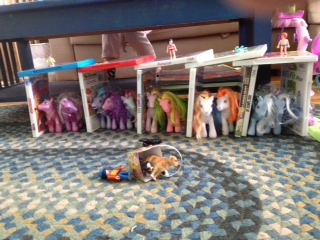
As I wrote this, she was eating an oreo and I taught her the old jingle, “Oh, the kid’ll eat the middle of an oreo first, and save the chocolate cookies outside for last.”  She’s thinks Perry the Platypus is cool, and she will have nothing to do with princesses.  This morning she spent a goodly amount of time constructing a stable out of DVD cases for her My Little Ponies.

But as she grows up, so do I.  It’s the end of innocence, all over again.  Sigh.

pony stable 2

The Easter Sermon

azaleaEaster Sunday is thirteen days away, no small thing for those of us in the profession of ministry.  It’s time to start thinking about the Easter sermon, and it helps that one of my colleagues is preaching this week for Palm Sunday – my brain has a little more space to jump ahead to resurrection, skipping the wine and the bread and the cross bit.

Oh, Easter; Christmas too, but we’ll just face Easter for now.  It’s hard to describe the odd weight of both expectation and indifference about the Easter Sunday service, at least from this pastor’s perspective.  I am always greeted first with a sense of inadequacy – how can I possibly convey anything close to the awe, wonder, amazement, fear, joy, miraculousness of that event?

After inadequacy greets me, I meet doubt; not doubt about the story, which I choose to believe as true (maybe not factual, but true.)  It’s trying to figure out the counter-arguments those in the congregation will be forming in their minds as they hear the gospel story and the sermon that follows.  Can I anticipate their questions and address them in the sermon?

After inadequacy and doubt, indifference saunters in.  I really don’t think that many people come to Easter services for the sermon.  I just don’t.  They come because it’s Easter and their mom is making them go to church.  They come because the music really is spectacular.  They come for lilies, although all of our indoor lilies are fake because of allergies – they will have to make do with azaleas.  They come to sing the Hallelujah Chorus at the end of the service.  But I’m pretty sure that less than 1% come for the sermon, and I’m okay with that.  Sort of.

Sort of, because in one way it takes the pressure off.  If very few really care what I talk about for ten to fifteen minutes, perhaps I don’t have to write The Best Easter Sermon Ever of All Time this year.  But sort of because then I get challenged.  Then I start thinking, but if I only write The Perfect Easter Sermon That Captures the Hearts and Minds of Believers and Doubter Alike, then maybe they will realize that the sermon is one of the many reasons to come to worship.

Oy vey.

I do take comfort in the details of the Easter story itself.  In Luke’s version, the women went to the tomb, saw two angelic figures but no Jesus, then ran to tell those male disciples that indeed he had risen.  The disciples dismissed their story as nothing more than an idle tale.  Good heavens, if the most incredible news for the followers of Jesus was heard as an idle tale, then why on earth should I worry about my Easter sermon?

Here’s the thing: a lot of us pastor types really do take worship seriously.  We love planning  worship, we love leading worship.  We love the poetry of worship, and the prose, and music, and the silence, and the sacraments, and the kids dropping their hymnals and the old people with their walkers and buzzing hearing aids.  We love to be translators between for the human and the holy.  We love to look out at the congregation and see the beloved community gathered, and realize on any given Sunday that there are people we’ve never seen before who have come to be a part of the beloved community, at least for an hour that particular Sunday.  We love God, and we want to share the love.

And for us pastors who love worship, Easter is weird and joyous at the same time.  It is our most high, holy day.  It commemorates the event that makes Christianity Christianity.  It also commemorates the event that people most question, or get turned off by, or laugh at.  And the service(s) is full, which is a nerve-wracking joy, but it ups the ante.  Why are these people I’ve never seen before here?  What are their expectations?  And should I even worry about meeting their expectations?

Here’s my goal for the next thirteen days: to let go of the expectations.  To picture the beloved community that will gather on March 31, to see familiar, dear faces and faces I’ve never seen before and may never see again.  To wrestle in my mind and heart about this idle tale upon which a religion has been constructed, this idle tale that sprinkles dollops of hope upon some in the world still.  To write well, clearly, leaning more toward the poetry than prose.  To not feel responsible for anyone’s faith but my own.  To allow joy and mystery, and to make room for doubters and believers.  And to have fun with it.

That’s my goal for the next thirteen days; that, and maybe a dollop or two of inspiration.

Estate Sale

estate saleThis morning, at 5:07 am, as I was trying to fall back asleep after my daughter with the runny nose had crawled into bed, I heard two car doors close.  A few minutes later (still awake) I heard another car door close.  Then I drifted off.  At 6:30, I went downstairs, chatted with my husband about the new puppy, and noticed a line of people outside our neighbor’s house.  At 7:00, when I left to go for a walk, the line was longer and there was no street parking available anywhere nearby.  At 7:30, when I returned, the line of people went around the corner, and more people were coming, some carrying folding chairs.

As it turns out, my neighbor was having an estate sale; better put, my neighbor’s attorney was having an estate sale on her behalf.  My neighbor is still alive, but since last summer has been living in a care facility.  When we moved here a year and a half ago, we didnt’ meet her but we met her caregivers, three of them, who provided 24-hour care.  She grew up in that house and lived there ninety-something years; she never married, she had no family, only her caregivers.  At least once a month we would see an ambulance out front, and she would be taken to the hospital for a few days, only to return.  I don’t know what precipitated the final move to the care facility.  I only know that the house has sat empty for the last nine months.

the nosy neighbor

the nosy neighbor from Bewitched

Last week there was a landscaping crew out there, trimming trees, mowing the lawn.  I should have known something was up. Last night, in a Gladys Kravitz sort of way, I peeked out the front window straining my eyes to read the signs that were taped to the garage.  Couldn’t read ’em.  Went to bed.  Woke up early, got annoyed quickly.

But after a day of cars coming and going, the line of people stretching and dwindling like pulled taffy, I ventured across the street, much more interested in the house itself than the stuff for sale inside.  Some friendly people from the estate-sale-planning place were out front.  I went in through the garage into the basement.  A beautiful inlaid wood table here, some old skies there.  A makeshift bedroom.  A laundry room.  At narrow, steep staircase up, which I took.   Three bedrooms, one off limits, kitchen, eating nook, living room, presumably a bathroom somewhere.  And people.  Lots of people.  Lots of people going through lots of stuff.

I did look at the stuff, but doing it felt wrong and creepy.  I have no problem with estate sales, garage sales, thrift stores, Goodwill, any of it.  I think it’s great that people reuse old things.  But I felt like a voyeur, going through my neighbor’s house, wondering whose wedding dress that was, since my neighbor never married.  Had she been engaged, called things off, got left at the altar?  And the pink dishes – was pink her favorite color?  Were they old Fiestaware, worth something?   Was she a skier, and if so, why did she have more than one set? It smelled as though a pet had lived there, but I don’t recall ever seeing one.

One woman was going through a box of old photos, and that’s what just about did me in.  She went through those photos, keeping some, leaving others.  Why?  I can’t imagine she knew the woman, or the people in the photos.  Was she an artist, collecting objects for a collage?  Did she have a fascination with old black and whites?  Was there something sinister in her desire for photos of people she didn’t know?

I think a lot about the stuff I’ve accumulated in my life.  We have three sets of china – china we registered for when we got married, china that belonged to my grandmother, china that belonged to my husband’s grandmother.  Will my daughter want all that china?  Will I get rid of it before she is saddled with that decision when I’m old and demented and in a care facility?  And what about all the photos – and I mean all the photos?  Should I organize them, label them, scrapbook them, scan them, or every ten years go through them and get rid of the ones that don’t matter any more?

Do I want some stranger rifling through my things?  Do I want my daughter to have to rifle through my things?

I think about the things that we accumulate because they have meaning to us.  They are memories and mementos, reminders of who we once were, a Girl Scout, a debater, a musical theater geek; a camp counselor, a teacher, a student body president; a granddaughter, a divorcee, a roommate.

I don’t expect my daughter to find meaningful the things that I have found meaningful.  She will choose her own memories and mementos.  I imagine a few will be of my husband and me, but she will collect things unique to her, to her life, to her experience.  She should feel free to let go of those things of mine that have no meaning for her – but not till I’m gone.

In the end, while I do believe in holding fast to what is good, sometimes it is better to let go of what was good, once.

Ciao, Superwoman

EnjoliI couldn’t tell you the exact moment or time, but at some point in my adult life I decided to quit trying to be Superwoman.  I neither brought home the bacon, nor fried it up in a pan, nor wore fabulous size six Qiana pants with four inch strappy heels while smelling great and changing a diaper.  (Thanks all the same, Enjoli.)

To be perfectly honest, it’s not like I really could have been Superwoman even if I’d wanted to.  I’m an okay cook; I have some talents but none in abundance.  I’m not athletically inclined, although with a good band or d.j., I can dance for hours (and I don’t care what I look like.)  I don’t mind hard work but I don’t thrive on it either.  I’m smart enough, maybe smarter than the average person, but I’m no genius.  I suppose I lack ambition, or else realized that it was like Tom Cruise in Top Gun: my ambition was writing checks my body couldn’t cash.

The real turning point was when I stopped caring about whether or not I impressed people.  Oh, there is a freedom to that – not trying to impress someone else, not seeking another’s approval, not really giving in to other people’s opinions.  Sure, part of that turning point is a pretty natural part of maturing and moving into, ahem, middle age.  But it’s theological, too.

I don’t so much preach what I think the congregation needs to hear as I do preach what I need to hear.  I preach a fair bit on God’s love and the goodness of creation, including the creation of humanity.  I also preach about God’s good intention for us.  And about God’s unconditional love.  While I never say it as eloquently, I completely agree with something Richard Rohr wrote:  “God does not love us because we are good.  God loves us because God is good.”

God loves me regardless of whether I am Superwoman or not.  In fact, if I’m trying to be Superwoman and I’m really not, I’m pretty sure that means I’m not living into my full humanity, that I’m not living into the unique, flawed, and splendid person God created me to be.

Writing that and reading it on the screen just now – “if I’m trying to be Superwoman and I’m really not, I’m pretty sure that means I’m not living into my full humanity” –  I’m good.  But the world sends other messages.  The world says, “Yes, you couldn’t get those size six Qiana pants over your knees, and they are out of fashion.  Your college GPA was just a few points too low to quality for xyz.  You took time off from your career to stay home with your new baby – that was a great choice but you’ve been out of circulation too long.  We need a little more sweetness and light, a little less truth and wit.”  You know – you’ve heard the world say it to you, too, whether you’re Superwoman or Clark Kent or Dr. Doofenshmirtz.

There are true wunderkind out there – people for whom talent and genius and personality of the highest order come naturally, and they’re  living their amazing lives with grace and ease.  And there are wunderkind out there who crack under the pressure; I’ve known some of them and they are not happy people, and they care too much about what they look like when they’re dancing.

In the end, I’d rather be happy and mediocre than wildly successful and constantly stressed out and miserable to be with.  (I do have gorgeous moments of being mediocre AND stressed out and miserable to be with.  Oh well.)  My trying to be Superwoman left no space for imperfection or messiness or people who were imperfect or messy or loveable.

So today I claim that I am free – free to set off the smoke alarm whenever I try to broil something; free to forget the words to the Lord’s Prayer when I’m leading in worship; free to send an angry, not-very-pastoral email to a teacher that I regretted sending as soon as I hit ‘send’; free to do things that disappoint God and disappoint me.  I am free to fail, and free to get up and try again.  And that is super.

wonder woman

The Sympathy Card

sympathy cardEveryone knows that the best place to buy greeting cards is at the car wash.  Don’t ask me why, but as I stand there waiting for Sherwood Forester to get all sparkly and clean, I browse the card carousel like there’s no tomorrow.

Here’s the thing: the car wash has birthday cards, thank you cards, you’re a great friend cards, wedding cards, engagement cards, thinking of you cards, congratulations on your divorce cards, but no sympathy cards.  And that’s a problem, because I am in need of some good sympathy cards.

Only once in my life have a found a great sympathy card, at an independent bookstore in Wauwatosa, Wisconsin.  The wife of a work colleague had been diagnosed with a brain tumor, and we found a card with a magnet attached that read “Oh sh*t” (except there was an “i” where the “*” is.)  Evidently she loved it, and kept the magnet on her fridge until the day she succumbed to that cancer.

I have sympathy cards to send – to the family I never met of the friend who died; to the best friend of the friend who died; to my husband’s sister-in-law who lost her dad; to the widow of a former minister colleague in Milwaukee.  Now some of those folks will be happy and comforted by a card with a beach sunset, or a bird flying against the sun, or a weeping willow.  But in my own grief, I want to find a card with a Jolly Roger flag that reads “I am so sorry you are going through hell right now, and I wish I could be with you but I think you have to get through this hell without me because, to be truthful, the thought of experiencing a loss like that terrifies me.  I’d rather walk the plank.”  I might even throw in a good “aarrrrrrr.”

But Hallmark doesn’t make those cards.

And even once I find the card, then I have to figure out what to write.  You have my deepest sympathy.  You and your family are in my prayers.  For the non-religious, I hold you in my heart.  And here’s the other thing: there are words we’re not supposed to use in our notes, so “It totally sucks that your beloved died” becomes “The passing of your loved one is a grief beyond comprehension” or something else poorly written like that.  Euphemisms play a big part in the sympathy card.

In seminary and in hospital chaplaincy training we were taught to use the words “die”, “death”, “dead”, and neither to beat around the bush nor hem and haw at the gates of the underworld.  As a pastor, I feel differently about that, and sort of decide in the moment which word I am going to use – “died”, or “went to God”?  “It sucks”, or “I can’t imagine your pain”?

Part of the problem is that I am a word person, and sometimes words don’t work.  Sometimes they do – Mary Oliver’s poem “When Death Comes” comes to mind, as do the lyrics to that great old hymn “I’ll Fly Away.”  But the words that I grasp for, in talking with someone or in writing the card, don’t come.  I am not a poet, nor a lyricist.  I’m a human being who will herself die one day, who is terrified of losing the people she loves, who really can’t make a 100% claim about the afterlife.

I guess, in the end, I’ll look for some blank cards with a beautiful picture, hoping the beauty might ease the soul.  I’ll write something truthful and gentle, and I’ll keep it brief.  I’ll put a stamp on the envelopes and put them in the mailbox.   Then I’ll tell my beloveds that it’s time for dinner, and in making dinner, and saying grace, and telling stories about our day, I’ll  let go of the worry of losing them for just a little bit, and hold fast to them in the time that I have.

jolly roger

Seven

I don’t remember much about being seven, but here’s what I do remember:

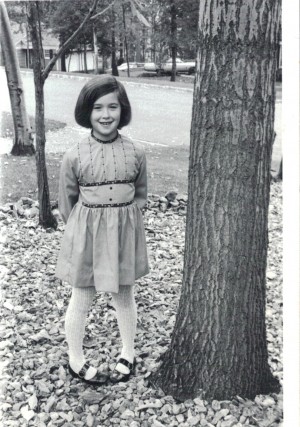
That my teacher, Miss Manley, got married in the middle of the year and then we needed to call her Mrs. Dwyer.  She invited us all to her wedding, and I wore my sister’s hand-me-down blue dress with the pretty ribbon on the front.  My best friend Jeanne asked me to wear that dress for her birthday, but I forgot.

Me at 7

Me at 7

I remember playing Lost in Space with Carolyn and Cindy, the two girls who lived across the street who were both a year older than I was; I always had to play Penny because I was the youngest, but I really wanted to play Judy.  I also remember the smell of the Avon girl’s “lipstick” – sort of chocolate-y and cake batter-ish.

I remember my little brother was born when I was seven.  I don’t remember the exact day he came home, but I do remember being annoyed when he would cry in the middle of the night and wake me up.  (Our relationship has improved since then.)

That’s really about all I remember.  We moved from New Jersey to Texas when I was eight, so it’s easy for me to differentiate years.  But I don’t remember much, which bothers me ever so slightly because my daughter just turned seven, and is navigating new landscapes every day, landscapes that bear no resemblance to anything I remember from that time in my life.

She loves screens – computer screens, tv screens, Iphone screens, and we limit her.  When I was seven we had one black and white tv with an antenna; watching Mutual of Omaha’s Wild Kingdom followed by the Wonderful World of Disney on a Sunday night was a big deal.  Now, we DVR things when we can’t watch them live, or she watches things again and again, while we try mightily to limit all the screen time to under two hours, just like the Wise People say we should.

Life is VERY dramatic for her.  She weeps – weeps- when she forgets to bring back her library books, weeps when she has to brush her teeth in the morning.  She is highly put out when the teacher rearranges the seating and she has to sit by Guy, who is annoying, and Ivan, who is distracting.  She is smart-mouthed and sassy, and when we enact the natural consequences of her bad choices, she sobs again.  We don’t spank her, mostly because I don’t think we could.  I remember only getting one spanking when I was little, for something we did when we went to Baskin Robbins.  To this day I have no idea what I did wrong; there was no connection between bad behavior and the spanking consequence, so that may have factored into our choice not to spank.

She dances.  She has moves that come out of some innate musical creature in here that just naturally gets the inference and mood of a song.  She invents steps.  She shakes her bum in a way that could bring Child Welfare out, so we only let her dance at home.

At seven, she has already figured out the Mommy Guilt card.  I don’t think she is actually trying to make me feel guilty, but she is quite articulate and expressive about her displeasure that I am always at work or at a meeting or something.  My mom stayed at home with us four kids, which is a different kind of a struggle, but I don’t remember even wishing she was around more.  (Nor do I remember wishing she was around less.)

She’s seven, and the world isn’t scary yet.  Strangers are still just potential friends and not threats.  She still believes in Santa Claus, though she’s a little more suspicious about the Tooth Fairy.  She still gets lost in her imagination, playing for hours at a time with her Polly Pockets or stuffed animals or those Little People she just won’t give away yet.  To her, the words “fart”, “poop”, and “chicken” are the most hilarious words in the English language.

She tells me I’m the best mom in the world, and that she loves me more than  a chicken nugget, and that she will go to the local community college so that she can live with us forever.  That will change.  But for now, while she’s seven, I’m glad she loves us so much and so freely.  Everyone should have a seven-year-old in their life, if only to remind them how fun and complex the world is.

More chocolate; thank you

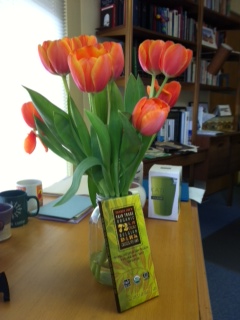
The gifts of tulip and chocolate.

The gifts of tulip and chocolate.

It’s always a bit unsettling when things converge; it makes it all the more possible that there is a divine force guiding us – or so I choose to believe.

If you’ve read some of my previous posts, you’ll know that 1) I invited people to eat chocolate every day for Lent as a reminder of God’s sweetness to us, and 2) that an old friend of mine was killed suddenly.  To have put the invitation out on the first thing, and now to be wrestling with the second thing has made for an interesting juxtaposition for me.  How do I contemplate the sweetness of God in the midst of sorrow and grief?

Truth be told, because of the nature of this pastoring thing, I may be one half-inch further along on the whole theodicy thing (why a loving God allows suffering.) I don’t have any answers, but I am slightly less uncomfortable with the mystery of it all.  And so the story that follows is not an answer in any way, nor does ease the chafing of points 1 and 2, but it’s a story and it has helped me.

So, as I’ve written previously, my college friend Martha died last Friday.  We lived together in a suite of ten our sophomore year, and in the days that have followed since the news of her death, we ten have been trying to get in touch with each other.  On Monday I had a call from one of the other women from that suite, a friend who was an engineering major in college (I majored in art history), a friend who was a gifted athlete (it was all I could do to get the simple box step down in my forays into musical theatre.)  We lived together but lived very different lives.  We had not stayed in touch.  Until Monday.

Monday she calls me at the church; she lives in Portland, can she stop by for a visit?  It was fantastic, and again I was so thrilled to see how this friend from my early adulthood had grown into this fabulous, generous, beautiful woman who gave up engineering and runs a non-profit that gives books to children.

And here’s the thing: she brought me chocolate and tulips, because, as she said, that’s what Martha would have done.  This old friend who had become a stranger to me is a friend once more, and the angel bearing chocolate – a sweet salve for my achy heart.

May there be chocolate-bearing angels for you today.

Not Even the People App Is Safe

I have the app for People magazine. I’m not ashamed to admit it. I read it every day. I read it before the real news, just after I’ve checked my email and Facebook. What can I say? Life can be intense and People is like potato chips for the brain – pure junk, but so good. I will claim the higher ground that we don’t actually subscribe to People magazine – that would be a clear endorsement of the celebritainment industry. (We do, however, subscribe to Entertainment Weekly, as does my awesome, fully-tenured English professor sister who claims it helps her keep up with the cultural milieu of her students, or something like that.)

So I read the People app for pure escapism. I love the gossip. I love the dresses. I love the candid shots of beauties coming out of the grocery store with no makeup on looking better than I do at my most fancy. It takes my mind off things like how many Easter flowers we need to order this year, and what will that late-coming diagnosis for a dear parishioner reveal, and how late do we let the homeless guy sleep in the doorway.

And there I am, one afternoon, at home in the comfy chair in the fifteen minutes between coming home from work and leaving to pick up my child, scrolling through the People app. Aw, Ben Affleck says Jennifer Garner is the best wife ever. Man, that Beyonce can wear an outfit. Oh, and here’s a nice little tidbit about a Hollywood producer. Is he in trouble? Messing with his leading lady? Screaming at assistants? No, he’s saving the world.

That is just not okay. I do not read the People to be inspired by people changing their lives. I do not read the People app to be reminded that there is horrifying poverty in the world. I do not read it to have some beautiful Brazilian girl who lives in a garbage dump staring at me from some photograph. That is not part of the escapism.

So much for my reverie into the world of beauty and glamour. Back to suffering and pain and injustice. Because here’s this guy who was a successful Hollywood producer, who was on location somewhere and saw children living in garbage dumps. He gave up Hollywood and started a non-profit to help these people. I read the story, and do I give money to his non-profit? No. I just feel guilty.

I don’t know what to do about the crushing poverty in the world (some of which is in the U.S.) I am familiar with the story of the starfish washing up on the beach, and the man throwing them back one by one, and the observer telling him he can’t save them all and what difference does it make, and the man responding that it makes a difference to this one. Every time I hear that story (sadly, more than should be in sermons and children’s messages in worship) I want to shout, “But who’s figuring out why all the starfish are washing up on the shore in the first place?”

There’s charity and there’s justice, and we need both. And maybe , with all my first-world problems, I need more justice and a little less escapism. But the app was free, so I’m not going to give it up. Not just yet.

My Head, the Barometer

I am one of the thousands and thousands of people on this planet who suffers from migraines.  I know my triggers (sinus stuff, red wine + chocolate, not enough sleep) and I have a lovely prescription for generic Imitrex that usually takes care of the little buggers.  But now and then I get a migraine because of changes in the atmospheric pressure.  THE ATMOSPHERIC PRESSURE, for Heaven’s sake.  There is absolutely nothing I can do about it but hope I took the pill in time, and if not, crawl into bed and enjoy twenty-four hours in the cold, dark basement guest room and the porcelein god to whom I will be making my offering.

But usually it’s not that bad.

It does get me to thinking about people with chronic migraines, or people with chronic illnesses or pain, or those who contract incurable diseases (or were born with them).  As a pastor who also did her duty for a year as a hospital chaplain intern, I’ve seen some of those.  As a human being on the planet, I’ve known and loved people with ALS and cancer, women carrying babies with wonky 13th chromosomes – all of it, or at least enough of it to make me sad every single day.

My forty-year-old friend who died of breast cancer, leaving a bereft husband and six-year-old son behind.  That was a crappy one.  (And made worse by the horrific praise music sung at her funeral which made me so mad I didn’t think to cry.)  The physician who had ALS and knew exactly what was happening to him each day.  The twenty-year-old kid in the ICU whose life was finally ending after years of cystic fibrosis, surrounded by stuffed animals and family and the ICU nurses who had come to say goodbye, and me, the wet-behind-the-ears chaplain intern, unable to do anything of any help but say, “there, there” and pray my shift would be over soon.

My migraines are like little gnats in comparison- annoying but not life altering.  I don’t know how people endure all of that.  Some of them don’t, of course.  Some of them rage against the dying of the light in ways that make us breathless.  Some are so ugly about their pain and demise, a Quentin Tarentino sort of patient who vows to drag everyone down with him.  Some are beatific about it all – gracious and longsuffering and still giving of themselves even as their bodies give out.  It kills me.  It just kills me.

I guess it all comes down to our being fearfully and wonderfully made, as the psalmist says (#139, if you’re counting).  Fearful in our fragility, in these bodies with bones that can break and blood that can get cancer and these double-helixes, so elegant and mystical but also susceptible to flaws.  Wonderful, too, our bodies: these things that can dance and sing and draw and embrace and fall apart so that someone else gets to hold us together.  And really, isn’t it a fearful and wonderful thing that my head can tell the weather?  It is, unless I’m throwing up at the moment.

After we got married, my husband and I met with a fertility specialist, and got the 400-level course on the birds and the bees.  It was unbelievable, all the things and synapses that have to click in order for that little egg to get fertilized by that little sperm and for that little zygot to grow into a fetus.  Unbelievable, but it happens every day.  Unbelievable, and so much can, and sometimes does, go wrong.

As a parent, I go between fear and wonder all the time, watching my daughter grow and dance, get colds, give hugs.  I pray for her and all the children, that they won’t have to suffer.  But of course they will; we all do.  That’s the fearful part.  But I pray even more that they’ll have the joy, too.  And there’s the wonder of it all.