The Hate Part and the Love Part

heartI wonder if we homo sapiens are genetically engineered to hate.  Or to love, for that matter.

I suppose our ability to hate could be the monster offspring of the fight-or-flight impulse.  In order to survive, we human beings learned to detect a threat, and to run away or defend our turf.   Do that often enough and a pattern forms, an enemy becomes a familiar threat.  We grow an emotion that is attached to the impulse.  Hate is born.

What about love?  Where does that come from?   People like me who believe in God believe that love is an extra chromosome-like thing that God drops into the human heart.  Of course, we believers struggle with God and the existence of hate, too.  If God created us in the divine image, does the Divine One have a fight-or-flight impulse?  Or is fear part of free will, and part of the development of the human psyche that God allows to unfurl as we march onward?  We have free will, therefore, we have fear and hate – that’s the pat answer in my head when those sticky questions arise.

This morning’s glance at the news apps on my I-phone prompted the thinking.  Today is the 50th anniversary of the March on Washington for Jobs and Freedom, and this morning there are blog posts and headlines and editorials in abundance about the value of that speech and the state of race relations in our nation today.  The president and his advisors are contemplating military action in Syria.  I looked at a gorgeous and heartbreaking slide show of elephants in Africa being slaughtered for their ivory tusks.  The controversy of gay and lesbian athletes at the Russian Olympics continues.  Perpetrators of rape in the U.S. and India are being sought and persecuted, while some of those victims die or take their own lives.  Miley Cyrus seems to be getting a fair bit of press, too.

Hate abounds, borne out of fear and control and ignorance and a desire for power (which comes from fear and control.)  Does love abound more? Is there more love than hate, or are we fighting a losing battle?  And should I even use military language to describe love?  Is hate easier to see than love?  Is it easier to hate than it is to love?  Is hate more natural than love?

I want love to win.  I really do.  I want love to be stronger than hate,  I want love to stand up to the racists, and the chemical weapons, and the poaching, and the homophobia, and the violence, and the judgment.  I want love to win, but it’s not going to unless we let go of all the crap that is the by-product of that primordial fight-or-flight impulse.

I want love to win, and I want more love.  Not everyone who wants love to win shares the same belief system that I do.  That’s okay.  I know some very loving atheists, and I’d be interested in knowing what they think is the source of love.  Is there even a source of love, or is it someone we develop, work on, strengthen, build up?

We’ve been reading Robert Coles’ book about Ruby Bridges with our daughter.  I cannot read it without tearing up, thinking about that brave little six-year-old going to school with an armed guard, praying for the people who were shouting such terrible things at her.  There was love in that heart; there was courage too.  Maybe that’s it: hate is borne out of fear, but love is borne out of courage.

NORMAN ROCKWELL PAINTING RUBY BRIDGES

“The Problem We All Live With” by Norman Rockwell

May we have brave hearts.

The God of Second Chances

(This is a wedding homily for a couple at the church.  When discussing the service, which is very simple, the bride commented that it would be great if the homily could be like one of my blog posts.  It is posted here with their permission.  So here you are, Libby and Randy: may love continue to lead your way.)

lego bgWe stand here, at the beginning of a new thing today, because of the ending of some other things: the ending of solitude and loneliness, the end of the crush of grief, the end of the fear of loving again.  We stand here, today, on this glorious afternoon in this glorious spot of creation, because of second chances, because of this God we have who gives second chances to us beloveds.

The fact that you two stand up here this day says something about your confidence in second chances.  With this second chance you kind of know what you’re in for, or what you may be in for – the good and the bad and the heartbreaking of it.  But this love, this relationship, this commitment to each other is compelling, and here you are.

But maybe all of this isn’t really about second chances.  Maybe it’s not about that at all.  Maybe it really is about that stuff Paul described: faith and hope and love.

Faith in each other: the faith that this is a person I can trust; that this is a person who’s been through as much hell as I have and like me has come through to the land of the living; that this is a person I want to waltz with early and often.

Hope that something good was learned the first time around; hope that some of the things that happened before won’t happen this time; hope not that I will change this person, but that I will  be changed for the better because I am committed to this person.

And love, that four-letter word we toss about like a frisbee on a spring day.  You two know what love is, what real love is.  You know how love gets you through the grief and the loss and the disappointment.  You know how loves makes a tarnished old piece of life look shiny and new.   You’ve watched each other love your parents; you’ve watched each other love your brothers and sisters; you’ve watched each other love and raise your sons.  And you admire how each other loves, and you’re inspired by that, and you want to be in the midst of all of that adorable radiance.

We may well be here because of second chances, but really, I don’t think there’s any chance to this at all.  You’ve worked too hard to suggest that your marriage is the offspring of whimsy or serendipity or luck.  You’ve been loved by people who didn’t want to see you alone; you’ve been encouraged by your family and your friends and some professionals; you’ve been held up by each other.  You’ve been wise and patient.  And now you get the joy, and the rest of your life, together, and the waltz.  A future in 3/4 time: now that’s a second chance.

libby randy

Prayer of blessing for the marriage

Loving God, we thank you for the gift of this day, and for the gift of love, and for the gift that Libby and Randy are to so many of us.   In our gratitude and joy, we ask for your blessing on these two people as they make official their commitment to each other, to life together.

Bless them as parents, as they raise boys into men, and give them patience and wisdom and discerning hearts when the Legos have taken over  the living room and when curfews are broken. Bless their sons in this new version of family, and give them patience with their parents, and wisdom, and discerning hearts. 

Bless Randy and Libby as professionals in their careers, with a sense of accomplishment and challenge, with gratitude for the talents they have,  and with work that is meaningful and rewarding.

Bless Libby and Randy as daughter and son, as they care for their parents and demonstrate all that they have learned from them.

Bless them as brother and sister, as they discover again and again the camaraderie and friendship of their siblings.

And mostly this day, O God, we ask that you bless them as husband and wife, in their care for each other; on the days when everything is sunshine and a good IPA, and on the days when it’s gray gray Portland and the toast burned and washer backed up and tempers are short and relief feels an eternity away. Bless them with joy, at least a drop every day, and sometimes buckets. Bless them with joy, knowing that their joy is infectious, and becomes ours as well. Thank you, O God; thank you.  Amen.

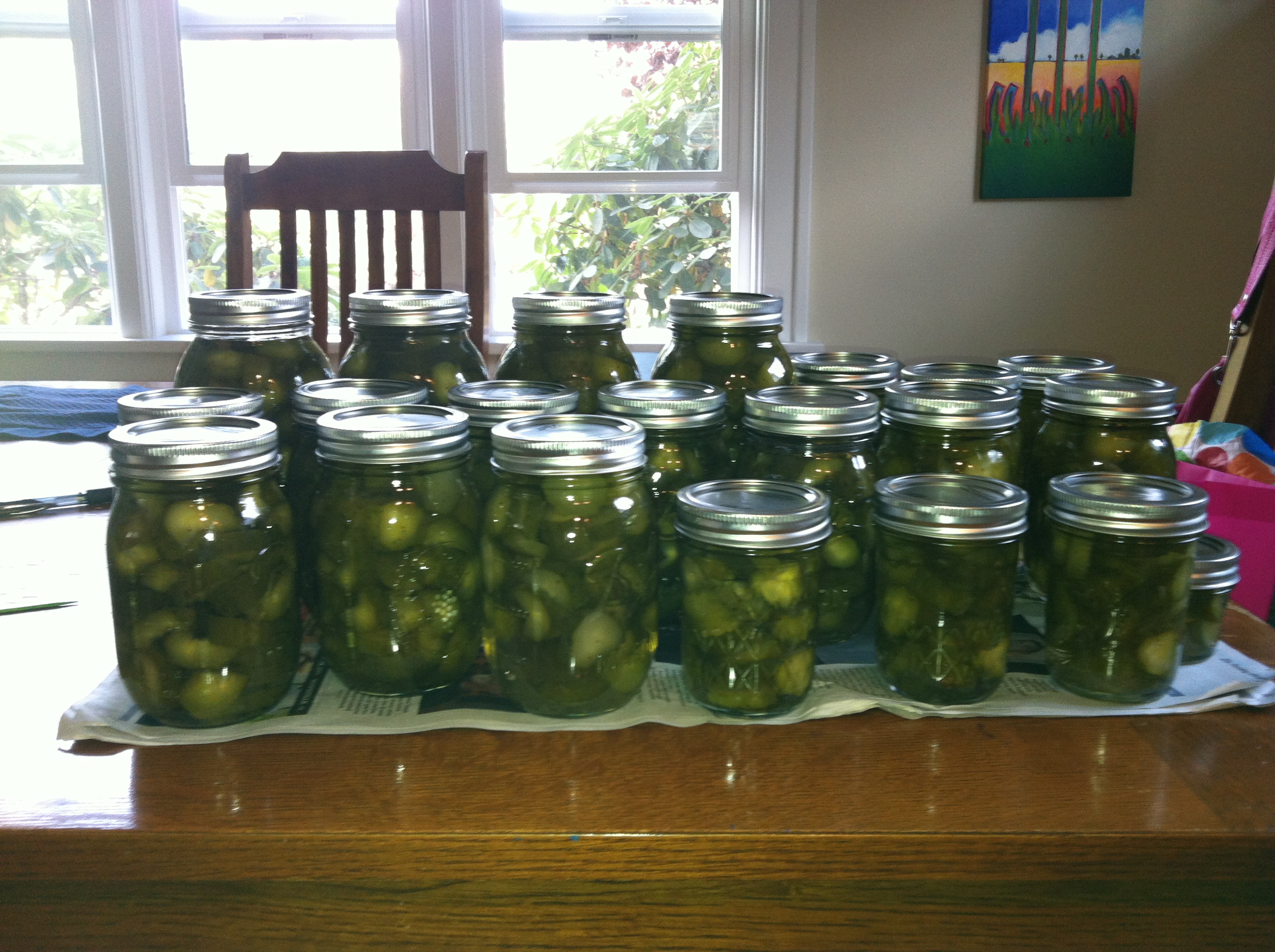
The Great Pickle Fiasco, or How I Learned the Hard Way that I’m Not a Domestic Goddess

last year's pickles

last year’s pickles

Every year in the late summer I make pickles with my aunt.  She’s been making these pickles for years, and everyone in the family loves them, and as she is 82 and probably will die in about twenty years, I decided that I would like to learn how to make them to carry on this tradition.

My aunt is amazing.  At 82 she takes care of the old ladies at her church.  She goes non-stop, and is gracious all the while.  Very little bothers her, and she is generous.  For the last three years she has bought the cucumbers as my birthday present, and I drive out to her farm in the country and we sit and visit and scrub and cut cucumbers.  Then we mix water with lime and put the cucumbers in the plastic bucket (this keeps them crisp.)  Usually at this point I take my bucket home, let the cucumbers soak in the lime solution for a day, then rinse them and soak them in cold water for a day, then make the brine and cook them and jar them and voila, pickles.

But this year because of our two schedules, after we put the cucumbers in the lime solution I left them with her and went off to the beach for our annual church retreat.  She soaked them and she rinsed them and she brined them, and on my way back from the retreat, I picked up my bucket of brined cucumbers to take home, cook, and can.  Easy peasy, as my daughter would say.

What was the first sign that I should not have pickled today?  Obviously the universe was trying to tell me something, but I would not listen.  Things had been going so well. I ran into one of my favorite church members in the grocery store.  The hardware store stayed open an extra five minutes and I was able to buy my jars before they closed.

Perhaps the first sign was that I couldn’t find the pickle recipe.  Or that it took over two hours to get the brine and cucumbers to boil.  Or that if you set the dishwasher to the sanitizer cycle it takes about four hours.  But really, when  the first quart jar of hot brine and pickles broke, I should’ve stopped.  But no.  I persevered.  I had been in a bad mood all day, and I wasn’t going to let some broken freakin’ glass or sticky, sticky counter and floor stop me.

My husband had the good sense to round up the child and the  dog and watch tv.  I pickled.  I only came up with one good line in the whole process: “I like my men like my pickle brine: hot and sweet.”  Really, that should have been all that the universe needed to tell me.

The pickles are done.  Mostly.  I still have about a gallon left but I ran out of jars and trust me, I was not going to go hunt some down tonight.  The un-jarred pickles are waiting patiently in tupperware in the fridge till tomorrow when I might buy some more jars.  If I do, I will personally test those jars before I give them away.  With two quarts of vinegar and nine cups of sugar in the brine, I can’t imagine anything malign would survive, but you never know.

In the first church I served there is a beautiful Tiffany woman of the Ideal Woman described in Proverbs 31.  I hated that window. As a piece of art, it is gorgeous.  As an exemplar for womankind, it stinks.  It reminds me of this imaginary rival I have created in my mind, an amalgam of clergywomen I know and envy.  This woman I’ve created, we’ll call her Sophia, is like the 21st century version of Proverbs 31.  She is talented.  She runs 10ks for charity all the time.  She isn’t beautiful but she is striking, which is way better than being beautiful.  She is published.  Her husband has a fantastic job in the for-profit world so they can go on really lovely vacations and tithe the full 10%.   She not only pickles cucumbers, but she makes homemade bread for her kids’ sandwiches and whips up fresh mayonnaise to go on it (except she calls is aioli.)  She weaves.  She never, ever, ever wears clogs with jumpers and tights, or sweaters with birdhouses on them.  Her congregation adores her, as do her children and nieces and nephews.  She’s been through therapy so she’s very centered.  I desperately want to be her friend but I hate her so I can’t.

All I could think today, while trying not to get any broken glass in the pickles jars, was that I am so not Sophie and I should really give up trying to be.  I have no desire to run a 10k, or a 5k, or a block.   I cannot make pickles.  My dinner tonight consisted of almonds and red wine, with a few bites of the homemade granola I thought I should make while waiting for the brine to boil.  I begged off putting our daughter to bed so that I could clean the kitchen, but really, so that I could write this post.

One of my mentors used to ask after a fiasco, “What have we learned from this?”  She always elongated the verb – “what have we l – e – a – r – n – e – d ?”  Well, Margaret, this is what I have learned:

That red wine and almonds do not a good dinner make, nor are they sufficient nutrition for enduring pickling fiascos.

That sometimes the best course of action is to leave the kitchen and go watch tv.

That no one really cares if I make pickles or not, so this is all on me.

That this will make a great story starting about tomorrow, and that next year, my aunt I and will make pickles again.

And sometimes, that stained glass window you see is really just a stained glass window.

this is the window

this is the window

Fearfully and Wonderfully Made

bagpipe darthI was talking with a church member yesterday, who told me the following story.  Over the weekend she and her family had gone down to the waterfront, where they encountered a person wearing a Darth Vader mask riding a unicycle while playing the bagpipes.  Let me repeat:  a person wearing a Darth Vader mask riding a unicycle playing the bagpipes.  Only in Portland.

All of which got me to thinking:  we really are fearfully and wonderfully made, and then we add to that.  Some add tattoos and piercings; some add pounds, stretch marks, cellulite.  Some add hair color, some shave their heads.  We add contact lenses and titanium hip joints and pig valves in the heart.  Our hearts add other stuff too: grief and joy, regret, disappointment that washes everything to a dull grey, hope for something better the next time around.

As a pastor, I think a lot about the community of fearfully and wonderfully made people, and the “I” and “we” of that, and the tension of individual desires and needs and the common good of the community.  Even after twenty years in ordained ministry, I struggle with pastoring well to everyone, knowing that that is an impossible yet necessary (but maybe not necessary) goal.  Several years ago, Duke Divinity School professor Stanley Hauerwas observed that in the modern day, ministry had reduced to a pastor being “a quivering mass of availability.”  While that is the shortcut to burn out, there is something about the pastor being available, or present, or caring for, our fearfully and wonderfully made folk.

And we aren’t always.  Every time I drop the pastoral care ball, I lose sleep, and the Tums rest on the bedside table for a while.  I hate letting people down, and I do it, and so there’s some therapy in my future, I think.  And I wonder what role grace plays in all of that.

Do I have enough grace to rejoice that someone delights in riding the Darth Vader/Bagpiper unicycle?

Do I have enough grace with myself not to wallow in my regret and self-judgment?

Am I holding out grace as the tie that binds the fearfully and wonderfully made community together?  Do I teach that, and do I practice that?

It takes grace to ride a unicycle, and to play the bagpipe.  I’m not sure I would say that grace is needed to wear a Darth Vader mask in public – courage, maybe, or divine foolishness.  I think there was some grace involved in our creation, too – fearfully and wonderfully and gracefully made.  Amen to that.

Too Soon

There are certain things that are not supposed to happen while on vacation.  It is not supposed to rain (which it did.)  When visiting a quaint beach town, one is not supposed to encounter protesters at the local post office who want to impeach the president and make their point by drawing a Hitler mustache on the leader of the free world (which also happened.)  And young adults whom you once knew as teenagers aren’t supposed to kill themselves.

As much as we might pretend to vacate the world or our own little realities from time to time, life presses on.  Good things happen while we’re away, and tragic things too.  I shouldn’t be surprised.  I am not Queen of the Universe; the world doesn’t stop because I have set aside a little sabbath time.  But some things are hard no matter when they happen, like the death of a person you still remember as a bright, crazy-talented, slightly pimply teenager in your church’s youth group.

I served that church ten years ago, and have since lost touch with so many of the folks there.  I was a bit of a tertiary staff person to the youth program, but when the youth went on a retreat and they needed a pastor to celebrate communion, I was on deck, so I got to know these kids.  “These kids” – they are now adults, holding down jobs, finishing grad school, getting married and starting families and starting careers.  When I hear about them through the ecclesiastical grapevine, or one of them friends me on Facebook, I am so glad and so proud.  I have no reason to be proud, but I am.  They are on their way, and doing great, or at least doing as well as any of us might hope to, given our flaws and foibles and the general human condition.

But this kid.  This kid.  My heart aches for his parents and his sister.  For his friends, too, because I know that particular class from the youth group was tight.  Maybe they knew what I did not, that mental illness was a burden he carried, along with his talent and friendship and handsome gawkiness.   I picture his parents – devout, faithful, loving, possessing a patience and concern I never realized.  I picture his friends – the one who worked at Starbucks and made me a latte at 7:00 on a Sunday morning as I made my way to church.  The woman who was smarter and more beautiful than she ever realized.  The guy with the crazy hair who got ordained and now wears tabs on Sunday mornings.  The one who went into the Peace Corps.  The one who’s a doctor. All of them, tonight, grieving.  Grieving the death of a peer, a friend, maybe someone they would even call beloved.

This is about all I know tonight:  that he left the world a little more beautiful because of the talent he shared.   That he left the world a little more fragile because of that cusp of anxiety and depression that he teetered on.  That he woke us all up to the present, to the gift of right now, the gift of old friendships,  and the gift of community.

My prayers are with that community tonight.  Rest in peace, all.saugatuck

Eleven Things, or There About

elevenI’m readying myself and the household to be on vacation for two blissful, or differently stressful, weeks, and so I’m musing about the pastor/congregation relationship.  Here are eleven things (or there about) that I would want my parishioners, past and present, to know.

1.  I love you.  Sometimes it might appear that I don’t like you for a moment or two, or that I am exasperated by you, but I love you.  As my more evangelical friends would say, Jesus has put it on my heart to love you.  A pastor loving her parishioners is a non-negotiable in Jesus’ book.  So know that.

2.  The hand-shaking line after worship is not the best time to catch up or receive pastoral care.  I might try to gently move you along and say we can talk at coffee hour.  But if you really need pastoral care right then and there, I will listen and ignore the growing line or have the deacon wave everyone else along, because of #1.

3.  I have to have a “come to Jesus” conversation with Jesus every time one of you gets cancer, or loses a job, or loses a loved one suddenly, or gets a big ol’ pile of crap thrown into your particular fan.  Jesus never says much back, but I feel slightly better afterwards, until I think about you and my heart breaks a little.

4.  I really, really, really appreciate how you give my PK (preacher’s kid) room to be herself, and how you don’t have any expectations that she will be Good and Perfect and Completely Spiritually Formed because both of her parents happen to be pastors.  Thank you, too, for delighting in her as much as we do.  When she is a teenager, can she sometimes live with you when she hates me?

5.  I am spectacularly uninterested in being the Best Church in Town, or having the Best Choir, or Sunday School, or Youth Program, or Service Opportunities, or whatever.  Other churches are our partners in bringing God’s realm to earth, not our competitors for people or money or good Yelp scores.

6.  It hurts my heart when you say, “I wanted to call you about xyz, but I know how busy you are.”  I apologize if I appear too busy sometimes, or let my to-do list be a higher priority than you.

7.  I do not know everything and I do not have all the answers and if I start acting as though I do, please call me on it.  After all, God chose what is foolish in the world to confound the wise!

8.  It is a privilege to be invited into the sacred moments of your life – your baptisms and your weddings and your hospital stays and your hospice time and your funerals and memorial services.  I am honored to receive your trust, and I will do my best to channel a holy presence in that moment.

9.  Pay attention to how often you comment on a clergywoman’s appearance and how often you comment on a clergyman’s appearance.  There’s a reason we all wear robes on Sunday morning, and it’s not because black is slimming. (Well, maybe just a little bit because black is slimming.)

10.  Some of you think that four weeks of paid vacation and two weeks of study leave is excessive. Please remember that clergy  (like many others in the world) work weekends.  And we treasure our Saturdays when our kid is not in school and we might not have to work and we get to have family time.

11.  Thank you for four weeks of vacation and two weeks of study leave.  I am grateful for time away to relax and play and reflect.  I might swear a little more than usual, too.  (I recently read that people who swear a lot tend to be honest and trustworthy, so you want me to do this, I know.)

That’s it for now.  Really, it’s all about #1, so maybe I should have stopped there.beach

The Multiplication of the Papers and Woo-Woo Presbyterians

papersOne of the benefits of being an Art History major is that I know all sorts of obscure titles for religious paintings.  The Assumption of the Virgin (in which Mary does NOT make an ass of you and me but rather flies up to Heaven); the Harrowing of Hell (in which Jesus, after the cross but before Easter, goes to Hell and rescues all the souls who died before he could save them, like Adam and Eve, etc.) and the Multiplication of Loaves and Fishes, in which Jesus feeds a mess of people with five loaves of bread and two fish.  If you don’t believe me, type one of those titles into Google images and see the multiplication of Roman Catholic Great Masters’ paintings.

Of late, our household has experienced the multiplication of the morning papers.  It all began when for four days we didn’t receive our daily Oregonian, and then after one complaint call, we started getting three a day.  For ten days.  In spite of two more phone calls.

But today was special.  This morning when I walked the puppy at 6:00, I noticed our usual three papers on the porch.  My husband called and spoke to someone at the paper.  When I came home at lunch, there was a new paper – today’s paper – a fourth paper –  by the front door.  Maybe the earlier papers had a little Periodical Fun, and Fourth Paper in the Yellow Bag is their offspring.

Let’s detour for a moment to Woo Woo Presbyterians.  They call themselves this – I did not make it up.  I call them our Buddhist Presbyterians.  Whatever you want to call them, they are folks committed to our Presbyterian congregation who nonetheless see things on a different spiritual plain.  One of them once saw a delightful aura of white bouncing balls over my head while I preached.  (How AWESOME is that?)  Another can quote Buddhist masters, and pronounce their names correctly, at the drop of a hat.  I love them, because they are so generous in spirit, and let me be my usual frozen chosen self, not seeing auras and mispronouncing all sorts of names.

But because these Woo Woo Presbyterians are in my life, I’ve started to wonder if The Universe is trying to tell me something by sending me three or four morning papers.  I confess that my husband is the paper reader.  If I get to the Sudoku, I’m good.  If I finish the Sudoku and read the obituaries, it’s a banner day.  But is The Universe, by multiplying my Oregonian, suggesting that I actually read the paper?  That I know what’s happening in my community and in the world?  And that number three – that is WAY significant in Christianity: the Trinity, on the third day he arose, John 3:16.  But then what about the number four?

I don’t know.  And if tomorrow morning there is only one paper on the porch, or no paper, does that mean I should stop doing the Sudoku?  What would my Woo Woo Presbyterians say?

Maybe they would tell me it’s just The Universe pranking me.  Ha ha.  Funny.

Not an epic fail, but maybe a holy one

this pictures captures what the story was about

this pictures captures what the story was about

Yesterday in my sermon I committed the cardinal sin of pastor-parents: I told a story about my child without getting her permission.  Rookie mistake for this pastor of 20 years, but there you are.  It just fit so well into the sermon, and we had talked about it but in my mind we had not settled the matter.  But as it says in Galatians 6:7 (part of the passage I preached on) “you reap what you sow.”

So I’m in the first third of the sermon; my husband is sitting on the chancel near me and our daughter is sitting by herself in the front pew, as she usually does.  She hears me telling the story and she begins to cry, prostrating herself on the lovely needle-pointed pew cushion, weeping for not all but many to see and hear.  Crap.  Just the word the preacher wants to hear in her head while she is delivering the beautiful word of God.

I can handle a lot in worship.  I can handle crying babies, coughing parishioners, people who live on the streets wandering up and looking at the offering plates, fainters, barfers, organ ciphers, mangled liturgy, and laryngitis, but what absolutely does me in is when I have to be pastor and mom at the same time.  It doesn’t happen very often but when it does I become completely unglued – maybe because I suspect I’m not particularly good at either one, or maybe because it feels like both demand so much of my being.

So in the first third of my sermon, while my daughter is crying, I break the fourth wall of sorts, interrupt myself, and ask my husband to sit with her, which he does.  I then resume preaching, talking about accountability when we do something wrong, and being in community in our suffering, and reconciling with brother or sister before coming to the communion table.  And did I mention we celebrated communion yesterday?

At the end of the sermon, I issued this invitation to the congregation:

“I don’t know if gathered here this morning are people who are at odds with each other; sheer numbers would suggest that there are. I’m not going to ask  that we now pause for a minute for reconciliation – that would be putting all of us on the spot. But perhaps in the silence after the sermon, we might think of those we are at odds with. We might think about them, and about bearing their burden, about carrying our own load, about forgiveness and grace. We might imagine, as we all say the Lord’s Prayer during communion, sitting next to that person, and saying the prayer with them.”

It was so nice of the Holy Spirit to provide me with an opportunity to practice what I preach, and during the silence after the sermon I thought about how I could check in with my daughter before going to the table.  My husband/co-pastor came back up and said she was fine, mostly because one of her friends sweetly came up and sat with her and got her out of her funk.  During communion, my daughter passed by all the other celebrants to come receive the bread from me, and gave me a hug, and I told her I was sorry and I love her so much.

I thought it was a mediocre sermon that was made worse for the wear by my embarrassing my daughter.  As it turns out, what the congregation heard and saw were opportunities for grace, and realness, and empathy, and kindness, and grace again.

But if I ever tell a story about her again, I will get her permission in writing.

Never did say good-bye

What happens when we don’t get a chance to say goodbye?  Do we live with a sense of unfinished-ness?  Or do we move on and squish the unresolved stuff into that deep well in the gut where it gurgles and festers but never sees the light of day?

There are so many unfinished goodbyes.  A beloved, a friend, an acquaintance dies suddenly and there is no way to ask him for his cobbler recipe or to thank her for bailing you out that time.  A couple divorces, and friends must choose a side, and in-laws are cut off.  I know of two  (and there are more) congregations where the pastor was summarily dismissed, there one Sunday and gone the next, and parishioners who were for and against that person never had the opportunity to say things like “I never liked you but you showed up when you needed to” or “that sermon you preached on the woman at the well turned me around.”

A hospital chaplain used to admonish pastors and interns and everybody to keep our goodbyes current.  What happens when we don’t, when we lose the opportunity to get in a last, good word?  Sometimes it’s a mess, when we don’t say goodbye.  Sometimes we cling like shrinkwrap to the next best person.  Sometimes we grieve everywhere but the place we most need to.  Sometimes we wander lost, the way my cat did when his littermate died suddenly; he roamed the house, mewing and looking around, so sad and confused.  Bereft too, I would say.

I once served a congregation whose previous pastor had been let go suddenly, with no going away party.  I served there part-time for seven months, but when I left, they threw me the biggest shindig you can imagine.  I was bowled over; my husband reminded me that really, the party was as much for the previous pastor as it was for me.  Interim pastors learn that sort of thing, but I wish my predecessor could have been there too, since 90% of the party was for him.  (I did keep and still treasure the quilt they made for me.)

Our word goodbye derives from a 14th century word meaning “God be with ye.”  There is hope in that – though I didn’t get to say goodbye, I choose to believe that I and the one I miss are with God.  But one last hug would have been nice.goodbye

Keystone Kommunion

For some, the sacrament of Holy Communion, the celebration of the Lord’s Supper, the Eucharist -whatever you call it – is a solemn and holy occasion. It is replete with mystery, with grace, with all that church should be. Delicious, inclusive, meditative, intimate, theological.

And it is all of those things, except when it’s not, which is just about every month for me.

Everybody does communion a little bit differently. In our congregation, and I would guess in the majority of Presbyterian congregations, we celebrate communion once a month, on the first Sunday. Usually, but not always, we “do” communion by intinction, which means that the people come forward and take a little pre-cubed bite of bread and dip it into the chalice of grape juice. We say “the body of Christ” or “the bread of life” or “the bread of Heaven” and “the blood of Christ” or “the cup of salvation” or “the cup of forgiveness.” And the people partake, and then return to their seats as guided by one of the deacon ushers with all efficiency of a flight attendant giving safety instructions. We also sometimes pass plates of bread and trays of little cups of juice out into the congregation, but that does not make for very many good stories.

So here are three common communion mishaps that make it not a solemn and holy occasion but a joyful, mirthful feast.

1. Floaters

It always happens, and usually at the beginning. Someone very understandably drops their tiny piece of pre-cubed bread into the chalice. We always tell them to take another piece, that it happens all the time, but the partaker usually feels deep mortification, which I think is a spiritual discipline among the Opus Dei folks that involves flaying oneself with a studded whip. But I could be wrong. But maybe dropping the Bread of Heaven into the Cup of Salvation is the emotional or spiritual equivalent of flaying oneself. I actually wouldn’t know, as I always go last when there are plenty of floaters in the cup and it’s no big deal if my bread goes skinny dipping with the other pieces.

2. Drink Ye, All of It

Occasionally we have people who are from a different tradition within Christianity who are used to coming forward and actually drinking the cup. They’re usually from a tradition in which only men in white regalia will serve them, and in which they stick out their tongues and someone puts a communion “wafer” (read: piece of cardboard treated to look edible) on their tongue so they don’t have to touch anything. These people get confused by us Presbyterians. First of all, there might be women up front, and people who aren’t clergy. But our guests are game and hungry and faithful, so they help themselves to our nice yeasty bread cubes. Then they want the cup. Sometimes they get. Sometimes there’s a wrestling match. Sometimes they drink the floaters. Then we all pretend we’re not throwing up just the tiniest bit in our mouths, and we move on.

3. “But all I wanted was a little blessing…”

We have guests with us who want to be a part of the party but they’re really not sure about the whole body/blood thing. That or they’re scared of the floaters, or the person in front of them just drank the cup. Anyway, all they want is a blessing, but sometimes they’re not sure how to get that. I once attended a Catholic wedding, and one of the bridesmaids was Jewish. She had been instructed, when the wedding party was served communion, just to cross her arms over her chest to indicate she would not be partaking. In the heat of the moment, she forgot the choreography and instead clamped both hands over her mouth as though coming into any contact with the Body of Christ would magically indoctrinate her into the Christian Club, or would so offend the priest that he wouldn’t finish the wedding ceremony. (The couple is no longer married, but the bridesmaid is still a faithful Jew, so there you are.) Sometimes our people who just want a blessing do that too, put their hands over their mouths or cross their arms over their chests and that would all be fine. Unless the pastor and her serving partner misread the cue, and we end up trying to force-feed them the dang bread and cup, already! Yes, that happens. To me. More than once.

My husband is best on his feet at the spur of the moment and I love it when he offers the invitation to the table, because he manages to weave in the theme of the sermon or the image from scripture or some phrase from a hymn along with the graciousness to be someone who creates a floater or otherwise does thing not so decently or in order. And I love that, because really it is all about grace, about being invited to a table regardless of whether we’re hungry or sated, perfect or really screwed up, faithful or doubt-full, good/bad, wise/foolish, ballerina or bumpkin or clown.

clown communion

When I did a google image search on “clown communion” none of the clergy were the clowns. Pity. I think that’s more accurate!

So now, would you be gracious enough to share your Mirthful Feast stories?